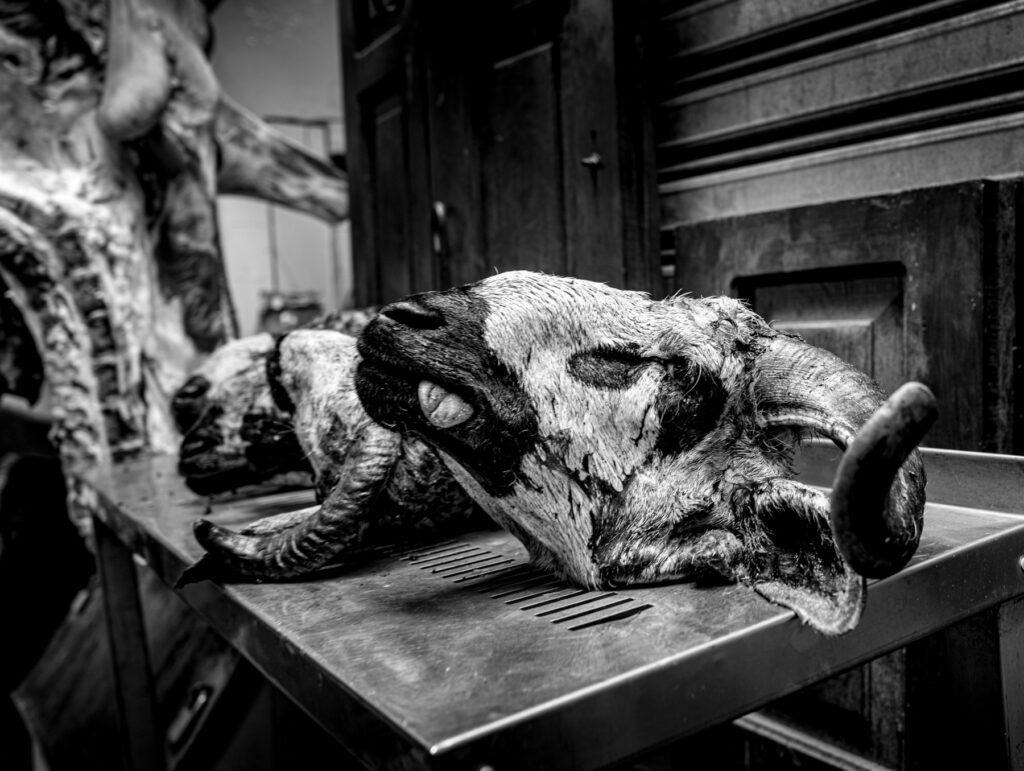
The scene hit me with a visceral honesty, a stark reminder of where our food comes from. Stepping into this traditional market, the air was thick with a unique blend of spices and the unmistakable scent of raw meat. My eyes were immediately drawn to the display on a cold, metal counter: a line of severed lamb heads, meticulously arranged, awaiting their next purpose. It wasn’t grotesque; it was real. I wanted to capture that raw authenticity, the unvarnished truth of a butcher’s trade. I chose to shoot in black and white to strip away any potential distractions of color, forcing the viewer to confront the textures, the lines, the stark contrasts. The fur, still clinging to the bone, felt almost alive in the monochromatic rendition, each strand sharply defined. The vacant eyes, the slight curl of a tongue – they told a silent story of life concluded, now prepared for sustenance. The horns, weathered and robust, spoke of the animal’s past, its wildness perhaps. My lens zoomed in, focusing on the nearest head, trying to capture the intricate details, the almost sculptural quality of the subject. It wasn’t about shock value; it was about respect for the animal and the tradition. In the background, out of focus, hung the larger carcasses, a blurred reminder of the cycle. This image, for me, is a meditation on the journey from farm to table, a challenging yet essential part of human existence, frozen in time and tone.
Historical Background:
The practice of consuming animal heads is deeply rooted in many cultures worldwide, often stemming from a philosophy of utilizing every part of the animal to avoid waste. Historically, in many traditional societies, meat was a precious commodity, and no part was discarded. Lamb or goat heads, in particular, are considered delicacies in various cuisines across the Middle East, North Africa, and parts of Europe and Asia. Dishes like ‚Pacha‘ (Iraq/Syria), ‚Maghreb‘ (North Africa), or ‚Smalahove‘ (Norway) highlight the head as a central ingredient, often slow-cooked to tender perfection, emphasizing flavor derived from the brain, tongue, and cheek meat. This tradition not only reflects culinary resourcefulness but also a deep historical connection to the land and livestock that sustained communities for centuries.
Schreibe einen Kommentar