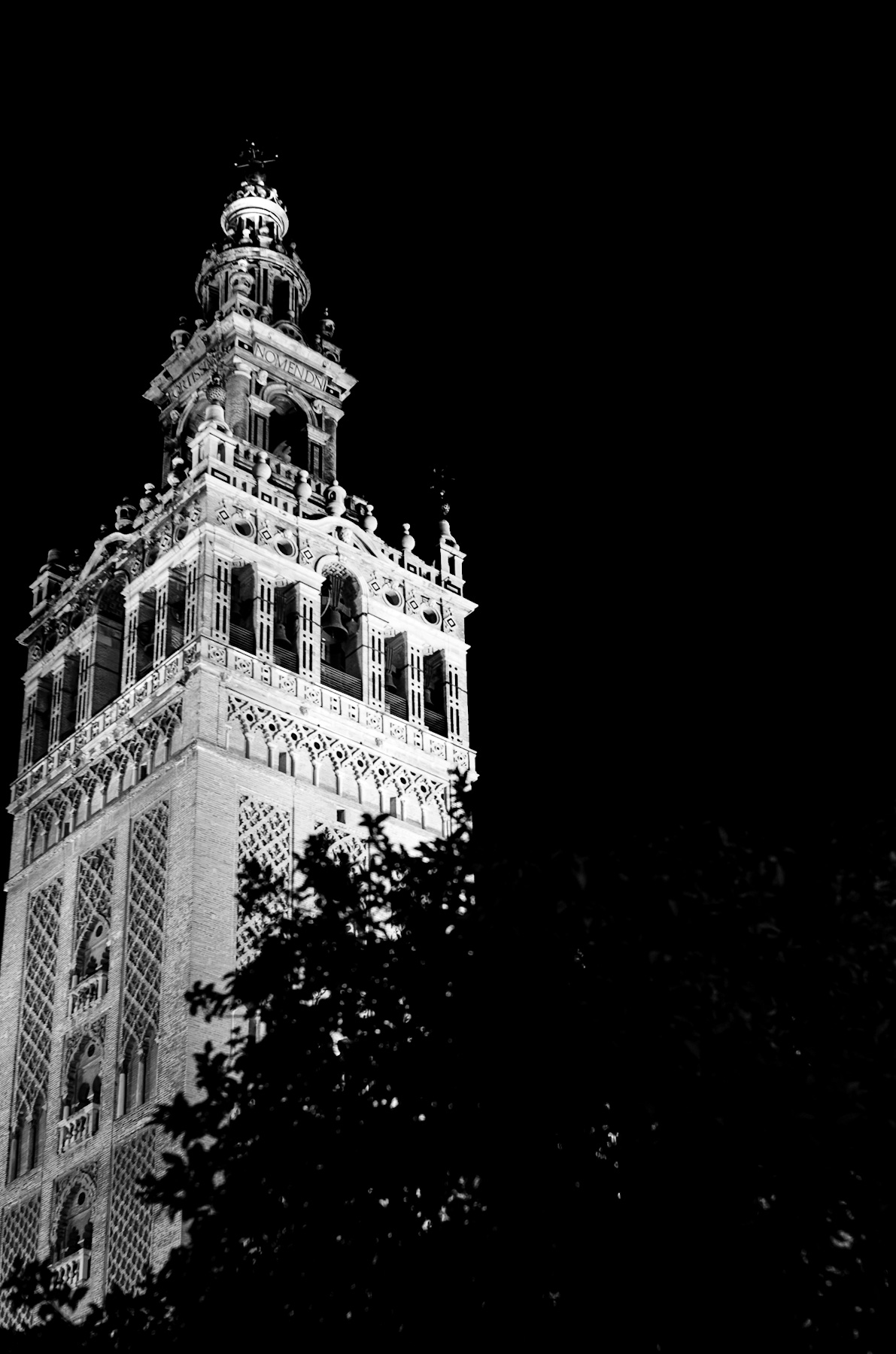
The accompanying photograph captures the iconic Giralda tower of Seville in a striking black and white composition, presenting an almost ethereal vision against the inky darkness of night. The low-angle perspective emphasizes its towering height and architectural grandeur, while the monochrome palette accentuates the intricate textures and forms of its multifaceted design. Silhouetted foliage in the foreground adds a layer of depth and mystery, framing the illuminated structure and drawing the viewer’s eye upwards to its historic pinnacle.
Every arch, every patterned brick, and every sculpted detail of the Giralda is brought into sharp relief by the stark contrast of light and shadow. The upper sections, particularly the elaborate bell chamber, reveal a complexity of design that speaks volumes of the craftsmanship across different eras. The absence of color strips away modern distractions, allowing the observer to truly appreciate the tower’s structural elegance and the historical narratives etched into its very stone. This visual approach transforms the landmark into a timeless monument, a silent observer of centuries.
**From Minaret to Bell Tower**
The Giralda’s history is as layered and rich as its intricate facade. Its origins trace back to the **Almohad caliphate** in the late 12th century, when it was conceived as the minaret for the Great Mosque of Seville. Designed by the esteemed architect Ahmad ibn Baso, the minaret was a masterpiece of Islamic engineering and artistry, intended to rival the Koutoubia Mosque in Marrakesh. Its robust brickwork and delicate geometric patterns, including the *sebka* or rhomboid network, are hallmarks of Almohad architecture, reflecting a period of significant cultural and intellectual flourishing in Al-Andalus. This original section, constituting the main body of the tower, served as a beacon for the faithful, calling them to prayer five times a day.
Following the **Reconquista** in 1248, when Seville fell to Christian forces, the Great Mosque was consecrated as a cathedral. Remarkably, the minaret was preserved, a testament to its architectural brilliance and structural integrity. However, its purpose was transformed. In the 16th century, the tower underwent a significant metamorphosis with the addition of a new, distinctly **Renaissance-style bell chamber**, designed by Hernán Ruiz II. This masterful integration saw the original Islamic minaret crowned with a series of ornate balconies, arches, and a domed structure, culminating in the installation of the **Giraldillo**, a bronze weather vane depicting Faith, which gave the tower its popular name. This fusion of Islamic and Christian architectural styles makes the Giralda a unique symbol of Seville’s cultural synthesis.
**A Timeless Icon**
Today, the Giralda stands as the bell tower of the **Seville Cathedral**, a **UNESCO World Heritage site**, and an enduring emblem of the city. It represents a fascinating dialogue between different civilizations, a physical manifestation of Seville’s evolving identity through centuries of Moorish rule and Christian reconquest. The photograph, with its dramatic interplay of light and dark, powerfully conveys this historical depth, inviting reflection on the monumental shifts that shaped not only this architectural marvel but the very fabric of Spanish history. It is a compelling visual narrative, a silent testament to the enduring power of design and the indelible marks left by time.
:status publish :post_status publish
Every arch, every patterned brick, and every sculpted detail of the Giralda is brought into sharp relief by the stark contrast of light and shadow. The upper sections, particularly the elaborate bell chamber, reveal a complexity of design that speaks volumes of the craftsmanship across different eras. The absence of color strips away modern distractions, allowing the observer to truly appreciate the tower’s structural elegance and the historical narratives etched into its very stone. This visual approach transforms the landmark into a timeless monument, a silent observer of centuries.
**From Minaret to Bell Tower**
The Giralda’s history is as layered and rich as its intricate facade. Its origins trace back to the **Almohad caliphate** in the late 12th century, when it was conceived as the minaret for the Great Mosque of Seville. Designed by the esteemed architect Ahmad ibn Baso, the minaret was a masterpiece of Islamic engineering and artistry, intended to rival the Koutoubia Mosque in Marrakesh. Its robust brickwork and delicate geometric patterns, including the *sebka* or rhomboid network, are hallmarks of Almohad architecture, reflecting a period of significant cultural and intellectual flourishing in Al-Andalus. This original section, constituting the main body of the tower, served as a beacon for the faithful, calling them to prayer five times a day.
Following the **Reconquista** in 1248, when Seville fell to Christian forces, the Great Mosque was consecrated as a cathedral. Remarkably, the minaret was preserved, a testament to its architectural brilliance and structural integrity. However, its purpose was transformed. In the 16th century, the tower underwent a significant metamorphosis with the addition of a new, distinctly **Renaissance-style bell chamber**, designed by Hernán Ruiz II. This masterful integration saw the original Islamic minaret crowned with a series of ornate balconies, arches, and a domed structure, culminating in the installation of the **Giraldillo**, a bronze weather vane depicting Faith, which gave the tower its popular name. This fusion of Islamic and Christian architectural styles makes the Giralda a unique symbol of Seville’s cultural synthesis.
**A Timeless Icon**
Today, the Giralda stands as the bell tower of the **Seville Cathedral**, a **UNESCO World Heritage site**, and an enduring emblem of the city. It represents a fascinating dialogue between different civilizations, a physical manifestation of Seville’s evolving identity through centuries of Moorish rule and Christian reconquest. The photograph, with its dramatic interplay of light and dark, powerfully conveys this historical depth, inviting reflection on the monumental shifts that shaped not only this architectural marvel but the very fabric of Spanish history. It is a compelling visual narrative, a silent testament to the enduring power of design and the indelible marks left by time.
:status publish :post_status publish
Schreibe einen Kommentar