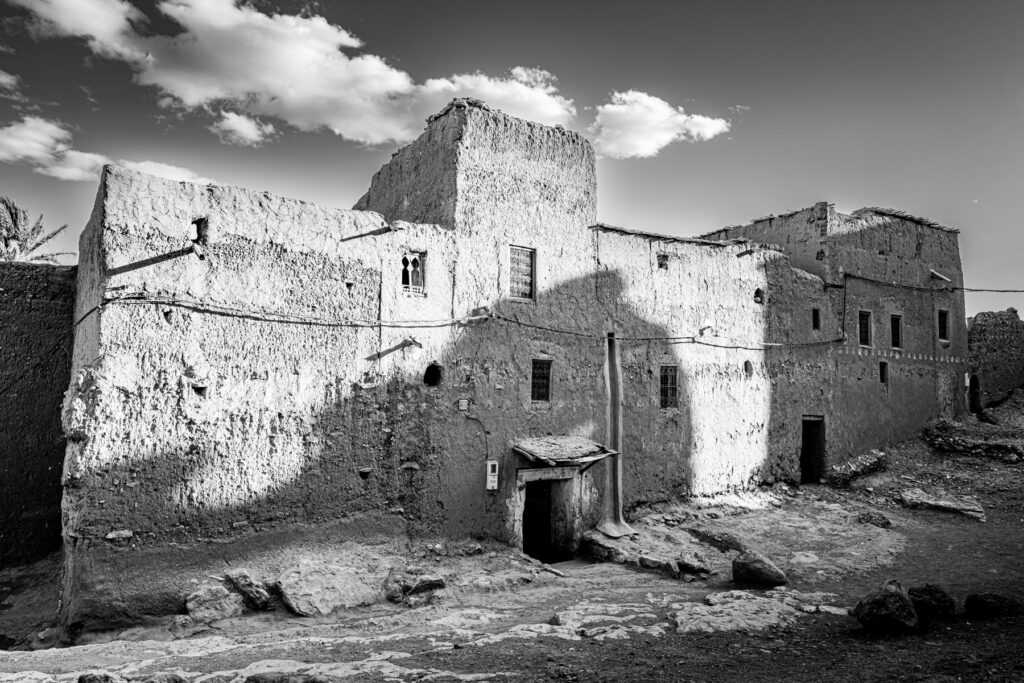
The first light of dawn always holds a promise, but it was the stark, midday sun that truly revealed the soul of this ancient place. Wandering through the winding paths of what felt like a forgotten world, I came across this magnificent mud-brick structure. The air was dry, carrying whispers of centuries, and the silence was profound, broken only by the distant call of a bird.As a photographer, moments like these are a gift. The rough, textured walls, built layer by layer from the very earth beneath my feet, spoke volumes of resilience and human ingenuity. I knew immediately this had to be in black and white. Color would only distract from the raw power of the light and shadow dancing across its facade. The contrast was incredible; sharp, defined lines carved by the sun on the eastern wall, juxtaposed against the deep, brooding shadows on the western side.I spent a good hour just observing, waiting for the clouds to drift into the perfect position to add depth to the vast sky. Each window, each doorway, felt like an eye peering back from a different era. There’s a particular kind of magic in capturing architecture that feels so intrinsically linked to its environment, almost grown from it. The challenge was to convey its monumental presence while also highlighting the intricate details – the subtle patterns on the windows, the rough plaster, the simple, practical lines of its construction.This image isn’t just a building; it’s a testament to life enduring in harsh landscapes, a silent guardian of history. It reminds me that sometimes, the simplest forms, stripped of unnecessary adornment, hold the most profound beauty.
The mud-brick architecture, often seen in regions like Morocco’s Atlas Mountains and pre-Saharan valleys, is a cornerstone of traditional Berber settlements. Structures like Kasbahs (fortified houses) and Ksours (fortified villages) are built using a technique called ‚pisé‘ or ‚tabia,‘ where moist earth, often mixed with straw or gravel, is compacted into formwork. This method is incredibly sustainable, utilizing readily available local materials, and provides excellent insulation against both extreme heat and cold. These buildings were not just homes but often served defensive purposes, with high walls, few external windows, and narrow, winding alleys designed to deter invaders. They represent a remarkable adaptation to the arid environment and a deep connection between the people and their land, a heritage that dates back centuries and continues to shape the landscape.
Schreibe einen Kommentar