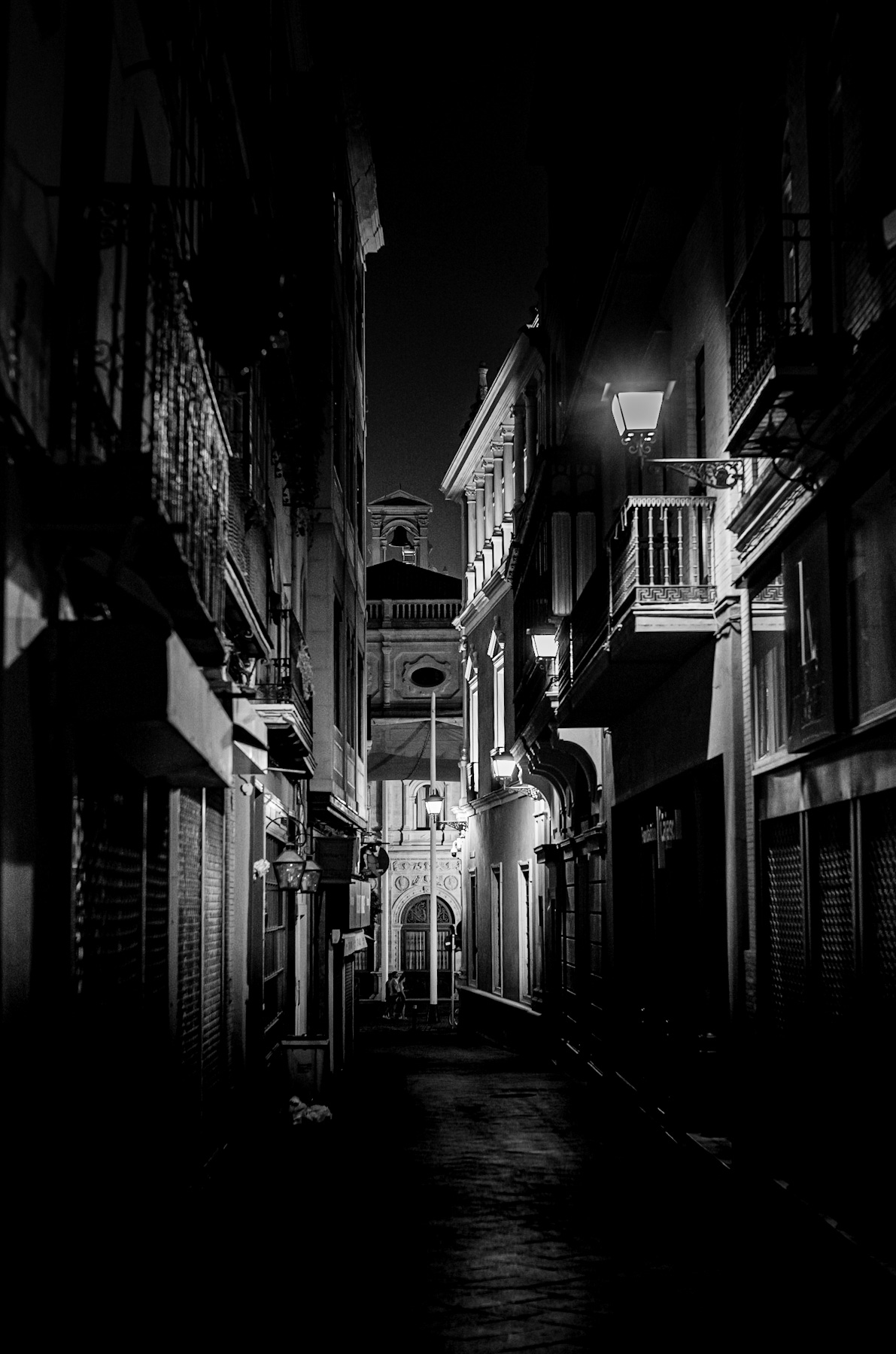
A narrow passage cuts through the deep Andalusian night, illuminated only by the soft, intermittent glow of ornate streetlamps. This black and white photograph captures more than just a street; it freezes a moment in a place where centuries of history converge. The dramatic play of light and shadow, a technique known as chiaroscuro, strips the scene of modern distractions, revealing the timeless textures of stone, iron, and plaster. It is an invitation to walk through a living museum, where every corner holds a story.
**The Anatomy of a Timeless Scene**
The composition leads the eye down a cobblestone path, worn smooth by generations of footsteps. On either side, the walls of historic buildings rise steeply, creating an intimate, canyon-like effect. Wrought-iron balconies, a signature of Spanish architecture, jut out into the darkness, their intricate metalwork silhouetted against the lit windows and walls behind them. The buildings themselves are a tapestry of styles—some with the simple, stark facades of residential homes, others hinting at grandeur with classical columns and decorative cornices. At the far end of the alley, framed perfectly by the towering walls, a Baroque bell tower stands as a focal point, its presence a constant reminder of the city’s deep-rooted faith and artistic heritage.
**A Street Forged by Sun and Strategy**
This labyrinthine layout is not an accident of time but a deliberate design, a legacy of the city’s Moorish past. When Seville, then known as *Isbiliya*, was a major capital in Al-Andalus, its streets were engineered to combat the fierce summer sun. The narrowness of the alleys ensures they remain in shadow for most of the day, creating a cooler microclimate. This design also served a defensive purpose, creating a confusing maze for potential invaders that was easily defended by those who knew its secrets. What we see in this photograph is the enduring result of climate-responsive and strategic urban planning from over a thousand years ago.
**Layers of History Etched in Stone**
While the blueprint of the street is Moorish, the architectural details tell a story of subsequent eras. Following the *Reconquista* in the 13th century, Christian culture began to layer itself onto the existing city. Churches and convents were built, often on the sites of former mosques. The bell tower visible in the distance is a prime example of this transition. Its Baroque style, popular in the 17th and 18th centuries, speaks to the city’s immense wealth during Spain’s Golden Age, when it held a monopoly on trade with the Americas. The ornate doorways and classical elements seen on the buildings are further testaments to this period of prosperity.
This single photograph, therefore, encapsulates the complex identity of a city like Seville. It is a visual representation of a cultural palimpsest, where a Moorish foundation is adorned with Renaissance and Baroque artistry. The darkness conceals the noise of the 21st century, allowing the whispers of the past to emerge from the stones, telling a silent, powerful story of conquest, faith, and artistry.
**The Anatomy of a Timeless Scene**
The composition leads the eye down a cobblestone path, worn smooth by generations of footsteps. On either side, the walls of historic buildings rise steeply, creating an intimate, canyon-like effect. Wrought-iron balconies, a signature of Spanish architecture, jut out into the darkness, their intricate metalwork silhouetted against the lit windows and walls behind them. The buildings themselves are a tapestry of styles—some with the simple, stark facades of residential homes, others hinting at grandeur with classical columns and decorative cornices. At the far end of the alley, framed perfectly by the towering walls, a Baroque bell tower stands as a focal point, its presence a constant reminder of the city’s deep-rooted faith and artistic heritage.
**A Street Forged by Sun and Strategy**
This labyrinthine layout is not an accident of time but a deliberate design, a legacy of the city’s Moorish past. When Seville, then known as *Isbiliya*, was a major capital in Al-Andalus, its streets were engineered to combat the fierce summer sun. The narrowness of the alleys ensures they remain in shadow for most of the day, creating a cooler microclimate. This design also served a defensive purpose, creating a confusing maze for potential invaders that was easily defended by those who knew its secrets. What we see in this photograph is the enduring result of climate-responsive and strategic urban planning from over a thousand years ago.
**Layers of History Etched in Stone**
While the blueprint of the street is Moorish, the architectural details tell a story of subsequent eras. Following the *Reconquista* in the 13th century, Christian culture began to layer itself onto the existing city. Churches and convents were built, often on the sites of former mosques. The bell tower visible in the distance is a prime example of this transition. Its Baroque style, popular in the 17th and 18th centuries, speaks to the city’s immense wealth during Spain’s Golden Age, when it held a monopoly on trade with the Americas. The ornate doorways and classical elements seen on the buildings are further testaments to this period of prosperity.
This single photograph, therefore, encapsulates the complex identity of a city like Seville. It is a visual representation of a cultural palimpsest, where a Moorish foundation is adorned with Renaissance and Baroque artistry. The darkness conceals the noise of the 21st century, allowing the whispers of the past to emerge from the stones, telling a silent, powerful story of conquest, faith, and artistry.
Schreibe einen Kommentar