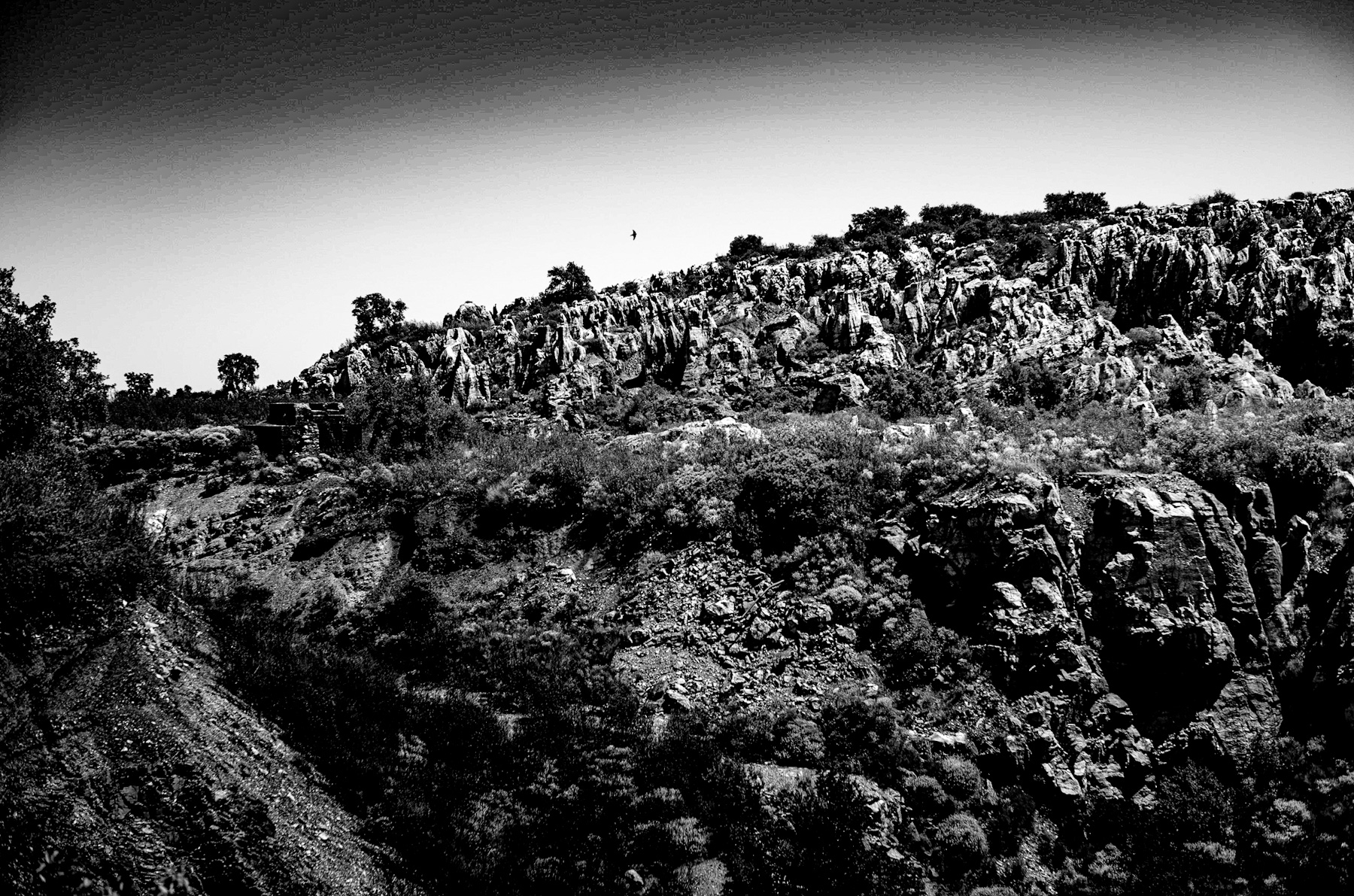
This stark, black-and-white photograph transports us to a landscape both timeless and deeply etched with history’s scars. It captures a rugged, sun-drenched hillside where nature and the enduring remnants of human ambition exist in a delicate, powerful balance. More than just an image, it’s a profound meditation on resilience, memory, and the silent stories embedded in stone.
A Landscape Carved by Time
The dominant feature here is the formidable, rocky terrain. The high-contrast monochrome treatment masterfully emphasizes the texture and form of the geological formations. Every crevice and jagged edge is sharply defined, a testament to millennia of wind and weather shaping this incredible vista. Yet, the rock face isn’t barren; it’s dotted with hardy, low-lying scrub and scattered trees that cling tenaciously to life in what appears to be an unforgiving environment. Their dark silhouettes stand out against the brighter tones of the rock and the smooth, gradient sky. A lone bird, captured mid-flight, adds a sense of scale and transient life to this otherwise permanent-seeming panorama. It soars above a world that has remained largely unchanged for centuries.
Whispers of a Forgotten Past
Nestled within this natural fortress are the subtle but unmistakable signs of human history. Partially obscured by tenacious vegetation, the angular lines of a stone structure emerge from the hillside. These aren’t the grand columns of a sprawling temple but the humble, functional ruins of what might have been a watchtower, a small fortification, or even a simple shepherd’s shelter.
Given the almost Mediterranean feel of the landscape, one can speculate on its origins. Could it be a Roman *castellum*, a small fort built to oversee a vital valley or a strategic route? Perhaps it’s a Moorish *atalaya*, a watchtower from the period of Islamic rule in the Iberian Peninsula, designed to communicate with other fortifications via smoke or light signals. Alternatively, it could be a far older, prehistoric settlement, its original purpose now lost to the sands of time.
Whatever its specific function, the structure unequivocally speaks of a primal human need for security and vantage. The people who built it chose this high ground for a reason: to see and not be seen, to protect themselves from threats, and to survey the land that sustained them. These ancient stones are a silent testament to their lives, their struggles, and their eventual departure, leaving the structure to be slowly reclaimed by the very nature it was once built to dominate.
The Power of Monochrome
The deliberate choice to render this powerful scene in black and white is an artistic stroke that significantly enhances its historical resonance. Stripped of the potential distractions of color, the viewer is compelled to focus on the fundamental elements: light, shadow, texture, and form. The deep blacks in the crevices of the rocks and the shadows of the bushes suggest mystery and the unknown depths of time. Meanwhile, the bright, almost-white highlights on the sun-bleached stones convey the intense heat and dry climate. This beautiful lack of color lends the photograph a documentary quality, as if it were a historical record itself, powerfully connecting the present moment of its capture to the deep past it depicts. The image transcends being merely a photograph of a place; it becomes a profound portrait of time itself.
A Landscape Carved by Time
The dominant feature here is the formidable, rocky terrain. The high-contrast monochrome treatment masterfully emphasizes the texture and form of the geological formations. Every crevice and jagged edge is sharply defined, a testament to millennia of wind and weather shaping this incredible vista. Yet, the rock face isn’t barren; it’s dotted with hardy, low-lying scrub and scattered trees that cling tenaciously to life in what appears to be an unforgiving environment. Their dark silhouettes stand out against the brighter tones of the rock and the smooth, gradient sky. A lone bird, captured mid-flight, adds a sense of scale and transient life to this otherwise permanent-seeming panorama. It soars above a world that has remained largely unchanged for centuries.
Whispers of a Forgotten Past
Nestled within this natural fortress are the subtle but unmistakable signs of human history. Partially obscured by tenacious vegetation, the angular lines of a stone structure emerge from the hillside. These aren’t the grand columns of a sprawling temple but the humble, functional ruins of what might have been a watchtower, a small fortification, or even a simple shepherd’s shelter.
Given the almost Mediterranean feel of the landscape, one can speculate on its origins. Could it be a Roman *castellum*, a small fort built to oversee a vital valley or a strategic route? Perhaps it’s a Moorish *atalaya*, a watchtower from the period of Islamic rule in the Iberian Peninsula, designed to communicate with other fortifications via smoke or light signals. Alternatively, it could be a far older, prehistoric settlement, its original purpose now lost to the sands of time.
Whatever its specific function, the structure unequivocally speaks of a primal human need for security and vantage. The people who built it chose this high ground for a reason: to see and not be seen, to protect themselves from threats, and to survey the land that sustained them. These ancient stones are a silent testament to their lives, their struggles, and their eventual departure, leaving the structure to be slowly reclaimed by the very nature it was once built to dominate.
The Power of Monochrome
The deliberate choice to render this powerful scene in black and white is an artistic stroke that significantly enhances its historical resonance. Stripped of the potential distractions of color, the viewer is compelled to focus on the fundamental elements: light, shadow, texture, and form. The deep blacks in the crevices of the rocks and the shadows of the bushes suggest mystery and the unknown depths of time. Meanwhile, the bright, almost-white highlights on the sun-bleached stones convey the intense heat and dry climate. This beautiful lack of color lends the photograph a documentary quality, as if it were a historical record itself, powerfully connecting the present moment of its capture to the deep past it depicts. The image transcends being merely a photograph of a place; it becomes a profound portrait of time itself.
Schreibe einen Kommentar