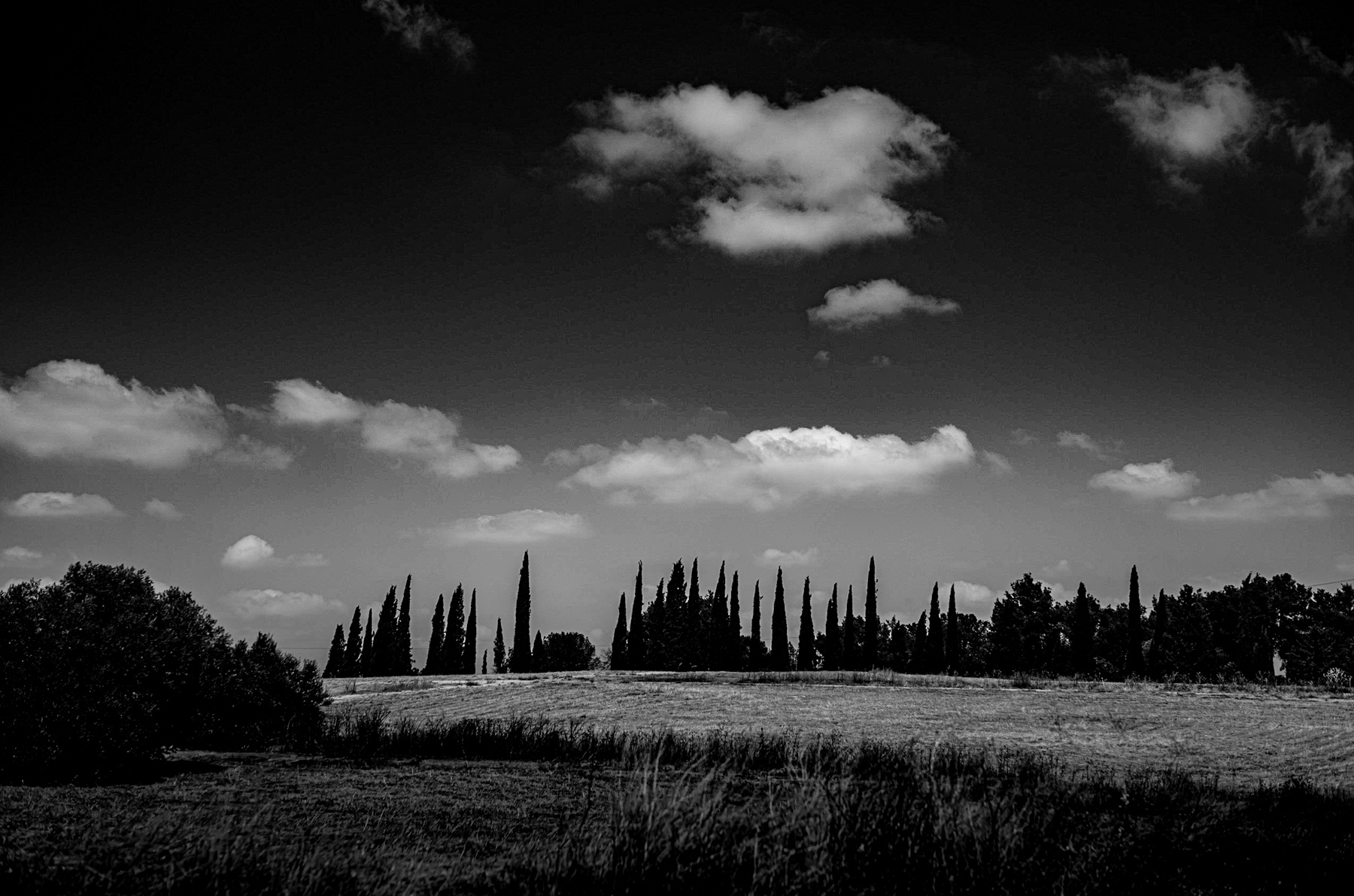
A stark, black and white photograph captures a scene of profound tranquility and timelessness. Before us lies a classic Mediterranean vista, likely from the rolling hills of Tuscany, Italy. This image is a study in contrast and form, where the absence of color amplifies the dramatic interplay of light and shadow. In the foreground, wild grasses give way to a gently sloping, harvested field. It is the horizon, however, that commands attention. A dense line of Italian Cypress trees stands like dark spires against a luminous sky, their sharp, vertical silhouettes breaking the soft curves of the land.
**A Masterpiece of Monochrome: Light, Shadow, and Dramatic Composition**
The power of this image lies in its dramatic composition and high-contrast monochrome palette. The sky is not a gentle grey but a deep, almost black canvas, against which brilliant white clouds drift. This high-contrast rendering gives the scene a powerful, almost theatrical quality. The cypress trees, rendered in deep black, become powerful graphic elements. They are not merely trees but symbols, guardians standing watch over the land. Their varying heights and dense grouping create a rhythmic pattern along the horizon, drawing the viewer’s eye across the frame. The choice of black and white strips the Tuscan landscape of its potentially vibrant greens and blues, forcing the viewer to focus on the fundamental shapes, textures, and the profound history embedded within the scene.
**The Ancient Roots of the Italian Cypress**
These are not just any trees. The slender, dark spires are the iconic **Italian Cypress trees** (*Cupressus sempervirens*), and they are deeply woven into the cultural and historical fabric of the Mediterranean. Their story stretches back to antiquity, where they held significant symbolic meaning for ancient civilizations.
* **Etruscan and Roman Symbolism:** Long before the Roman Empire, the Etruscans, who inhabited ancient Tuscany, associated the cypress with death and the afterlife. This connection was adopted and continued by the Romans, who frequently planted cypress trees at gravesites and cemeteries. Its evergreen nature symbolized eternal life after death, and its straight, upward growth was seen as a connection between the earth and the heavens. The somber, contemplative mood of the photograph echoes this ancient, funerary association of these magnificent trees.
* **A Renaissance Icon:** The legacy of the cypress tree extends far beyond antiquity. During the Renaissance, the rolling hills of Tuscany, punctuated by these elegant trees, became a favored backdrop for painters. Artists like Leonardo da Vinci and Piero della Francesca immortalized this landscape, cementing its status as the archetypal image of Italian beauty and harmony. The cypress tree transitioned from a symbol of mourning to one of elegance, permanence, and idyllic nature, becoming synonymous with the quintessential Mediterranean landscape.
This photograph, therefore, does more than just document a beautiful view. It presents a landscape saturated with millennia of human history and symbolism. The silent **cypress trees** are sentinels that have witnessed the rise and fall of civilizations. The stark, black and white treatment freezes this moment, making it feel both ancient and immediate—a powerful reminder of the enduring connection between land, history, and art.
**A Masterpiece of Monochrome: Light, Shadow, and Dramatic Composition**
The power of this image lies in its dramatic composition and high-contrast monochrome palette. The sky is not a gentle grey but a deep, almost black canvas, against which brilliant white clouds drift. This high-contrast rendering gives the scene a powerful, almost theatrical quality. The cypress trees, rendered in deep black, become powerful graphic elements. They are not merely trees but symbols, guardians standing watch over the land. Their varying heights and dense grouping create a rhythmic pattern along the horizon, drawing the viewer’s eye across the frame. The choice of black and white strips the Tuscan landscape of its potentially vibrant greens and blues, forcing the viewer to focus on the fundamental shapes, textures, and the profound history embedded within the scene.
**The Ancient Roots of the Italian Cypress**
These are not just any trees. The slender, dark spires are the iconic **Italian Cypress trees** (*Cupressus sempervirens*), and they are deeply woven into the cultural and historical fabric of the Mediterranean. Their story stretches back to antiquity, where they held significant symbolic meaning for ancient civilizations.
* **Etruscan and Roman Symbolism:** Long before the Roman Empire, the Etruscans, who inhabited ancient Tuscany, associated the cypress with death and the afterlife. This connection was adopted and continued by the Romans, who frequently planted cypress trees at gravesites and cemeteries. Its evergreen nature symbolized eternal life after death, and its straight, upward growth was seen as a connection between the earth and the heavens. The somber, contemplative mood of the photograph echoes this ancient, funerary association of these magnificent trees.
* **A Renaissance Icon:** The legacy of the cypress tree extends far beyond antiquity. During the Renaissance, the rolling hills of Tuscany, punctuated by these elegant trees, became a favored backdrop for painters. Artists like Leonardo da Vinci and Piero della Francesca immortalized this landscape, cementing its status as the archetypal image of Italian beauty and harmony. The cypress tree transitioned from a symbol of mourning to one of elegance, permanence, and idyllic nature, becoming synonymous with the quintessential Mediterranean landscape.
This photograph, therefore, does more than just document a beautiful view. It presents a landscape saturated with millennia of human history and symbolism. The silent **cypress trees** are sentinels that have witnessed the rise and fall of civilizations. The stark, black and white treatment freezes this moment, making it feel both ancient and immediate—a powerful reminder of the enduring connection between land, history, and art.
Schreibe einen Kommentar