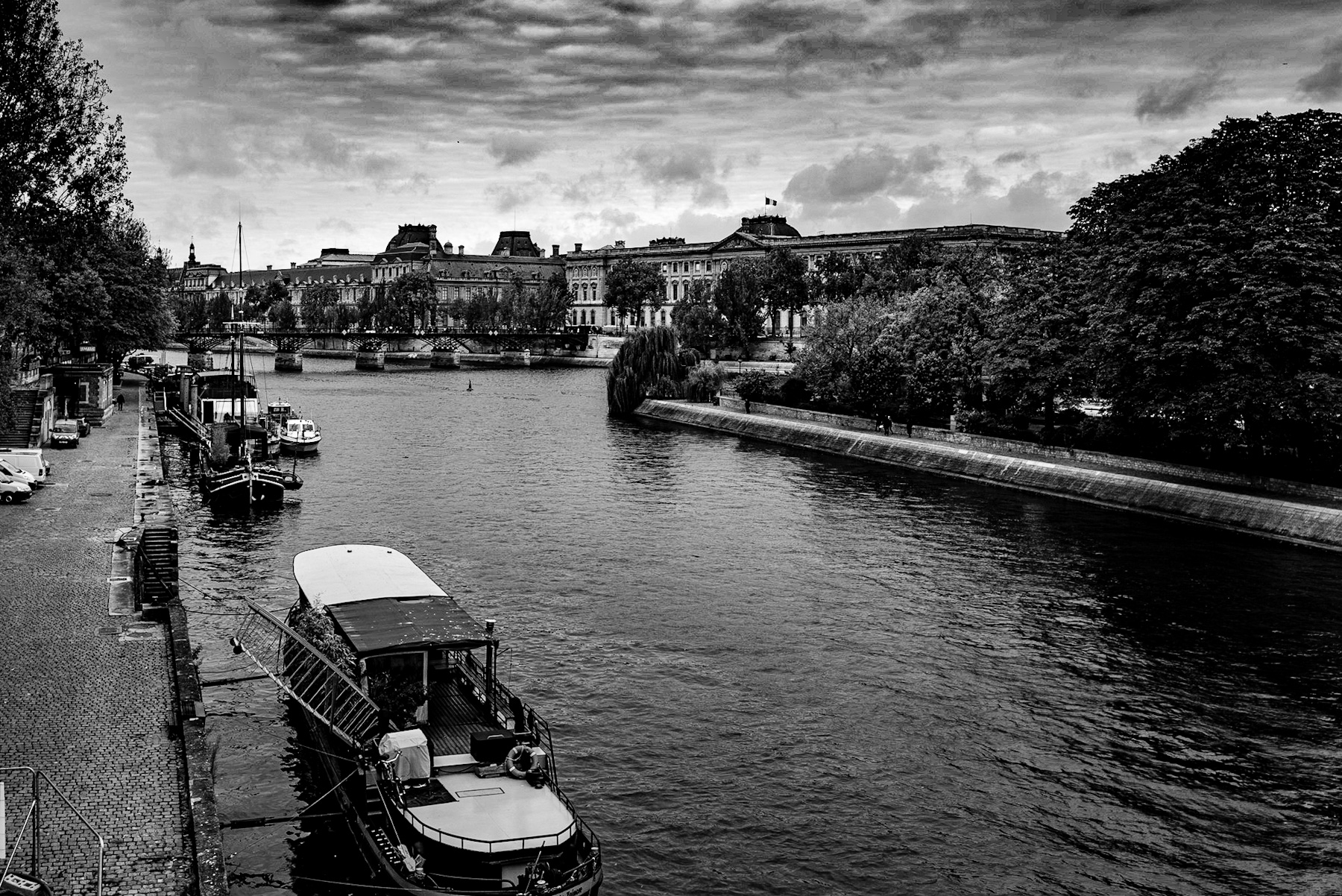
A dramatic, cloud-filled sky hangs over the River Seine, its reflection broken by the gentle ripples on the water’s surface. This black-and-white photograph captures a timeless view of Paris, stripping the city of its contemporary colors to reveal its deep-seated historical soul. The composition masterfully balances the elements of nature, human life, and monumental architecture, creating a scene that feels both immediate and ancient.
**Life Along the Seine’s Edge**
In the foreground, the vibrant pulse of river life is palpable. A traditional French houseboat, a *péniche*, is gracefully moored along the cobbled quay. These vessels are more than mere boats; they are cherished homes, a living testament to a unique Parisian lifestyle that has endured for generations.
To the left, the stone quay buzzes with a quiet charm. Parked vehicles and other moored boats hint at the continuous flow of commerce and daily routines that have always characterized the banks of the Seine. This area, once a bustling hub for transporting goods into the very heart of Paris, now seamlessly blends residential tranquility with leisurely pursuits, perfectly embodying the city’s remarkable ability to adapt while fiercely preserving its unique character.
**The Enduring Legacy of the Louvre Palace**
Dominating the far bank is the unmistakable and majestic silhouette of the Louvre Palace. Its long, classical facade stretches majestically across the horizon, a powerful symbol of French influence, artistic innovation, and profound history. What we admire today is the culmination of centuries of dedicated construction and thoughtful transformation.
The Louvre’s extraordinary story began in the late 12th century as a formidable fortress, built by King Philip Augustus to defend Paris. Over the centuries, it was meticulously transformed by successive monarchs into an increasingly lavish royal residence. It was during the French Renaissance that the Louvre truly began to take on the palatial form we recognize today. King Francis I and his successors meticulously tore down the old fortress, replacing it with a grand palace befitting their elevated status. The magnificent building in the photograph, with its rhythmic arrangement of windows, columns, and ornate roofline, is a direct product of this long architectural evolution.
After the royal court relocated to Versailles in the 17th century, the Louvre’s destiny shifted dramatically. During the tumultuous French Revolution, it was decreed that this former symbol of monarchy should be reborn as a public museum, a sacred place to display the nation’s invaluable artistic treasures for all citizens. Today, the Louvre Museum stands proudly as the world’s largest art museum, its historic walls guarding masterpieces from across human history. The French flag, proudly visible atop the roof, boldly asserts its status as a quintessential national monument.
**Beyond Color: A Glimpse into Paris’s Soul**
The monochrome palette of this captivating photograph profoundly enhances its historical resonance. By thoughtfully removing the distraction of color, the image compels the viewer to focus intently on texture, form, and light. The rugged cobblestones, the dark, reflective water, the intricate details of the palace, and the dramatic, brooding clouds all gain a heightened sense of presence and depth. This deliberate artistic choice effortlessly bridges the gap between the present moment and the countless historical photographs taken from this very same iconic vantage point. It serves as a poignant reminder that while the boats may evolve and people may come and go, the fundamental character of this iconic Parisian vista—the timeless interplay between the flowing River Seine and the stoic Louvre—remains eternally captivating.
**Life Along the Seine’s Edge**
In the foreground, the vibrant pulse of river life is palpable. A traditional French houseboat, a *péniche*, is gracefully moored along the cobbled quay. These vessels are more than mere boats; they are cherished homes, a living testament to a unique Parisian lifestyle that has endured for generations.
To the left, the stone quay buzzes with a quiet charm. Parked vehicles and other moored boats hint at the continuous flow of commerce and daily routines that have always characterized the banks of the Seine. This area, once a bustling hub for transporting goods into the very heart of Paris, now seamlessly blends residential tranquility with leisurely pursuits, perfectly embodying the city’s remarkable ability to adapt while fiercely preserving its unique character.
**The Enduring Legacy of the Louvre Palace**
Dominating the far bank is the unmistakable and majestic silhouette of the Louvre Palace. Its long, classical facade stretches majestically across the horizon, a powerful symbol of French influence, artistic innovation, and profound history. What we admire today is the culmination of centuries of dedicated construction and thoughtful transformation.
The Louvre’s extraordinary story began in the late 12th century as a formidable fortress, built by King Philip Augustus to defend Paris. Over the centuries, it was meticulously transformed by successive monarchs into an increasingly lavish royal residence. It was during the French Renaissance that the Louvre truly began to take on the palatial form we recognize today. King Francis I and his successors meticulously tore down the old fortress, replacing it with a grand palace befitting their elevated status. The magnificent building in the photograph, with its rhythmic arrangement of windows, columns, and ornate roofline, is a direct product of this long architectural evolution.
After the royal court relocated to Versailles in the 17th century, the Louvre’s destiny shifted dramatically. During the tumultuous French Revolution, it was decreed that this former symbol of monarchy should be reborn as a public museum, a sacred place to display the nation’s invaluable artistic treasures for all citizens. Today, the Louvre Museum stands proudly as the world’s largest art museum, its historic walls guarding masterpieces from across human history. The French flag, proudly visible atop the roof, boldly asserts its status as a quintessential national monument.
**Beyond Color: A Glimpse into Paris’s Soul**
The monochrome palette of this captivating photograph profoundly enhances its historical resonance. By thoughtfully removing the distraction of color, the image compels the viewer to focus intently on texture, form, and light. The rugged cobblestones, the dark, reflective water, the intricate details of the palace, and the dramatic, brooding clouds all gain a heightened sense of presence and depth. This deliberate artistic choice effortlessly bridges the gap between the present moment and the countless historical photographs taken from this very same iconic vantage point. It serves as a poignant reminder that while the boats may evolve and people may come and go, the fundamental character of this iconic Parisian vista—the timeless interplay between the flowing River Seine and the stoic Louvre—remains eternally captivating.
Schreibe einen Kommentar