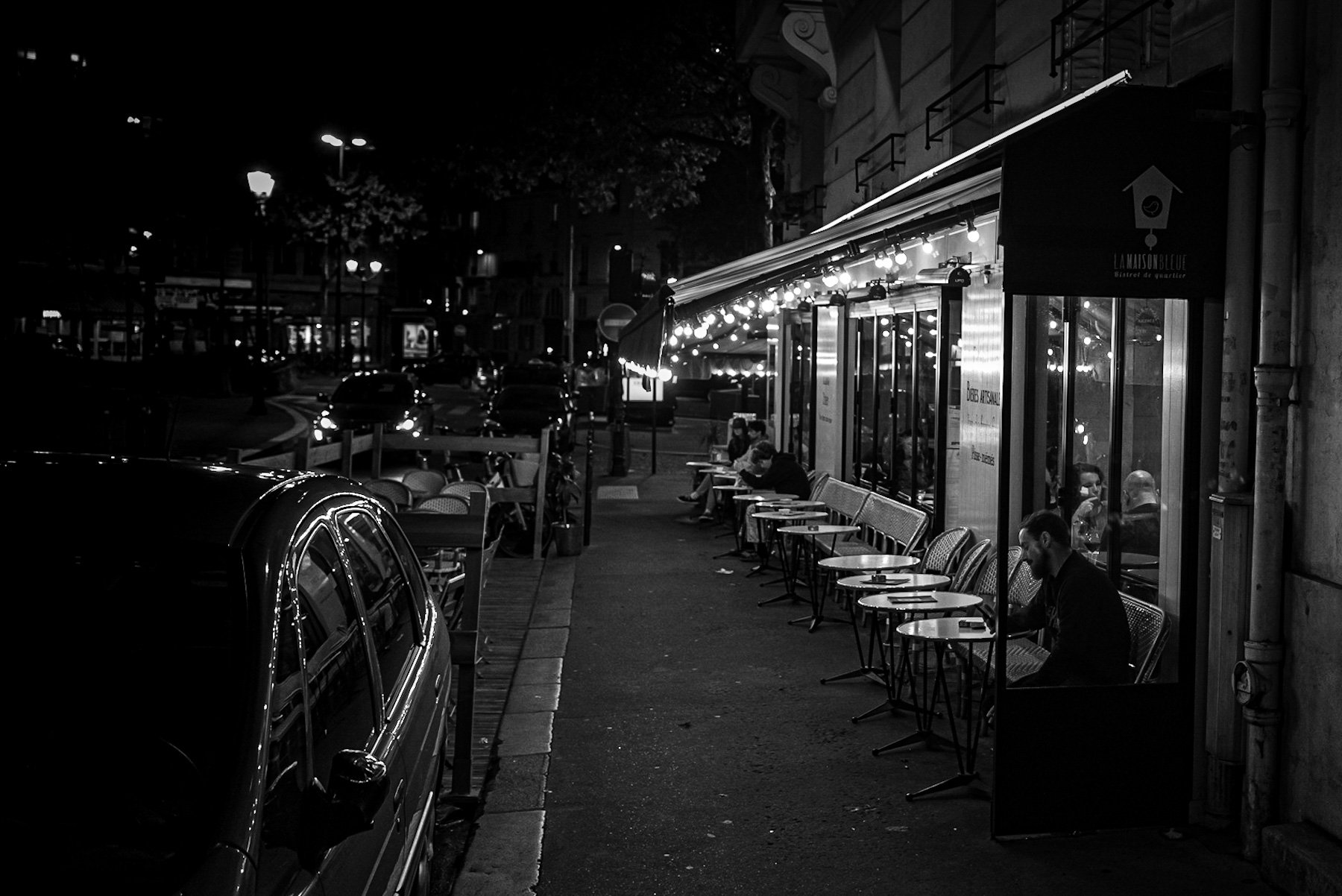
A string of warm lights cuts through the monochrome night, illuminating a scene that is quintessentially Parisian. The photograph captures the exterior of „La Maison Bleue,“ a **Bistrot de quartier**—a neighborhood bistro—its terrace offering a quiet refuge from the dark, anonymous city street. This is not just a picture of a place to eat; it is a snapshot of an institution that lies at the very heart of Parisian social and cultural history.
A Stage for Urban Life
The composition draws the eye along a row of small, round tables and classic wicker chairs lining the sidewalk. Some are empty, waiting for future conversations, while others are occupied by solitary figures or quiet couples. A man in the foreground sits alone, absorbed in his own world, while further down, others are silhouetted against the bright interior of the bistro. The contrast between the warm, inviting light of the café and the deep shadows of the street creates a powerful sense of atmosphere. The reflection of the city on the parked car in the foreground serves as a reminder that while this scene feels intimate and contained, it is part of a larger, bustling metropolis.
Echoes of a Bygone Era: The Historical Soul of the Café
To understand this image is to understand the history of Paris itself. The sidewalk café, or *terrasse de café*, became a prominent feature of Parisian life in the 19th century, particularly after Baron Haussmann’s radical redesign of the city. His creation of wide, tree-lined boulevards provided the perfect stage for these outdoor establishments.
Cafés quickly evolved from simple coffee houses into vital social hubs. They were the „parliament of the people,“ where ideas were debated, revolutions were plotted, and art was born. In the 20th century, legendary establishments like Les Deux Magots and Café de Flore became the haunts of intellectuals, writers, and artists. Figures like **Jean-Paul Sartre, Simone de Beauvoir, Albert Camus, and Ernest Hemingway** did more than just drink here; they wrote, argued, and shaped the cultural movements of their time. The simple act of sitting at a café table, as the people in this photograph are doing, connects them to this profound intellectual and artistic lineage.
The Modern Flâneur and the Enduring Tradition
The scene also evokes the concept of the ***flâneur***, the 19th-century figure of the urban wanderer, an observer of city life. The lone patrons on the terrace can be seen as modern-day *flâneurs*, participating in the life of the city simply by being present, watching the world go by.
The sign „Bistrot de quartier“ is significant. It designates this not as a tourist trap, but as a local institution, a cornerstone of its community. This is where neighbors meet, where daily life unfolds, and where the spirit of Paris is kept alive. The photograph, in its quiet, observational style, captures the enduring appeal of this tradition. It shows that even in the 21st century, the Parisian café remains a vital space for contemplation, conversation, and connection—a timeless beacon in the city of light.
A Stage for Urban Life
The composition draws the eye along a row of small, round tables and classic wicker chairs lining the sidewalk. Some are empty, waiting for future conversations, while others are occupied by solitary figures or quiet couples. A man in the foreground sits alone, absorbed in his own world, while further down, others are silhouetted against the bright interior of the bistro. The contrast between the warm, inviting light of the café and the deep shadows of the street creates a powerful sense of atmosphere. The reflection of the city on the parked car in the foreground serves as a reminder that while this scene feels intimate and contained, it is part of a larger, bustling metropolis.
Echoes of a Bygone Era: The Historical Soul of the Café
To understand this image is to understand the history of Paris itself. The sidewalk café, or *terrasse de café*, became a prominent feature of Parisian life in the 19th century, particularly after Baron Haussmann’s radical redesign of the city. His creation of wide, tree-lined boulevards provided the perfect stage for these outdoor establishments.
Cafés quickly evolved from simple coffee houses into vital social hubs. They were the „parliament of the people,“ where ideas were debated, revolutions were plotted, and art was born. In the 20th century, legendary establishments like Les Deux Magots and Café de Flore became the haunts of intellectuals, writers, and artists. Figures like **Jean-Paul Sartre, Simone de Beauvoir, Albert Camus, and Ernest Hemingway** did more than just drink here; they wrote, argued, and shaped the cultural movements of their time. The simple act of sitting at a café table, as the people in this photograph are doing, connects them to this profound intellectual and artistic lineage.
The Modern Flâneur and the Enduring Tradition
The scene also evokes the concept of the ***flâneur***, the 19th-century figure of the urban wanderer, an observer of city life. The lone patrons on the terrace can be seen as modern-day *flâneurs*, participating in the life of the city simply by being present, watching the world go by.
The sign „Bistrot de quartier“ is significant. It designates this not as a tourist trap, but as a local institution, a cornerstone of its community. This is where neighbors meet, where daily life unfolds, and where the spirit of Paris is kept alive. The photograph, in its quiet, observational style, captures the enduring appeal of this tradition. It shows that even in the 21st century, the Parisian café remains a vital space for contemplation, conversation, and connection—a timeless beacon in the city of light.
Schreibe einen Kommentar