A Monument Forged in Controversy
To understand the Eiffel Tower is to look back to the late 19th century, a period of immense industrial and technological advancement. Designed by the engineering firm of Gustave Eiffel, the tower was erected as the grand entrance to the 1889 Exposition Universelle (World's Fair), an event organized to celebrate the 100th anniversary of the French Revolution.
Its construction was a marvel of engineering, utilizing over 18,000 individual wrought-iron parts and 2.5 million rivets. At 300 meters (today 330 meters with its antennas), it dwarfed every other man-made structure on Earth, holding the title of the world's tallest for 41 years. However, its revolutionary design was not universally celebrated. A committee of prominent artists and intellectuals, including author Guy de Maupassant, vehemently protested its construction, decrying it as a „useless and monstrous“ factory smokestack that would dishonor the architectural beauty of Paris.
From Temporary Exhibit to Eternal Icon
Originally intended to stand for only 20 years, the tower's salvation came from its utility. Its height made it an invaluable platform for scientific experiments and, crucially, a transmission tower for the new science of radiotelegraphy. It played a vital role in communications during World War I, solidifying its importance to the nation beyond mere spectacle.
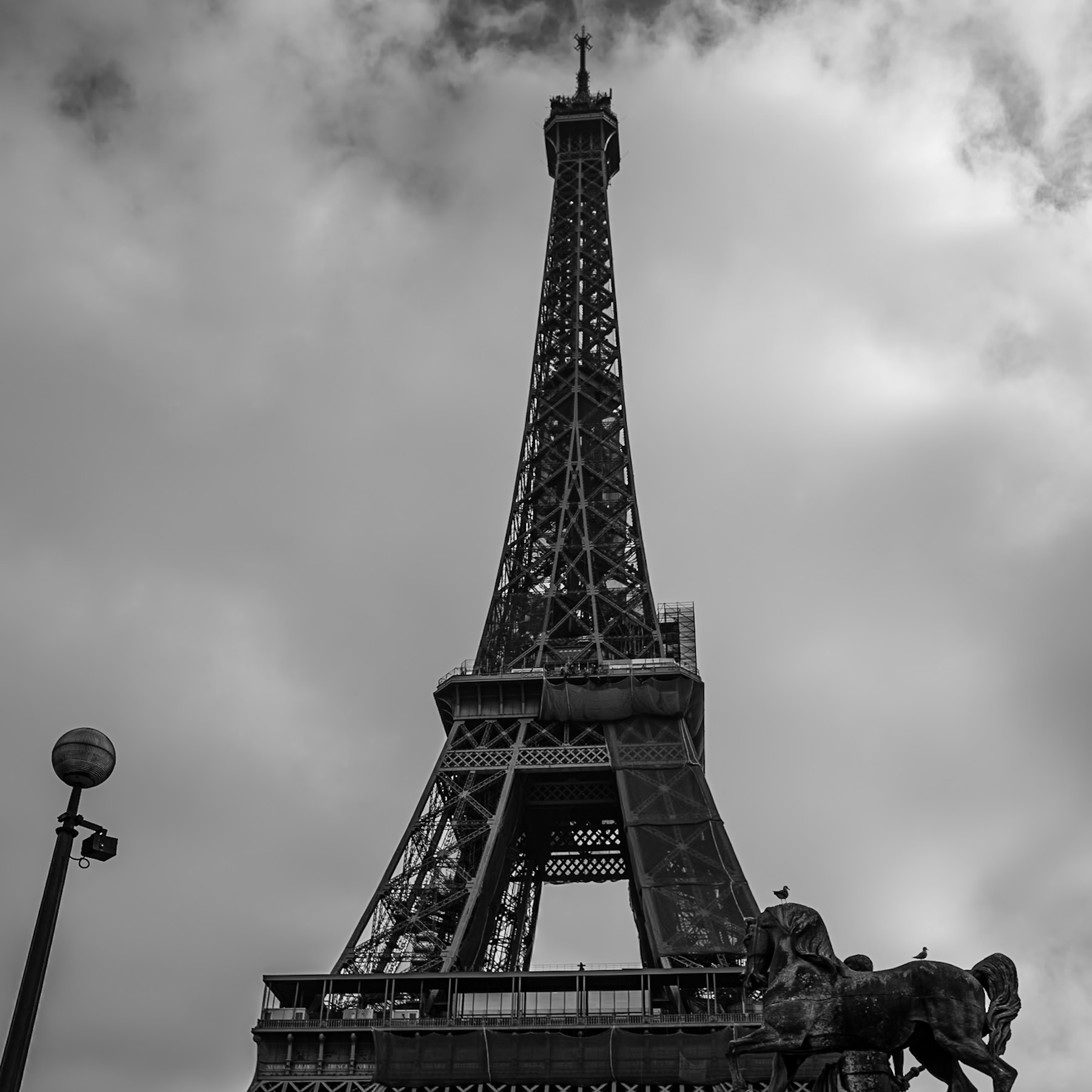
The photograph captures this sense of permanence and strength. The monochrome palette strips away the distraction of color, forcing the viewer to focus on the form, texture, and sheer ambition of Eiffel's vision. The visible scaffolding and netting, a subtle detail in the image, speak to the constant care and restoration required to preserve this icon for future generations. It is a reminder that the tower is not a static relic but a living piece of history, continually maintained to withstand the test of time.
This image, with its dramatic composition and timeless feel, does more than just depict a landmark. It captures a narrative of bold innovation, initial rejection, and ultimate triumph. The Eiffel Tower stands not just as a symbol of Paris, but as a monument to human ingenuity and the power of a visionary idea to endure and inspire.
Schreibe einen Kommentar