Haussmann's Legacy: The Timeless Architecture of a Parisian Street
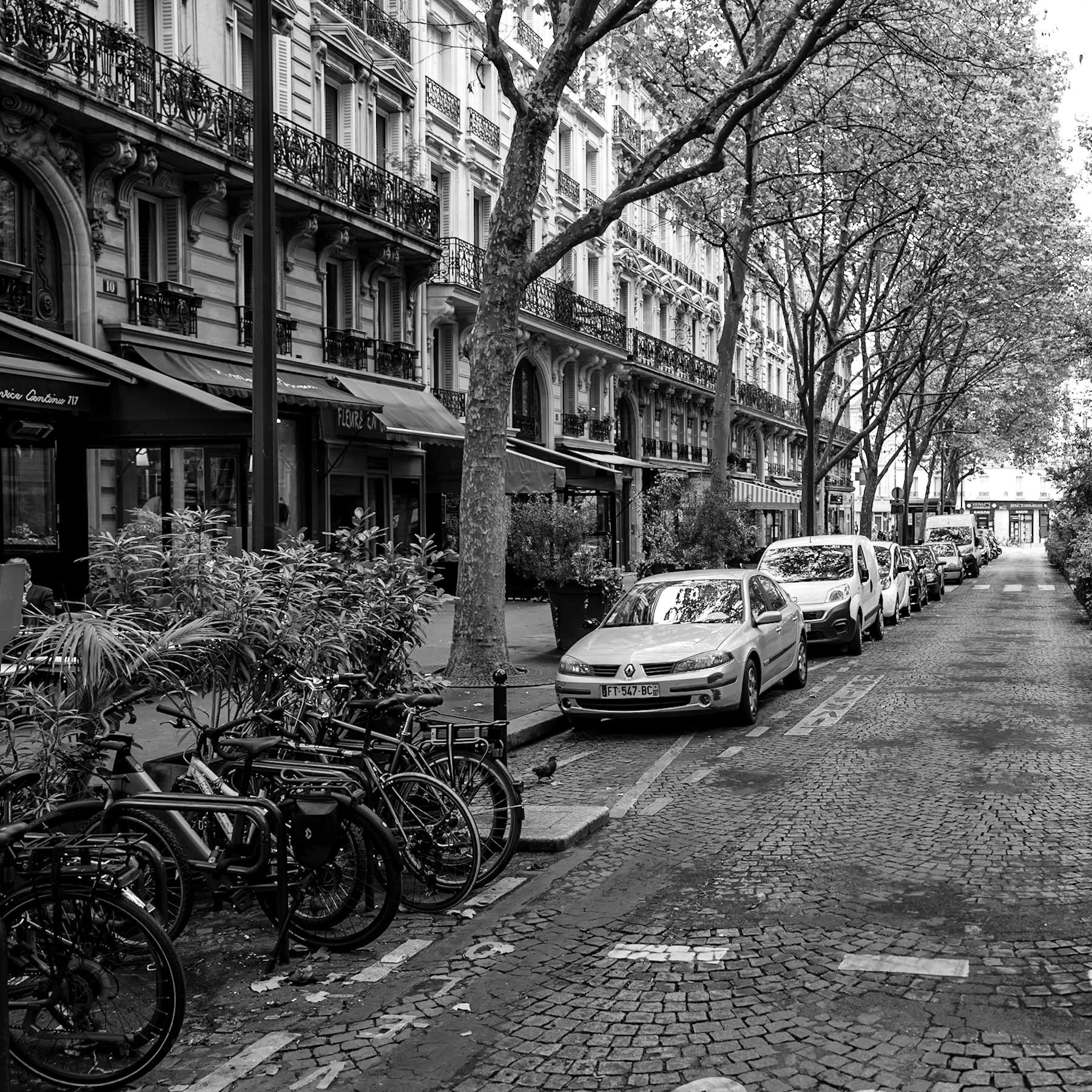
This black and white photograph captures a quintessential Parisian street, a scene that feels both contemporary and deeply rooted in history. The image presents a quiet moment where the grandeur of 19th-century urban planning meets the rhythm of 21st-century daily life. The cobblestone road, the line of parked cars and bicycles, and the leafy plane trees all exist under the watchful presence of the iconic buildings that define the city's visual identity.
The dominant feature is the magnificent and uniform facade of the apartment blocks, a direct legacy of Baron Haussmann's radical renovation of Paris between 1853 and 1870. Commissioned by Emperor Napoleon III, Haussmann’s mandate was to modernize the city, replacing its dark, narrow medieval lanes with wide, airy boulevards, parks, and a new, cohesive architectural style. The buildings in the photograph are a perfect example of this vision. Notice the consistent height, the cream-colored stone (Lutetian limestone), and the alignment of balconies. This uniformity was not just for aesthetics; it was designed to create a sense of order, grandeur, and hygiene.
A closer look reveals the specific characteristics of Haussmannian architecture:
- Wrought-Iron Balconies: The intricate, black wrought-iron railings are a signature element. They typically wrap around the entire building on the second floor—the étage noble or noble floor, once considered the most desirable—and often appear on the fifth floor as well. These balconies break the monotony of the stone facade and add a layer of delicate ornamentation.
- Tall French Windows: The long, elegant windows, often with shutters, were designed to let in maximum light, a stark contrast to the small windows of the older buildings Haussmann’s project replaced.
- Structured Floors: Though not visible in detail, these buildings follow a strict hierarchy. The ground floor was for shops, the mezzanine for storage or the shopkeeper's lodging, the second floor for the wealthiest residents, and the upper floors for the middle class, with the very top floor (attic rooms) reserved for servants.
Down on the street level, the photograph reveals a blend of eras. The worn pavés, or cobblestones, have paved Parisian roads for centuries and are as much a part of the city's fabric as the buildings themselves. Juxtaposed against this historic foundation are modern vehicles—a Renault sedan, a white van—and a rack of bicycles, reflecting the city's evolving relationship with transportation. The awnings of a café or restaurant hint at the vibrant commercial life that continues to thrive on the ground floors of these historic structures, just as they were designed to do.
The composition, rendered in monochrome, strips the scene of color, encouraging the viewer to focus on texture, light, and form. It highlights the rough bark of the plane trees, the smooth stone of the buildings, and the uneven surface of the road. This timeless quality underscores the enduring success of Haussmann's vision: a city designed for a specific historical moment that has proven remarkably adaptable, retaining its unparalleled charm and character through the centuries.
Schreibe einen Kommentar