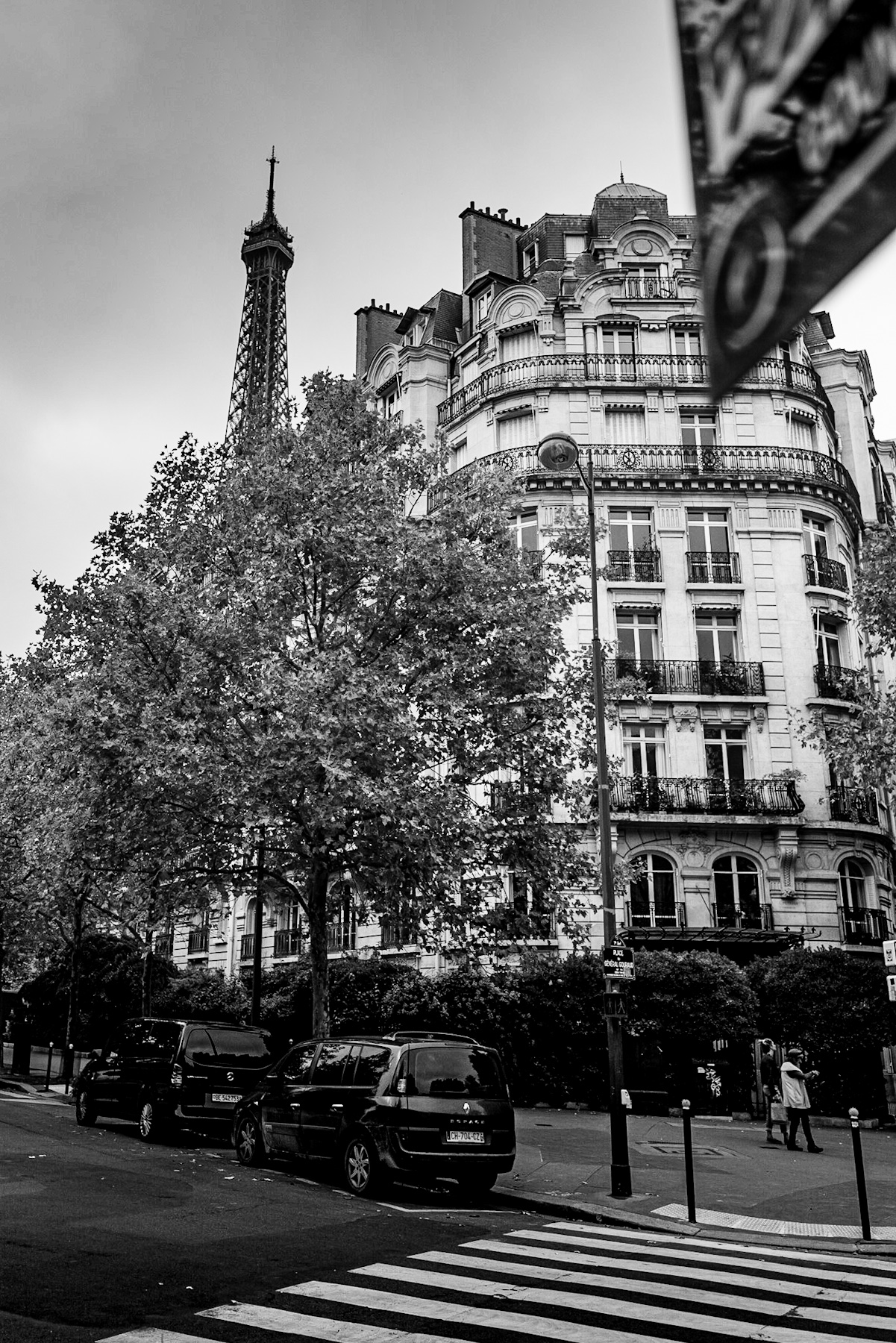
A black-and-white photograph immortalizes a quintessential Parisian street corner, a tableau brimming with architectural history and cultural resonance. The low-angle perspective expertly draws the eye upward, from the bustling modern street to a historical skyline, revealing a layered composition where various eras of Parisian development beautifully coexist.
At the heart of this Parisian vista stands a prime example of Haussmannian architecture, the defining style of central Paris. This aesthetic emerged from the monumental urban renewal project spearheaded by Emperor Napoleon III and Baron Georges-Eugène Haussmann from 1853 to 1870. The buildings of this era, like the one pictured, are instantly recognizable by their uniform facades of cream-colored cut stone, bringing a sense of order to the grand boulevards. Intricate wrought-iron balconies grace the windows, with the continuous, wrap-around balcony on the second floor, known as the ‚étage noble,‘ serving as a distinct status symbol for the city’s wealthiest. Haussmann’s meticulous regulations also dictated specific building heights and floor plans, typically allocating the ground floor for shops and the upper floors for apartments of diminishing prestige. Capping these structures is the distinctive 45-degree pitched mansard roof, often housing attic rooms or ‚chambres de bonne‘ for servants.
This transformation was far more than cosmetic. Haussmann’s ambitious plan involved the demolition of crowded, medieval neighborhoods to pave the way for wide avenues, expansive parks, and elegant squares. This not only dramatically improved sanitation and traffic flow but also served a strategic military purpose, making it significantly harder for uprisings to erect barricades. The architectural gem in our photograph stands as a direct descendant of this monumental, and at times controversial, chapter in Parisian history.
Just above these classic Haussmannian rooftops, the unmistakable lattice silhouette of the Eiffel Tower emerges. Its towering presence offers a pivotal historical counterpoint. Erected between 1887 and 1889 as the centerpiece of the Exposition Universelle (World’s Fair), the tower was a groundbreaking symbol of 19th-century industrial engineering and forward-thinking modernism.
The Eiffel Tower’s arrival was initially met with sharp criticism from Paris’s artistic and literary circles, who decried it as a „monstrous factory chimney“ that clashed with the city’s established classical beauty. It stood in stark contrast to the elegant stone-and-plaster aesthetic of Haussmann’s vision. Yet, with the passage of time, these two iconic symbols have found a profound reconciliation. What was once a jarring contrast is now a harmonious pairing, representing two distinct yet equally defining chapters of the city’s narrative: the ordered, bourgeois elegance of the Second Empire and the audacious industrial ambition of the Third Republic.
This single photograph beautifully encapsulates this synthesis. The vibrant foreground, complete with parked cars and a bustling pedestrian crossing, firmly roots the scene in the present day. It serves as a powerful reminder that this historic cityscape is far from a mere museum exhibit; it is a living, breathing urban environment where daily life continually unfolds against a backdrop of profound architectural and social history.
At the heart of this Parisian vista stands a prime example of Haussmannian architecture, the defining style of central Paris. This aesthetic emerged from the monumental urban renewal project spearheaded by Emperor Napoleon III and Baron Georges-Eugène Haussmann from 1853 to 1870. The buildings of this era, like the one pictured, are instantly recognizable by their uniform facades of cream-colored cut stone, bringing a sense of order to the grand boulevards. Intricate wrought-iron balconies grace the windows, with the continuous, wrap-around balcony on the second floor, known as the ‚étage noble,‘ serving as a distinct status symbol for the city’s wealthiest. Haussmann’s meticulous regulations also dictated specific building heights and floor plans, typically allocating the ground floor for shops and the upper floors for apartments of diminishing prestige. Capping these structures is the distinctive 45-degree pitched mansard roof, often housing attic rooms or ‚chambres de bonne‘ for servants.
This transformation was far more than cosmetic. Haussmann’s ambitious plan involved the demolition of crowded, medieval neighborhoods to pave the way for wide avenues, expansive parks, and elegant squares. This not only dramatically improved sanitation and traffic flow but also served a strategic military purpose, making it significantly harder for uprisings to erect barricades. The architectural gem in our photograph stands as a direct descendant of this monumental, and at times controversial, chapter in Parisian history.
Just above these classic Haussmannian rooftops, the unmistakable lattice silhouette of the Eiffel Tower emerges. Its towering presence offers a pivotal historical counterpoint. Erected between 1887 and 1889 as the centerpiece of the Exposition Universelle (World’s Fair), the tower was a groundbreaking symbol of 19th-century industrial engineering and forward-thinking modernism.
The Eiffel Tower’s arrival was initially met with sharp criticism from Paris’s artistic and literary circles, who decried it as a „monstrous factory chimney“ that clashed with the city’s established classical beauty. It stood in stark contrast to the elegant stone-and-plaster aesthetic of Haussmann’s vision. Yet, with the passage of time, these two iconic symbols have found a profound reconciliation. What was once a jarring contrast is now a harmonious pairing, representing two distinct yet equally defining chapters of the city’s narrative: the ordered, bourgeois elegance of the Second Empire and the audacious industrial ambition of the Third Republic.
This single photograph beautifully encapsulates this synthesis. The vibrant foreground, complete with parked cars and a bustling pedestrian crossing, firmly roots the scene in the present day. It serves as a powerful reminder that this historic cityscape is far from a mere museum exhibit; it is a living, breathing urban environment where daily life continually unfolds against a backdrop of profound architectural and social history.
Schreibe einen Kommentar