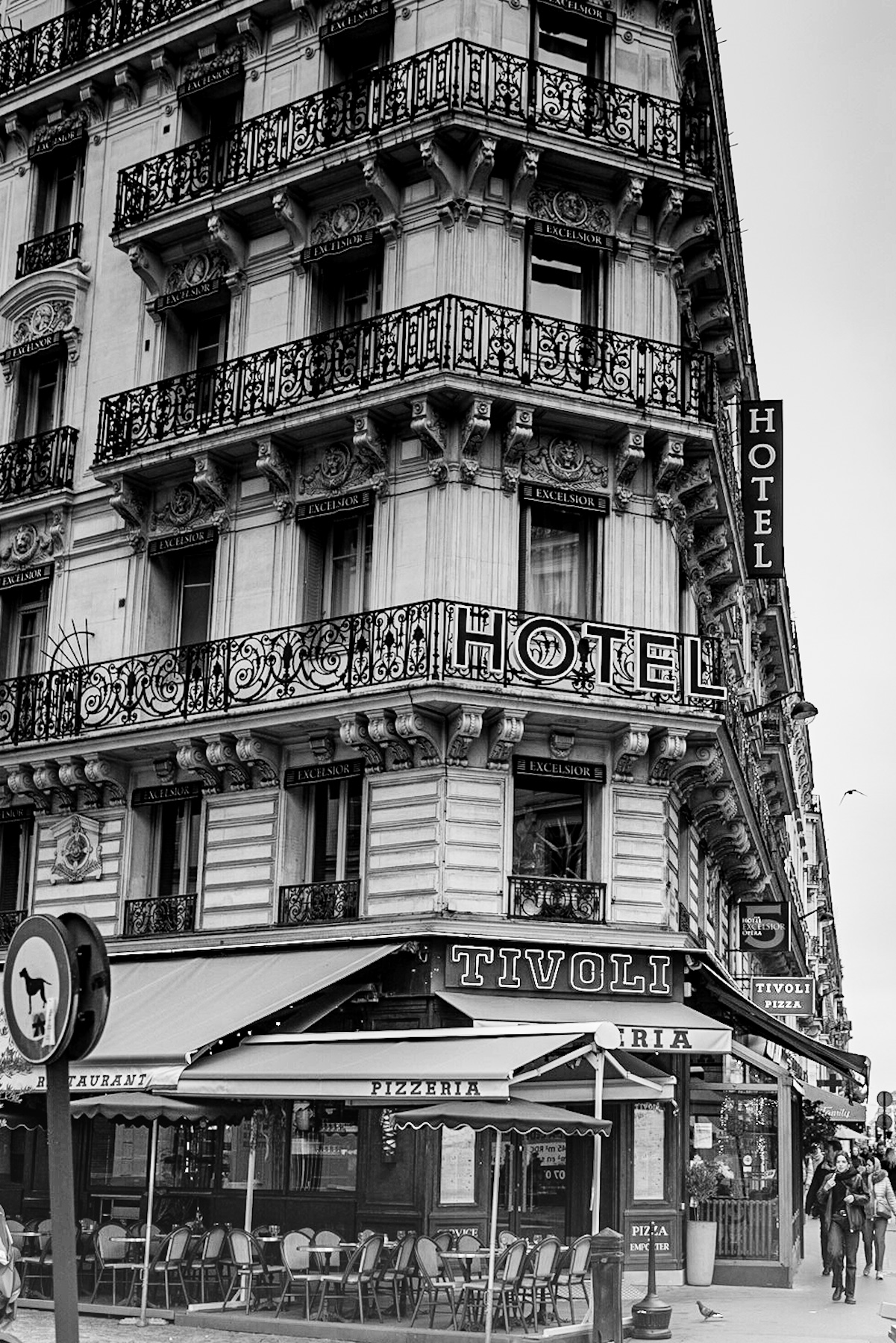
Captured in monochrome, this image presents a quintessential Parisian street corner, a scene that is both a snapshot of daily life and a window into the city’s rich architectural history. The focal point is a grand corner building, home to the Hotel Excelsior and the Tivoli Pizzeria, which stands as a testament to a transformative period in Paris’s urban development.
The Haussmannian Blueprint
The building is a textbook example of Haussmannian architecture, the style that defines much of central Paris today. This architectural identity was forged during the Second French Empire, under the direction of Emperor Napoleon III, who commissioned Baron Georges-Eugène Haussmann to undertake a massive public works program between 1853 and 1870. The goal was to replace the cramped, dark, and unsanitary medieval streets with wide avenues, modern sanitation, and stately, uniform buildings.
This photograph perfectly illustrates the core principles of Haussmann’s vision:
* Uniformity and Grandeur: The building adheres to a strict height limit, creating a harmonious roofline with its neighbors (implied outside the frame). The facade is constructed from cream-colored Lutetian limestone, giving the city its characteristic luminous quality. * Structured Facades: The design follows a clear horizontal division. The ground floor is dedicated to commercial use—in this case, the „Tivoli“ restaurant. The floors above are residential or, as indicated by the signs, for the Hotel Excelsior. The second and fifth floors are typically adorned with continuous, ornate balconies. * Ornate Details: While the overall structure is uniform, the details are rich and elaborate. This reflects the influence of the Beaux-Arts style, which emphasized symmetry, hierarchy, and opulent decoration.
A Closer Look at the Details
A detailed examination of the facade reveals the craftsmanship of the era. The most striking features are the intricate wrought-iron balconies. These were not merely decorative; they provided private outdoor space for the residents of the étage noble (the noble floor, or second floor), which was considered the most desirable. The flowing, almost floral patterns of the ironwork contrast beautifully with the solid, geometric lines of the stone.
Beneath the balconies, carved stone corbels provide structural and aesthetic support. Each window is framed with care, and the name „EXCELSIOR“ is elegantly inscribed above many of them, reinforcing the building’s identity. The large „HOTEL“ sign, with its classic typography, is both a functional marker and an integral part of the building’s character, a common sight on the Parisian urban landscape.
Life at Street Level
Anchoring this monumental structure is the vibrant life at street level. The „TIVOLI“ Pizzeria, with its wide awnings and outdoor seating, embodies the famous Parisian café culture. The chairs and tables arranged on the sidewalk invite passersby to pause, dine, and observe the city’s flow. This seamless integration of commercial and residential life is a hallmark of Parisian urbanism, creating a dynamic and walkable city. The pedestrians on the right side of the frame add a sense of movement, reminding us that this historic architecture is not a museum piece but the living, breathing backdrop to modern life.
In conclusion, this photograph captures more than just a building. It encapsulates an entire philosophy of urban design that prioritized beauty, function, and social order. The Hotel Excelsior is a microcosm of Paris itself: a place where historical grandeur meets the simple, everyday pleasures of a meal on a bustling sidewalk.
The Haussmannian Blueprint
The building is a textbook example of Haussmannian architecture, the style that defines much of central Paris today. This architectural identity was forged during the Second French Empire, under the direction of Emperor Napoleon III, who commissioned Baron Georges-Eugène Haussmann to undertake a massive public works program between 1853 and 1870. The goal was to replace the cramped, dark, and unsanitary medieval streets with wide avenues, modern sanitation, and stately, uniform buildings.
This photograph perfectly illustrates the core principles of Haussmann’s vision:
* Uniformity and Grandeur: The building adheres to a strict height limit, creating a harmonious roofline with its neighbors (implied outside the frame). The facade is constructed from cream-colored Lutetian limestone, giving the city its characteristic luminous quality. * Structured Facades: The design follows a clear horizontal division. The ground floor is dedicated to commercial use—in this case, the „Tivoli“ restaurant. The floors above are residential or, as indicated by the signs, for the Hotel Excelsior. The second and fifth floors are typically adorned with continuous, ornate balconies. * Ornate Details: While the overall structure is uniform, the details are rich and elaborate. This reflects the influence of the Beaux-Arts style, which emphasized symmetry, hierarchy, and opulent decoration.
A Closer Look at the Details
A detailed examination of the facade reveals the craftsmanship of the era. The most striking features are the intricate wrought-iron balconies. These were not merely decorative; they provided private outdoor space for the residents of the étage noble (the noble floor, or second floor), which was considered the most desirable. The flowing, almost floral patterns of the ironwork contrast beautifully with the solid, geometric lines of the stone.
Beneath the balconies, carved stone corbels provide structural and aesthetic support. Each window is framed with care, and the name „EXCELSIOR“ is elegantly inscribed above many of them, reinforcing the building’s identity. The large „HOTEL“ sign, with its classic typography, is both a functional marker and an integral part of the building’s character, a common sight on the Parisian urban landscape.
Life at Street Level
Anchoring this monumental structure is the vibrant life at street level. The „TIVOLI“ Pizzeria, with its wide awnings and outdoor seating, embodies the famous Parisian café culture. The chairs and tables arranged on the sidewalk invite passersby to pause, dine, and observe the city’s flow. This seamless integration of commercial and residential life is a hallmark of Parisian urbanism, creating a dynamic and walkable city. The pedestrians on the right side of the frame add a sense of movement, reminding us that this historic architecture is not a museum piece but the living, breathing backdrop to modern life.
In conclusion, this photograph captures more than just a building. It encapsulates an entire philosophy of urban design that prioritized beauty, function, and social order. The Hotel Excelsior is a microcosm of Paris itself: a place where historical grandeur meets the simple, everyday pleasures of a meal on a bustling sidewalk.
Schreibe einen Kommentar