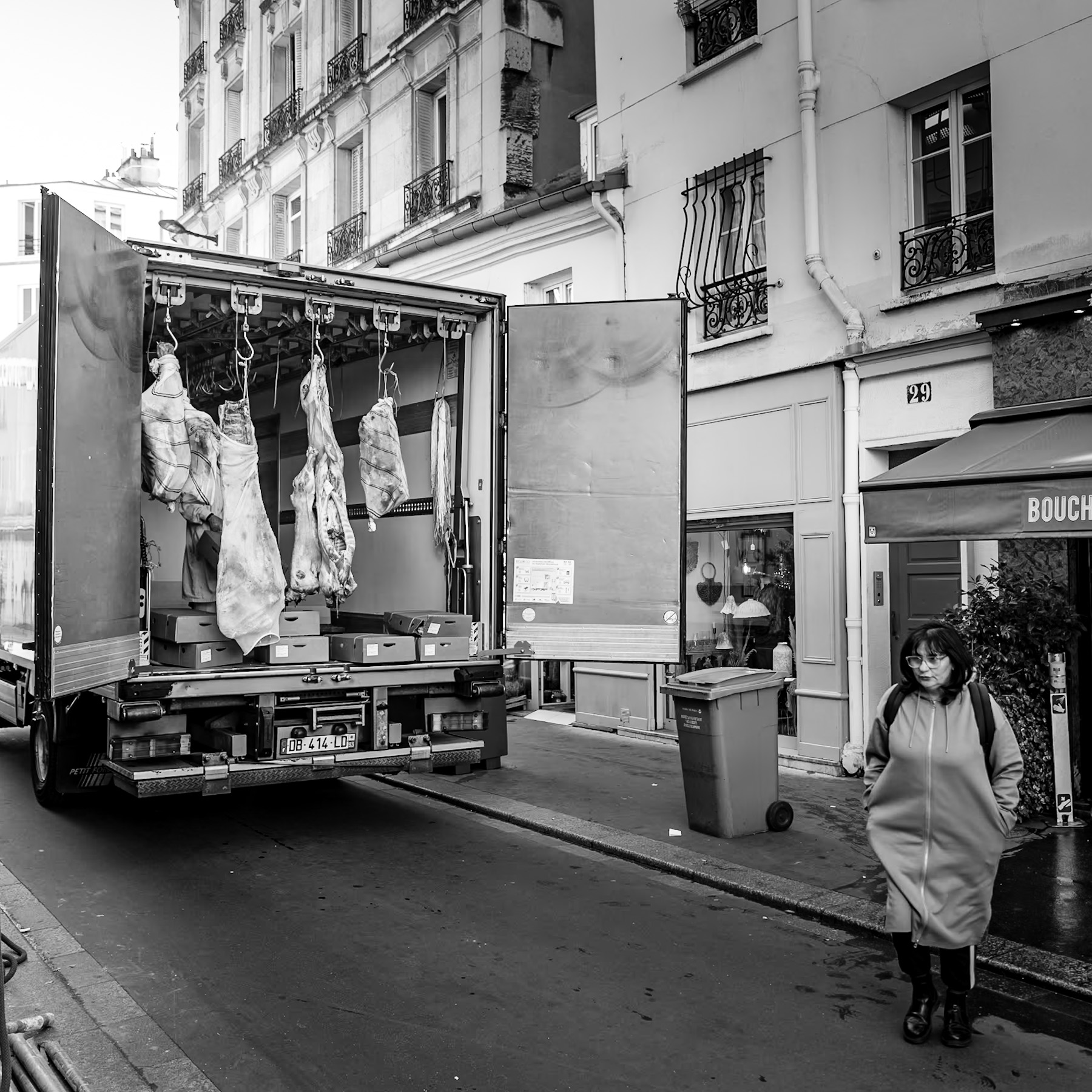
In the quiet light of a Parisian morning, a refrigerated truck stands with its doors agape, revealing a sight both mundane and primal. Large carcasses of meat hang from steel hooks, a stark and unadorned view of the city’s food supply chain in motion. This black and white photograph captures more than just a delivery; it encapsulates a centuries-old tradition that continues to beat at the heart of Paris, set against the backdrop of its iconic Haussmannian architecture.
A Glimpse into the Daily Grind
The scene is set in a narrow street, typical of the French capital. The truck, a modern necessity, is parked directly in front of a boucherie, its destination clear. The raw meat, partially wrapped, is ready to be unloaded and transformed by the skilled hands of the local butcher. This daily ritual is the essential, often unseen, link between the countryside and the consumer’s plate. It’s a moment of transition, where the raw material of French gastronomy begins its journey into the refined products celebrated worldwide. The photograph’s monochrome palette strips the scene of distraction, focusing the viewer on the textures and forms: the rough surfaces of the meat, the cold metal of the truck, and the elegant stone of the surrounding buildings.
Echoes of Les Halles
To understand the full weight of this image, one must look to the history of Paris itself, specifically to the legendary market of Les Halles. For over 800 years, this central market was famously dubbed „Le Ventre de Paris“ („The Belly of Paris“) by the novelist Émile Zola. It was a sprawling, chaotic, and vibrant hub where all the food for the city converged. The meat pavilions of Les Halles were a world unto themselves, a place of immense labor and vital importance to the city’s survival and culinary identity.
While the central market moved to Rungis in 1969, its spirit lives on in scenes like this. This single truck, delivering directly to a neighborhood Parisian boucherie, is a modern, decentralized echo of that massive, historic operation. The fundamental process remains the same: the transportation of animal carcasses from the abattoir to the artisan. This image serves as a powerful reminder that behind the romantic façade of Paris lies a working city, one that relies on a complex and deeply rooted network of trade and craft.
The Juxtaposition of Life and Architecture
The photograph masterfully plays with contrast. The organic, almost visceral nature of the hanging meat is juxtaposed with the rigid, ornate geometry of the 19th-century buildings. The wrought-iron balconies and clean architectural lines speak of order, culture, and permanence. The delivery, however, speaks of the transient, cyclical nature of life and sustenance. A woman stands on the pavement, a contemporary observer of this timeless transaction. Her presence grounds the scene in the present moment, a citizen navigating the space where history and daily necessity intersect.
This single frame is a powerful piece of documentary. It is not the Paris of postcards, but the authentic Paris—a city that honors its culinary traditions not just in its Michelin-starred restaurants, but in the quiet, essential work that happens every day on its historic streets.
A Glimpse into the Daily Grind
The scene is set in a narrow street, typical of the French capital. The truck, a modern necessity, is parked directly in front of a boucherie, its destination clear. The raw meat, partially wrapped, is ready to be unloaded and transformed by the skilled hands of the local butcher. This daily ritual is the essential, often unseen, link between the countryside and the consumer’s plate. It’s a moment of transition, where the raw material of French gastronomy begins its journey into the refined products celebrated worldwide. The photograph’s monochrome palette strips the scene of distraction, focusing the viewer on the textures and forms: the rough surfaces of the meat, the cold metal of the truck, and the elegant stone of the surrounding buildings.
Echoes of Les Halles
To understand the full weight of this image, one must look to the history of Paris itself, specifically to the legendary market of Les Halles. For over 800 years, this central market was famously dubbed „Le Ventre de Paris“ („The Belly of Paris“) by the novelist Émile Zola. It was a sprawling, chaotic, and vibrant hub where all the food for the city converged. The meat pavilions of Les Halles were a world unto themselves, a place of immense labor and vital importance to the city’s survival and culinary identity.
While the central market moved to Rungis in 1969, its spirit lives on in scenes like this. This single truck, delivering directly to a neighborhood Parisian boucherie, is a modern, decentralized echo of that massive, historic operation. The fundamental process remains the same: the transportation of animal carcasses from the abattoir to the artisan. This image serves as a powerful reminder that behind the romantic façade of Paris lies a working city, one that relies on a complex and deeply rooted network of trade and craft.
The Juxtaposition of Life and Architecture
The photograph masterfully plays with contrast. The organic, almost visceral nature of the hanging meat is juxtaposed with the rigid, ornate geometry of the 19th-century buildings. The wrought-iron balconies and clean architectural lines speak of order, culture, and permanence. The delivery, however, speaks of the transient, cyclical nature of life and sustenance. A woman stands on the pavement, a contemporary observer of this timeless transaction. Her presence grounds the scene in the present moment, a citizen navigating the space where history and daily necessity intersect.
This single frame is a powerful piece of documentary. It is not the Paris of postcards, but the authentic Paris—a city that honors its culinary traditions not just in its Michelin-starred restaurants, but in the quiet, essential work that happens every day on its historic streets.
Schreibe einen Kommentar