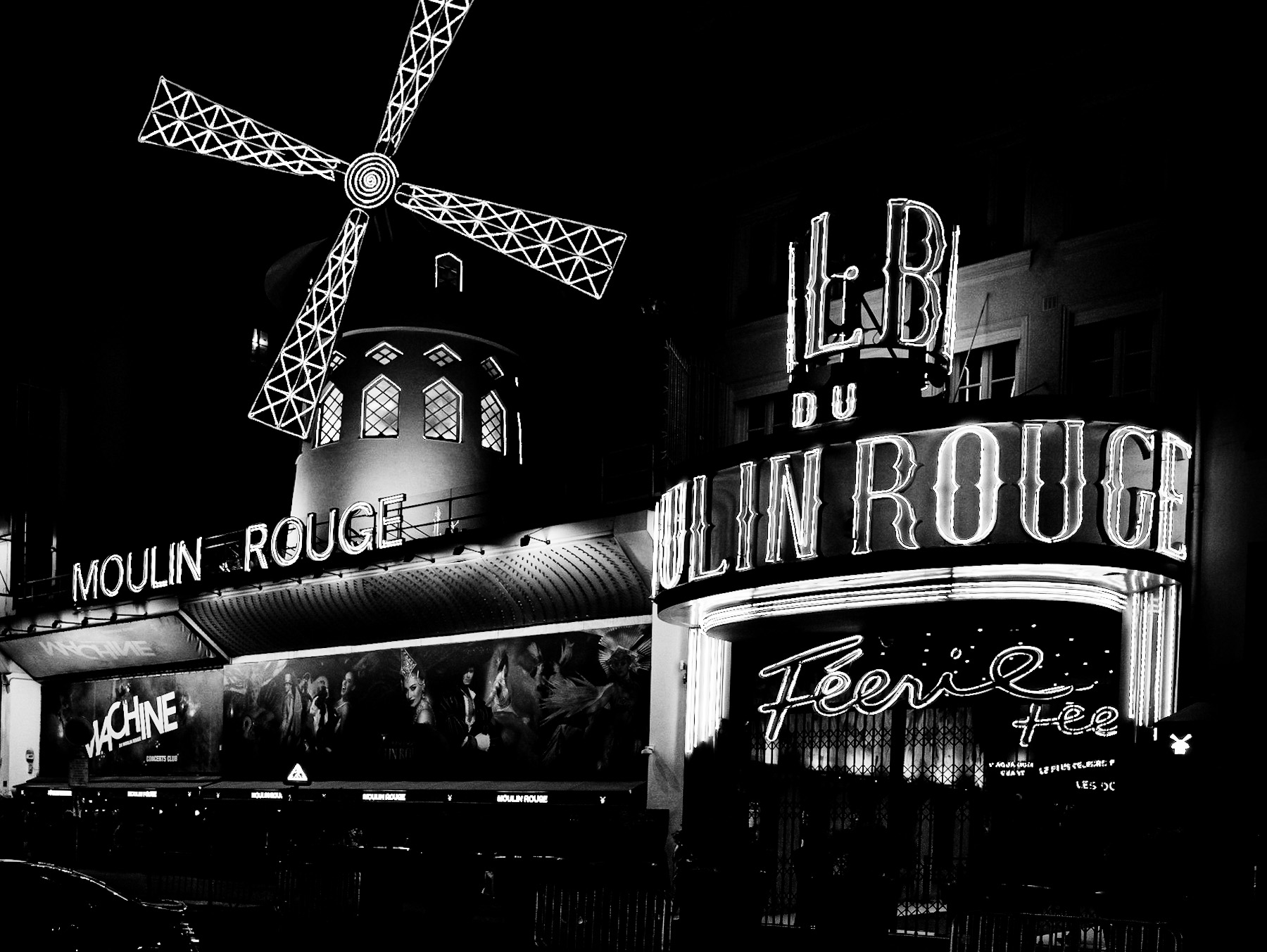
The image presents a striking, high-contrast black-and-white view of a world-renowned landmark: the Moulin Rouge. Stripped of its famous crimson hue, the scene is reduced to its essential forms of light and shadow. The iconic windmill, its sails intricately latticed and glowing against the pitch-black sky, stands as a silent sentinel. Below, the bold, retro neon letters spelling out „MOULIN ROUGE“ and „Féerie“ burn brightly, carving the cabaret’s identity into the Parisian night. This monochromatic treatment emphasizes not the color, but the enduring energy and architectural character of a place steeped in history.
The Birth of a Legend in the Belle Époque
To understand the Moulin Rouge is to step back into the Paris of 1889. Co-founded by Charles Zidler and Joseph Oller, the cabaret opened its doors during the peak of the Belle Époque—a period of optimism, artistic freedom, and industrial progress in France. Situated in the bohemian Montmartre district, it was designed to be a place where people from all social classes could mix, from artists and writers to the wealthy elite and working-class locals. Its unique, extravagant architecture, complete with the now-famous red windmill, was a spectacle in itself, promising a world of fantasy and escape from the moment one approached its doors.
The Dance and the Artist that Defined an Era
The Moulin Rouge didn’t just offer a venue; it launched a cultural phenomenon. It is globally recognized as the birthplace of the modern form of the Can-Can, a high-energy, physically demanding dance that was considered scandalous and liberating in equal measure. Dancers like La Goulue and Jane Avril became the first true stars of the cabaret world, their fame immortalized by the artist who became synonymous with Montmartre’s nightlife: Henri de Toulouse-Lautrec. His iconic posters and paintings captured the vibrant, chaotic, and poignant essence of the Moulin Rouge, elevating its performers from entertainers to muses and cementing the cabaret’s place in art history.
A Modern Beacon with a Storied Past
Today, as the photograph illustrates, the Moulin Rouge continues to be a major draw in Paris. The sign for „Féerie,“ its current grand spectacle, glows with the same promise of enchantment that has lured audiences for over a century. The posters visible below the main sign depict modern performers, a direct lineage from the dancers Toulouse-Lautrec once sketched.
By removing the color, the image allows us to see the Moulin Rouge not just as a tourist attraction, but as a historical constant. The light it casts on the Boulevard de Clichy is more than just electricity; it is the lingering glow of the Belle Époque, a testament to Paris’s enduring spirit of joie de vivre. The structure stands as a bridge between the past and present—a symbol of artistic rebellion, extravagant entertainment, and the timeless allure of Parisian nights.
The Birth of a Legend in the Belle Époque
To understand the Moulin Rouge is to step back into the Paris of 1889. Co-founded by Charles Zidler and Joseph Oller, the cabaret opened its doors during the peak of the Belle Époque—a period of optimism, artistic freedom, and industrial progress in France. Situated in the bohemian Montmartre district, it was designed to be a place where people from all social classes could mix, from artists and writers to the wealthy elite and working-class locals. Its unique, extravagant architecture, complete with the now-famous red windmill, was a spectacle in itself, promising a world of fantasy and escape from the moment one approached its doors.
The Dance and the Artist that Defined an Era
The Moulin Rouge didn’t just offer a venue; it launched a cultural phenomenon. It is globally recognized as the birthplace of the modern form of the Can-Can, a high-energy, physically demanding dance that was considered scandalous and liberating in equal measure. Dancers like La Goulue and Jane Avril became the first true stars of the cabaret world, their fame immortalized by the artist who became synonymous with Montmartre’s nightlife: Henri de Toulouse-Lautrec. His iconic posters and paintings captured the vibrant, chaotic, and poignant essence of the Moulin Rouge, elevating its performers from entertainers to muses and cementing the cabaret’s place in art history.
A Modern Beacon with a Storied Past
Today, as the photograph illustrates, the Moulin Rouge continues to be a major draw in Paris. The sign for „Féerie,“ its current grand spectacle, glows with the same promise of enchantment that has lured audiences for over a century. The posters visible below the main sign depict modern performers, a direct lineage from the dancers Toulouse-Lautrec once sketched.
By removing the color, the image allows us to see the Moulin Rouge not just as a tourist attraction, but as a historical constant. The light it casts on the Boulevard de Clichy is more than just electricity; it is the lingering glow of the Belle Époque, a testament to Paris’s enduring spirit of joie de vivre. The structure stands as a bridge between the past and present—a symbol of artistic rebellion, extravagant entertainment, and the timeless allure of Parisian nights.
Schreibe einen Kommentar