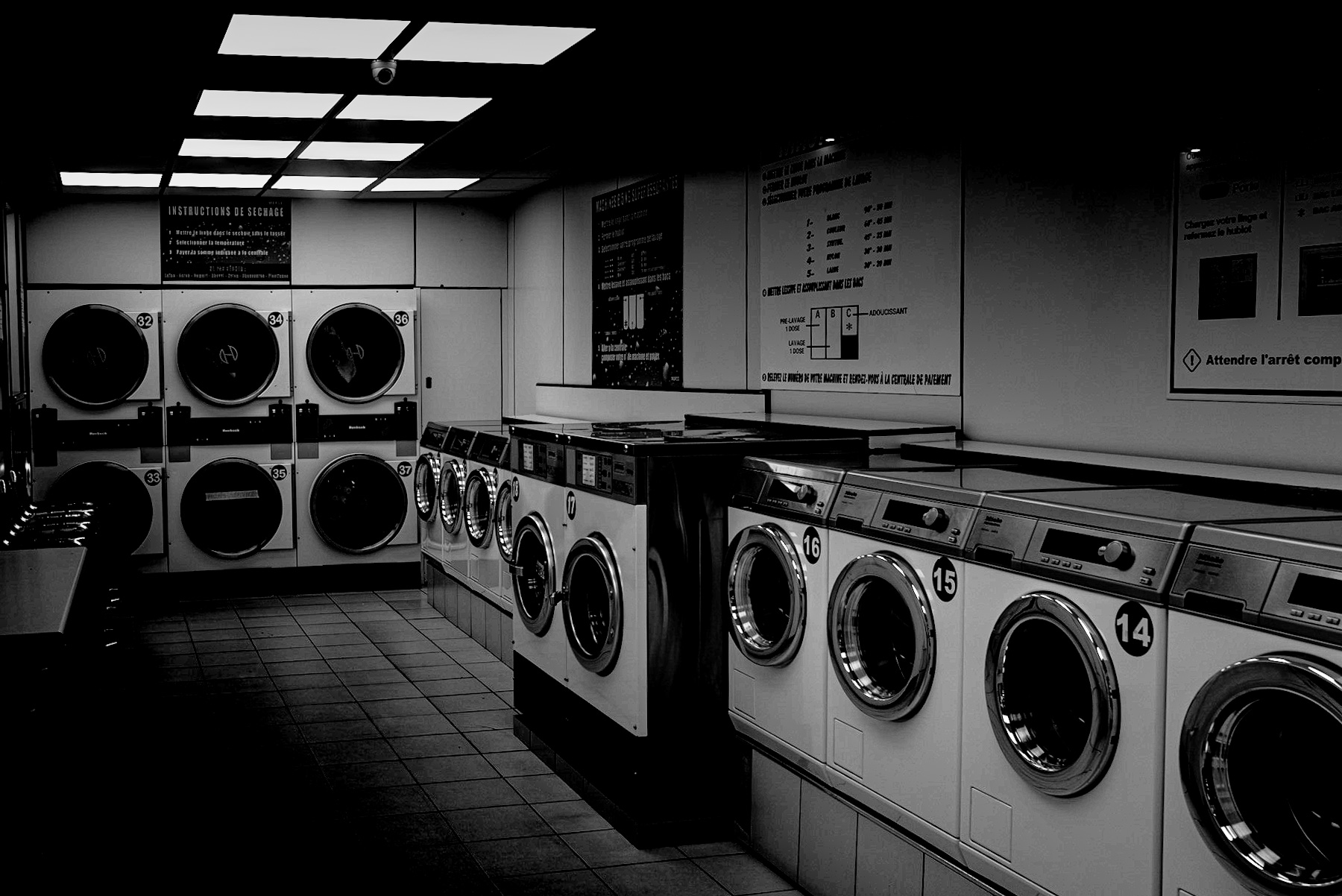
Captured in stark black and white, this image presents a scene that is both mundane and deeply evocative: an empty laundromat. Rows of front-loading washing machines and dryers stand at attention, their chrome doors reflecting the sterile, gridded fluorescent lights above. The perspective draws the viewer’s eye down the tiled aisle, past numbered machines, creating a sense of order and repetition. The silence is palpable; this is a space of waiting, a pause in the rhythm of urban life. The French instructions on the wall—“Instructions de Séchage“—place us in a specific cultural context, yet the scene itself is universally understood.
A Post-War Revolution in Cleanliness
The public laundromat, or *laverie* as it might be called here, is a relatively modern invention, yet it fundamentally altered domestic life. Its origins trace back to the 1930s, but the concept truly flourished in the post-World War II era. Several societal shifts converged to make the self-service laundry a necessity:
* **Urbanization:** As populations moved into cities, living spaces shrank. Apartments and small homes often lacked the space for a personal washing machine and the yard for a clothesline. * **Economic Factors:** Early automatic washing machines were expensive luxury items. The laundromat offered an affordable, pay-per-use alternative, democratizing access to mechanized cleaning. * **Changing Social Structures:** With more women entering the workforce, the time-consuming chore of hand-washing laundry became increasingly impractical for many households.
The laundromat was more than a convenience; it was a symbol of post-war progress and efficiency. It outsourced one of the most laborious domestic tasks, freeing up valuable time for individuals and families.
From Social Hub to Solitary Space
In its heyday, the laundromat was an unintentional community center. It was a place where neighbors crossed paths, where conversations unfolded over the rhythmic hum and tumble of the machines. It became a unique social landscape, a melting pot of a neighborhood’s residents, all united by a common, simple task. This cultural significance is reflected in countless films and television shows, where the laundromat serves as a backdrop for chance encounters, quiet confessions, and slices of everyday life.
The image, however, portrays the other side of this coin. The absence of people transforms the space from a social hub into a zone of quiet solitude. The security camera on the ceiling is a subtle reminder of its public, yet often anonymous, nature. In our contemporary, fast-paced world, the laundromat is often visited at odd hours, a place for solitary reflection while the machines perform their cycle.
The Enduring Cycle
This photograph captures the essence of the laundromat as a liminal space—a place of transition. Clothes go in dirty and come out clean. It is a place of renewal, of resetting for the week ahead. The stark, high-contrast monochrome aesthetic strips the scene of distraction, focusing our attention on the form and function of the machines and the geometry of the room. It feels both timeless and slightly dated, a testament to an invention that has remained remarkably consistent in its purpose for over 70 years. It stands as a quiet monument to a simple, essential aspect of modern urban existence.
A Post-War Revolution in Cleanliness
The public laundromat, or *laverie* as it might be called here, is a relatively modern invention, yet it fundamentally altered domestic life. Its origins trace back to the 1930s, but the concept truly flourished in the post-World War II era. Several societal shifts converged to make the self-service laundry a necessity:
* **Urbanization:** As populations moved into cities, living spaces shrank. Apartments and small homes often lacked the space for a personal washing machine and the yard for a clothesline. * **Economic Factors:** Early automatic washing machines were expensive luxury items. The laundromat offered an affordable, pay-per-use alternative, democratizing access to mechanized cleaning. * **Changing Social Structures:** With more women entering the workforce, the time-consuming chore of hand-washing laundry became increasingly impractical for many households.
The laundromat was more than a convenience; it was a symbol of post-war progress and efficiency. It outsourced one of the most laborious domestic tasks, freeing up valuable time for individuals and families.
From Social Hub to Solitary Space
In its heyday, the laundromat was an unintentional community center. It was a place where neighbors crossed paths, where conversations unfolded over the rhythmic hum and tumble of the machines. It became a unique social landscape, a melting pot of a neighborhood’s residents, all united by a common, simple task. This cultural significance is reflected in countless films and television shows, where the laundromat serves as a backdrop for chance encounters, quiet confessions, and slices of everyday life.
The image, however, portrays the other side of this coin. The absence of people transforms the space from a social hub into a zone of quiet solitude. The security camera on the ceiling is a subtle reminder of its public, yet often anonymous, nature. In our contemporary, fast-paced world, the laundromat is often visited at odd hours, a place for solitary reflection while the machines perform their cycle.
The Enduring Cycle
This photograph captures the essence of the laundromat as a liminal space—a place of transition. Clothes go in dirty and come out clean. It is a place of renewal, of resetting for the week ahead. The stark, high-contrast monochrome aesthetic strips the scene of distraction, focusing our attention on the form and function of the machines and the geometry of the room. It feels both timeless and slightly dated, a testament to an invention that has remained remarkably consistent in its purpose for over 70 years. It stands as a quiet monument to a simple, essential aspect of modern urban existence.
Schreibe einen Kommentar