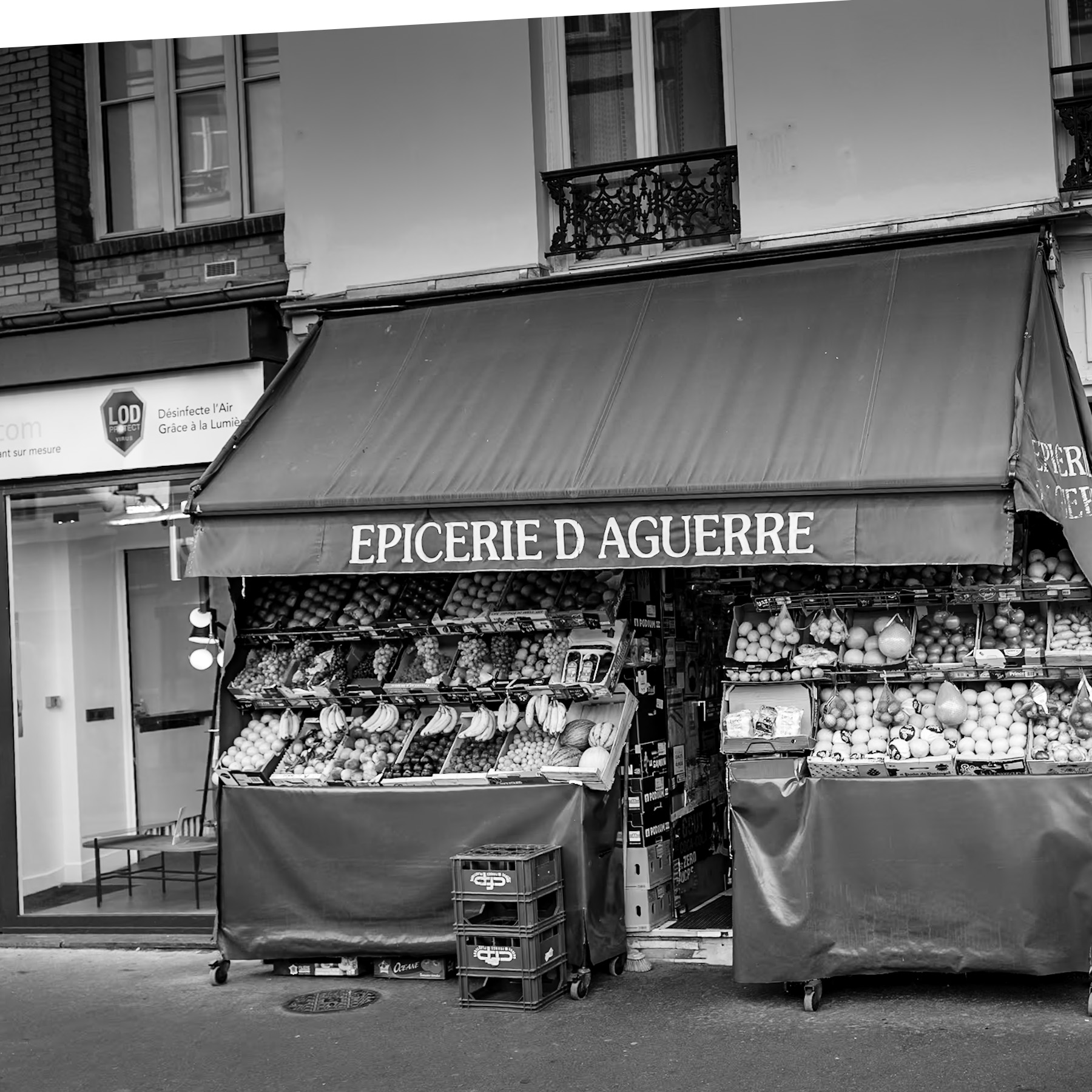
This captivating black and white photograph offers more than a glimpse of a fruit stand; it’s a frozen moment of daily Parisian life, steeped in cultural and historical layers. We’re introduced to the „Epicerie D Aguerre,“ a quintessential neighborhood grocer, its awning graciously sheltering a vibrant display of produce that artfully spills onto the sidewalk. The monochrome palette instantly lends a timeless quality, evoking generations of Parisians who have found their daily essentials in similar establishments.
**The Epicerie: A Cornerstone of French Life**
The *épicerie* is far more than just a shop in French culture; it’s the beating heart of any *quartier*. Historically, these small, often family-run enterprises have been the primary source for fresh fruits, vegetables, cheeses, wines, and countless other necessities. Beyond commerce, they are vibrant hubs of social interaction, places where neighbors exchange pleasantries, and the shopkeeper knows their customers by name and often their preferred weekly staples.
This image perfectly encapsulates that enduring tradition. The produce – inviting bunches of bananas, sturdy crates of citrus, and lush cascades of grapes – is arranged with meticulous care, presented in abundance rather than pre-packaged. This method encourages customers to browse, touch, and select, fostering a direct, tactile connection with their food. The presence of mobile carts subtly hints at a dynamic, flexible relationship with the street itself, a common and charming sight in Paris where the boundary between public and private commercial space frequently blurs.
**A Photographic Legacy in a Name**
The name emblazoned on the awning, „Epicerie D Aguerre,“ is particularly fascinating and offers a striking historical connection. Any visitor to Paris, especially one with an appreciation for history, will likely spot the striking similarity to **Louis Daguerre**, a true pioneer of photography. It was in 1839 that Daguerre introduced the Daguerreotype process, the world’s first commercially successful photographic method, effectively giving birth to this art form right here in Paris.
This potential nod – whether intentional or a delightful coincidence – creates a beautiful resonance within the image. Here we have a photograph, a modern digital capture, depicting a scene whose very name echoes the origins of photography itself. It transforms the image into a compelling self-referential piece of art. The bustling street scene, a subject deeply favored by early photographers keen on documenting urban life, is here branded with the name of one of the medium’s founding fathers. This subtle yet powerful link elevates the photograph from a simple documentary shot to a profound commentary on the very act of observation and preservation that photography enables.
**Old World Charm Meets Modern Reality**
While the scene undeniably radiates an old-world charm, a closer look reveals subtle contemporary details. To the left of the *épicerie*, a sign in a neighboring window reads, „Désinfecte l’Air Grâce à la Lumière“ (Disinfects the Air Thanks to Light). This small, yet significant detail firmly anchors the photograph in the 21st century, reflecting current societal concerns about health and hygiene.
This compelling juxtaposition is precisely what makes the image so powerful. It showcases a city where ancient traditions, such as the beloved neighborhood grocer, and profound historical legacies, like the name Daguerre, not only coexist but actively adapt to the pressing realities of the modern world. The Parisian street is far from a static museum exhibit; it is a living, breathing entity where history and the present engage in a constant, dynamic dialogue. This photograph stands as a perfect testament to that enduring and spirited Parisian narrative.
**The Epicerie: A Cornerstone of French Life**
The *épicerie* is far more than just a shop in French culture; it’s the beating heart of any *quartier*. Historically, these small, often family-run enterprises have been the primary source for fresh fruits, vegetables, cheeses, wines, and countless other necessities. Beyond commerce, they are vibrant hubs of social interaction, places where neighbors exchange pleasantries, and the shopkeeper knows their customers by name and often their preferred weekly staples.
This image perfectly encapsulates that enduring tradition. The produce – inviting bunches of bananas, sturdy crates of citrus, and lush cascades of grapes – is arranged with meticulous care, presented in abundance rather than pre-packaged. This method encourages customers to browse, touch, and select, fostering a direct, tactile connection with their food. The presence of mobile carts subtly hints at a dynamic, flexible relationship with the street itself, a common and charming sight in Paris where the boundary between public and private commercial space frequently blurs.
**A Photographic Legacy in a Name**
The name emblazoned on the awning, „Epicerie D Aguerre,“ is particularly fascinating and offers a striking historical connection. Any visitor to Paris, especially one with an appreciation for history, will likely spot the striking similarity to **Louis Daguerre**, a true pioneer of photography. It was in 1839 that Daguerre introduced the Daguerreotype process, the world’s first commercially successful photographic method, effectively giving birth to this art form right here in Paris.
This potential nod – whether intentional or a delightful coincidence – creates a beautiful resonance within the image. Here we have a photograph, a modern digital capture, depicting a scene whose very name echoes the origins of photography itself. It transforms the image into a compelling self-referential piece of art. The bustling street scene, a subject deeply favored by early photographers keen on documenting urban life, is here branded with the name of one of the medium’s founding fathers. This subtle yet powerful link elevates the photograph from a simple documentary shot to a profound commentary on the very act of observation and preservation that photography enables.
**Old World Charm Meets Modern Reality**
While the scene undeniably radiates an old-world charm, a closer look reveals subtle contemporary details. To the left of the *épicerie*, a sign in a neighboring window reads, „Désinfecte l’Air Grâce à la Lumière“ (Disinfects the Air Thanks to Light). This small, yet significant detail firmly anchors the photograph in the 21st century, reflecting current societal concerns about health and hygiene.
This compelling juxtaposition is precisely what makes the image so powerful. It showcases a city where ancient traditions, such as the beloved neighborhood grocer, and profound historical legacies, like the name Daguerre, not only coexist but actively adapt to the pressing realities of the modern world. The Parisian street is far from a static museum exhibit; it is a living, breathing entity where history and the present engage in a constant, dynamic dialogue. This photograph stands as a perfect testament to that enduring and spirited Parisian narrative.
Schreibe einen Kommentar