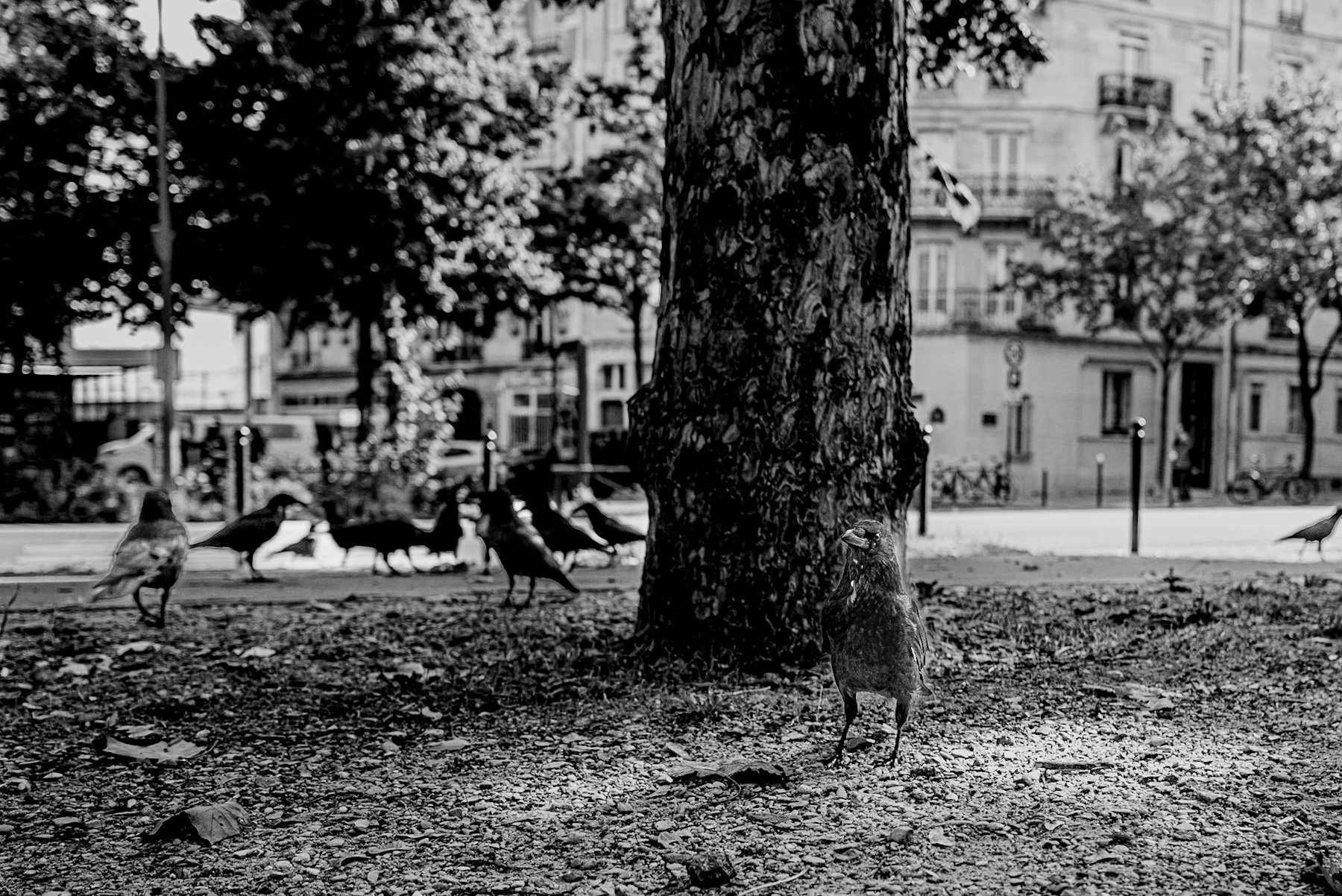
In the stark contrast of black and white, an ordinary urban moment is elevated into a scene rich with texture and narrative. The photograph captures a slice of life in what appears to be a European city, most likely Paris, where the natural world intersects with the built environment. In the foreground, a single crow stands alert, its gaze fixed on the viewer, establishing an immediate and compelling connection. The ground beneath it is a mosaic of gravel and earth, each pebble defined by the sharp, dramatic light.
**The Historical Stage: Architecture and Nature**
The background provides a deep historical context. A classic Haussmann-style building, with its stone facade and wrought-iron balconies, anchors the scene in 19th-century urban planning. These structures are the enduring legacy of Baron Haussmann’s radical transformation of Paris, designed to create wide boulevards, open spaces, and a sense of monumental grandeur. The trees themselves, likely London Planes (*Platanus x acerifolia*), are also part of this history. They were planted extensively during this era to line the new avenues, offering shade and softening the stone cityscape. Today, their gnarled, textured bark, prominently featured in the photograph, stands as a living testament to over a century of the city’s history. They are silent witnesses to the passage of time, from the Belle Époque to the modern day.
**The Ancient Observers: The Symbolism of the Crow**
The choice of subjects—the crows—is equally significant. Corvids have been entwined with human history and mythology for millennia. In many cultures, they are not merely birds but symbols of profound meaning. In Norse mythology, the god Odin was accompanied by two ravens, Huginn (thought) and Muninn (memory), who flew across the world to bring him information. In Celtic lore, they were associated with prophecy and transformation.
Viewed through this lens, the crows in the image are more than just urban wildlife foraging for food. They are the city’s timeless inhabitants, intelligent observers perched on the edge of human activity. The crow in the foreground, separated from its flock, takes on the role of a sentinel or a narrator. Its direct gaze challenges the viewer, suggesting a knowledge and awareness that transcends the fleeting moment captured by the camera. They are a constant presence in a city that is always changing, their dark forms a stark silhouette against the backdrop of history.
**The Photographic Language: A Nod to Street Photography**
The decision to render the image in monochrome is a deliberate artistic choice that connects it to the rich tradition of European street photography. It strips away the distraction of color, forcing the viewer to focus on form, light, shadow, and texture. This aesthetic recalls the work of masters like Henri Cartier-Bresson and Robert Doisneau, who chronicled the poetic, everyday moments of Parisian life. The photograph captures a *decisive moment*—not of human action, but of animal consciousness within the human world. It freezes a narrative, leaving the viewer to ponder the story behind the crow’s confident stance and the quiet drama of the urban park. This single frame encapsulates a dialogue between nature, architecture, and the enduring spirit of the city.
**The Historical Stage: Architecture and Nature**
The background provides a deep historical context. A classic Haussmann-style building, with its stone facade and wrought-iron balconies, anchors the scene in 19th-century urban planning. These structures are the enduring legacy of Baron Haussmann’s radical transformation of Paris, designed to create wide boulevards, open spaces, and a sense of monumental grandeur. The trees themselves, likely London Planes (*Platanus x acerifolia*), are also part of this history. They were planted extensively during this era to line the new avenues, offering shade and softening the stone cityscape. Today, their gnarled, textured bark, prominently featured in the photograph, stands as a living testament to over a century of the city’s history. They are silent witnesses to the passage of time, from the Belle Époque to the modern day.
**The Ancient Observers: The Symbolism of the Crow**
The choice of subjects—the crows—is equally significant. Corvids have been entwined with human history and mythology for millennia. In many cultures, they are not merely birds but symbols of profound meaning. In Norse mythology, the god Odin was accompanied by two ravens, Huginn (thought) and Muninn (memory), who flew across the world to bring him information. In Celtic lore, they were associated with prophecy and transformation.
Viewed through this lens, the crows in the image are more than just urban wildlife foraging for food. They are the city’s timeless inhabitants, intelligent observers perched on the edge of human activity. The crow in the foreground, separated from its flock, takes on the role of a sentinel or a narrator. Its direct gaze challenges the viewer, suggesting a knowledge and awareness that transcends the fleeting moment captured by the camera. They are a constant presence in a city that is always changing, their dark forms a stark silhouette against the backdrop of history.
**The Photographic Language: A Nod to Street Photography**
The decision to render the image in monochrome is a deliberate artistic choice that connects it to the rich tradition of European street photography. It strips away the distraction of color, forcing the viewer to focus on form, light, shadow, and texture. This aesthetic recalls the work of masters like Henri Cartier-Bresson and Robert Doisneau, who chronicled the poetic, everyday moments of Parisian life. The photograph captures a *decisive moment*—not of human action, but of animal consciousness within the human world. It freezes a narrative, leaving the viewer to ponder the story behind the crow’s confident stance and the quiet drama of the urban park. This single frame encapsulates a dialogue between nature, architecture, and the enduring spirit of the city.
Schreibe einen Kommentar