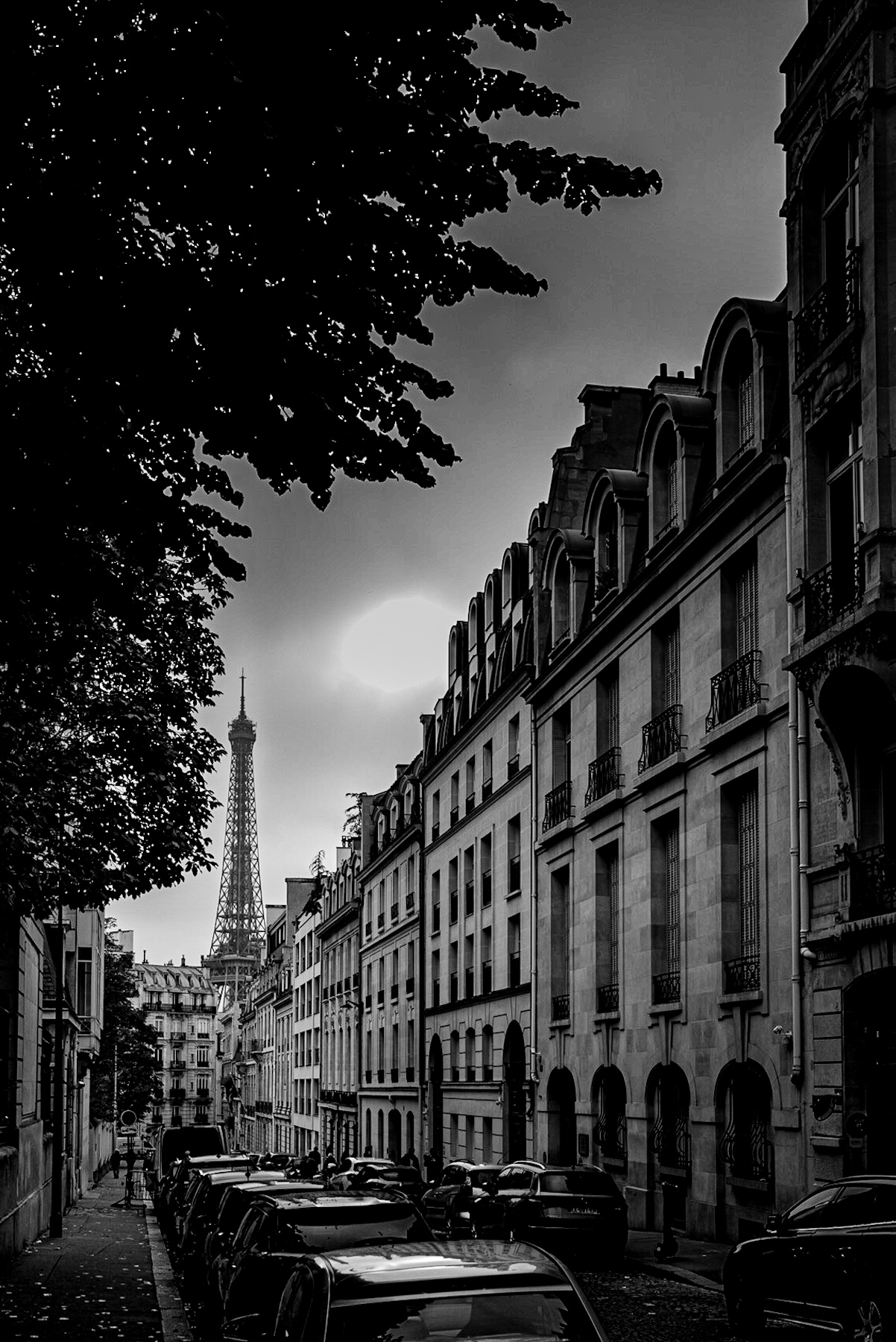
This striking black and white photograph captures more than just a street in Paris; it encapsulates a dialogue between eras. The composition draws the eye down a narrow, cobblestoned lane, flanked by classic Parisian apartment buildings, culminating in a perfectly framed view of the iconic Eiffel Tower.
The monochrome palette strips the scene of temporal distractions, focusing our attention on the interplay of light, shadow, texture, and form. This creates a profound sense of timelessness and nostalgia.
**The Enduring Architecture of Haussmann**
The dominant features of the streetscape are the stately buildings lining the road. Their uniform stone facades, rhythmic placement of windows, and elegant wrought-iron balconies are hallmarks of the architectural style implemented by **Baron Georges-Eugène Haussmann** during the Second French Empire (1852-1870). Under the direction of Napoleon III, Haussmann’s renovation of Paris was one of the most ambitious urban planning projects in history.
The goal was to transform the dark, crowded, and unsanitary medieval streets into a modern capital with wide avenues, parks, and improved infrastructure. The buildings seen here, with their distinct mansard roofs dotted with dormer windows, are a direct result of this transformation. They were designed to create a harmonious and visually cohesive urban environment—a philosophy that continues to define the aesthetic of central Paris to this day. The photograph highlights the grandeur and order of this design, with the strong vertical and horizontal lines creating a powerful sense of structure.
**An Iron Icon Against the Sky**
Peeking through the urban canyon is the **Eiffel Tower**, the undeniable symbol of Paris. When it was erected as the entrance arch for the 1889 Exposition Universelle (World’s Fair), it was a marvel of modern engineering. However, it was met with considerable criticism from Paris’s artistic and literary elite, who viewed the iron lattice structure as a monstrous blight on the city’s elegant skyline.
History, of course, has rendered a different verdict. The tower, initially intended to be a temporary structure, has become a beloved global icon. In this image, it stands not as an industrial intrusion but as an integral part of the cityscape. Its delicate latticework contrasts beautifully with the solid stone of the Haussmannian buildings. Its presence anchors the photograph, providing a famous point of reference within an otherwise anonymous, intimate street scene.
**A Living History**
While the architecture and the tower speak of the 19th century, the line of parked cars firmly places the scene in the contemporary world. This juxtaposition is key to the photograph’s narrative. It shows that Paris is not a static museum but a vibrant, living city where daily life unfolds against a backdrop of immense historical weight.
The modern vehicles on the weathered cobblestones serve as a quiet reminder that history and modernity are not mutually exclusive. They coexist, creating the unique and enduring charm of **Parisian street photography**. This image is a testament to that seamless blend—a single frame capturing the soul of a city shaped by grand visions and lived in by ordinary people.
The monochrome palette strips the scene of temporal distractions, focusing our attention on the interplay of light, shadow, texture, and form. This creates a profound sense of timelessness and nostalgia.
**The Enduring Architecture of Haussmann**
The dominant features of the streetscape are the stately buildings lining the road. Their uniform stone facades, rhythmic placement of windows, and elegant wrought-iron balconies are hallmarks of the architectural style implemented by **Baron Georges-Eugène Haussmann** during the Second French Empire (1852-1870). Under the direction of Napoleon III, Haussmann’s renovation of Paris was one of the most ambitious urban planning projects in history.
The goal was to transform the dark, crowded, and unsanitary medieval streets into a modern capital with wide avenues, parks, and improved infrastructure. The buildings seen here, with their distinct mansard roofs dotted with dormer windows, are a direct result of this transformation. They were designed to create a harmonious and visually cohesive urban environment—a philosophy that continues to define the aesthetic of central Paris to this day. The photograph highlights the grandeur and order of this design, with the strong vertical and horizontal lines creating a powerful sense of structure.
**An Iron Icon Against the Sky**
Peeking through the urban canyon is the **Eiffel Tower**, the undeniable symbol of Paris. When it was erected as the entrance arch for the 1889 Exposition Universelle (World’s Fair), it was a marvel of modern engineering. However, it was met with considerable criticism from Paris’s artistic and literary elite, who viewed the iron lattice structure as a monstrous blight on the city’s elegant skyline.
History, of course, has rendered a different verdict. The tower, initially intended to be a temporary structure, has become a beloved global icon. In this image, it stands not as an industrial intrusion but as an integral part of the cityscape. Its delicate latticework contrasts beautifully with the solid stone of the Haussmannian buildings. Its presence anchors the photograph, providing a famous point of reference within an otherwise anonymous, intimate street scene.
**A Living History**
While the architecture and the tower speak of the 19th century, the line of parked cars firmly places the scene in the contemporary world. This juxtaposition is key to the photograph’s narrative. It shows that Paris is not a static museum but a vibrant, living city where daily life unfolds against a backdrop of immense historical weight.
The modern vehicles on the weathered cobblestones serve as a quiet reminder that history and modernity are not mutually exclusive. They coexist, creating the unique and enduring charm of **Parisian street photography**. This image is a testament to that seamless blend—a single frame capturing the soul of a city shaped by grand visions and lived in by ordinary people.
Schreibe einen Kommentar