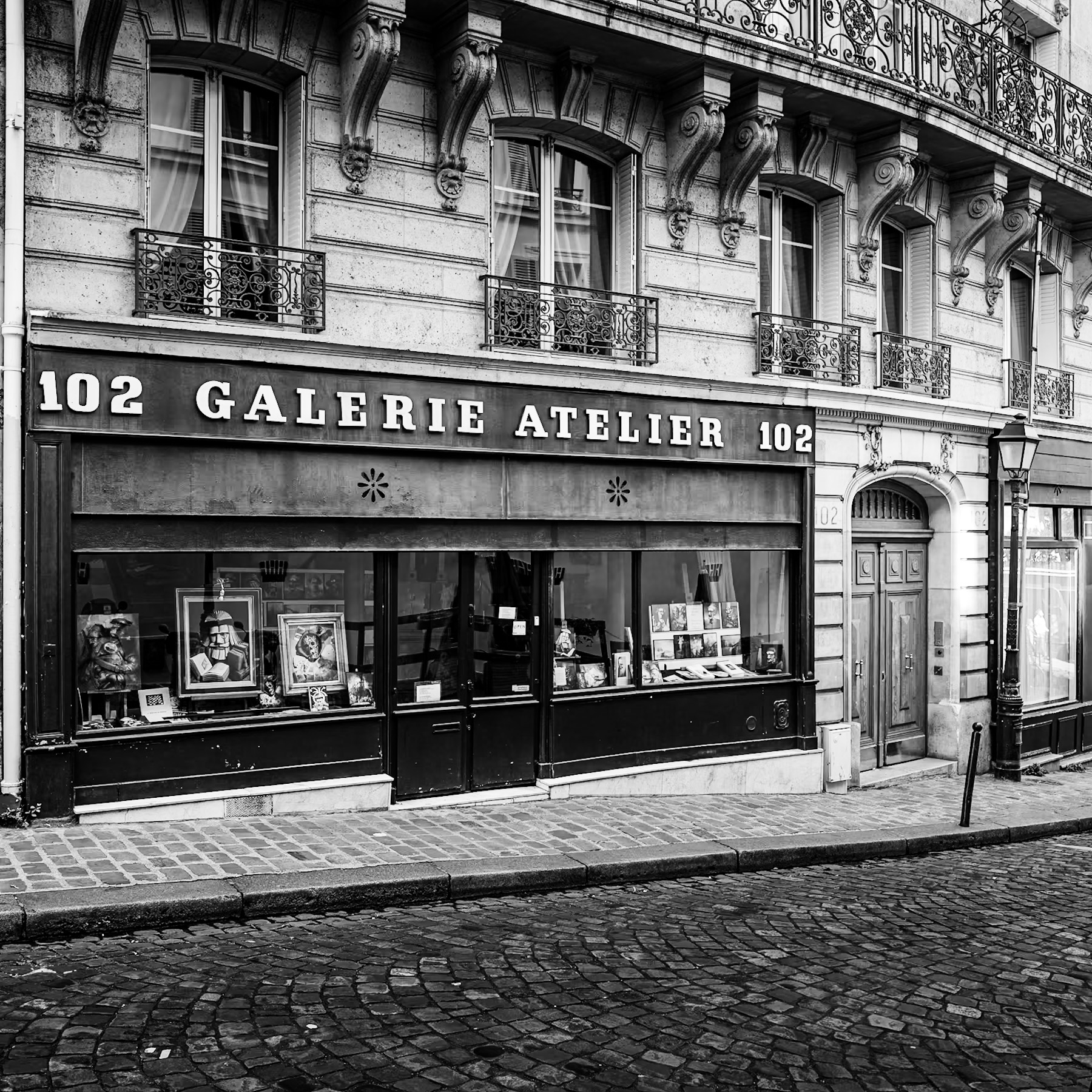
Step into a classic Parisian street scene, where history and contemporary art beautifully converge. The monochromatic lens captures a striking interplay of venerable architecture and modern artistic expression. At its heart is „102 Galerie Atelier 102,“ a welcoming shopfront that declares its dual identity as both an art gallery and an artist’s studio. Through its expansive display windows, you can glimpse a curated collection of framed artworks, prints, and perhaps art books or smaller unique objects, inviting passersby into a world of creativity nestled within this historic urban landscape. The scene is firmly grounded by a classic cobblestone street, its irregular patterns adding texture and a profound sense of enduring history to the foreground.
Haussmannian Grandeur: The Architectural Backbone
The building housing the atelier stands as a prime example of Haussmannian architecture, a style intrinsically linked with the dramatic transformation of Paris during the Second Empire under Baron Haussmann in the mid-19th century. This monumental period saw a radical overhaul of the city, replacing its medieval, labyrinthine streets with wide boulevards and a meticulously standardized aesthetic. Key features clearly evident in the photograph include the robust stone facade, most likely limestone, a material quarried locally and emblematic of Parisian construction. Above the ground-floor shop, the upper stories boast elegant windows adorned with intricate wrought-iron balconies and decorative corbels. These architectural elements, while uniform, are richly detailed, speaking to an era of grand urban planning and a deliberate effort to create the harmonious and imposing cityscape that defines so much of modern Paris.
The Artistic Pulse: Galerie Atelier
The very presence of a „Galerie Atelier“ at street level is deeply rooted in Paris’s unwavering identity as a global art capital. For centuries, the city has been a magnet for artists, thinkers, and innovators, fostering a vibrant ecosystem of creative production and exhibition. From the refined salons of the 18th century to the groundbreaking avant-garde movements of the 19th and 20th centuries – be it Impressionism, Cubism, or Surrealism – Paris has consistently served as a crucible for artistic development. An atelier historically refers to an artist’s studio, the hallowed space where creations come to life, while a galerie serves as a vital showcase, bridging the artist with the admiring public. This establishment at number 102 proudly continues this rich tradition, suggesting an ongoing, dynamic dialogue between artistic creation and public appreciation, a powerful testament to the city’s enduring artistic spirit.
A Journey Through Time: Cobblestones and Black & White
The street itself, paved with cobblestones (or *pavé* in French), offers yet another tangible link to Paris’s storied past. Before the widespread adoption of asphalt, these hand-laid stones formed the vital arteries of European cities. They evoke vivid images of horse-drawn carriages, pivotal historical events, and countless footsteps echoing through generations. Adjacent to the building, a traditional street lamp stands sentinel, its design a poignant reminder of the gas lamps that once illuminated Parisian nights, marking the gradual evolution of urban infrastructure.
The deliberate decision to render this iconic Parisian street scene in black and white photography further amplifies its timeless quality. Without the potential distraction of color, the viewer’s attention is powerfully drawn to the rich textures of the stone, the intricate ironwork, the subtle variations in light and shadow, and the intriguing depth visible within the shop window. This aesthetic choice imbues the image with a profound sense of nostalgia, directly connecting the present moment to the city’s illustrious past and emphasizing the pure architectural forms and historical essence that characterize this iconic setting. It’s a visual narrative of beautiful continuity, where history and art gracefully converge on a single, evocative street corner.
Haussmannian Grandeur: The Architectural Backbone
The building housing the atelier stands as a prime example of Haussmannian architecture, a style intrinsically linked with the dramatic transformation of Paris during the Second Empire under Baron Haussmann in the mid-19th century. This monumental period saw a radical overhaul of the city, replacing its medieval, labyrinthine streets with wide boulevards and a meticulously standardized aesthetic. Key features clearly evident in the photograph include the robust stone facade, most likely limestone, a material quarried locally and emblematic of Parisian construction. Above the ground-floor shop, the upper stories boast elegant windows adorned with intricate wrought-iron balconies and decorative corbels. These architectural elements, while uniform, are richly detailed, speaking to an era of grand urban planning and a deliberate effort to create the harmonious and imposing cityscape that defines so much of modern Paris.
The Artistic Pulse: Galerie Atelier
The very presence of a „Galerie Atelier“ at street level is deeply rooted in Paris’s unwavering identity as a global art capital. For centuries, the city has been a magnet for artists, thinkers, and innovators, fostering a vibrant ecosystem of creative production and exhibition. From the refined salons of the 18th century to the groundbreaking avant-garde movements of the 19th and 20th centuries – be it Impressionism, Cubism, or Surrealism – Paris has consistently served as a crucible for artistic development. An atelier historically refers to an artist’s studio, the hallowed space where creations come to life, while a galerie serves as a vital showcase, bridging the artist with the admiring public. This establishment at number 102 proudly continues this rich tradition, suggesting an ongoing, dynamic dialogue between artistic creation and public appreciation, a powerful testament to the city’s enduring artistic spirit.
A Journey Through Time: Cobblestones and Black & White
The street itself, paved with cobblestones (or *pavé* in French), offers yet another tangible link to Paris’s storied past. Before the widespread adoption of asphalt, these hand-laid stones formed the vital arteries of European cities. They evoke vivid images of horse-drawn carriages, pivotal historical events, and countless footsteps echoing through generations. Adjacent to the building, a traditional street lamp stands sentinel, its design a poignant reminder of the gas lamps that once illuminated Parisian nights, marking the gradual evolution of urban infrastructure.
The deliberate decision to render this iconic Parisian street scene in black and white photography further amplifies its timeless quality. Without the potential distraction of color, the viewer’s attention is powerfully drawn to the rich textures of the stone, the intricate ironwork, the subtle variations in light and shadow, and the intriguing depth visible within the shop window. This aesthetic choice imbues the image with a profound sense of nostalgia, directly connecting the present moment to the city’s illustrious past and emphasizing the pure architectural forms and historical essence that characterize this iconic setting. It’s a visual narrative of beautiful continuity, where history and art gracefully converge on a single, evocative street corner.
Schreibe einen Kommentar