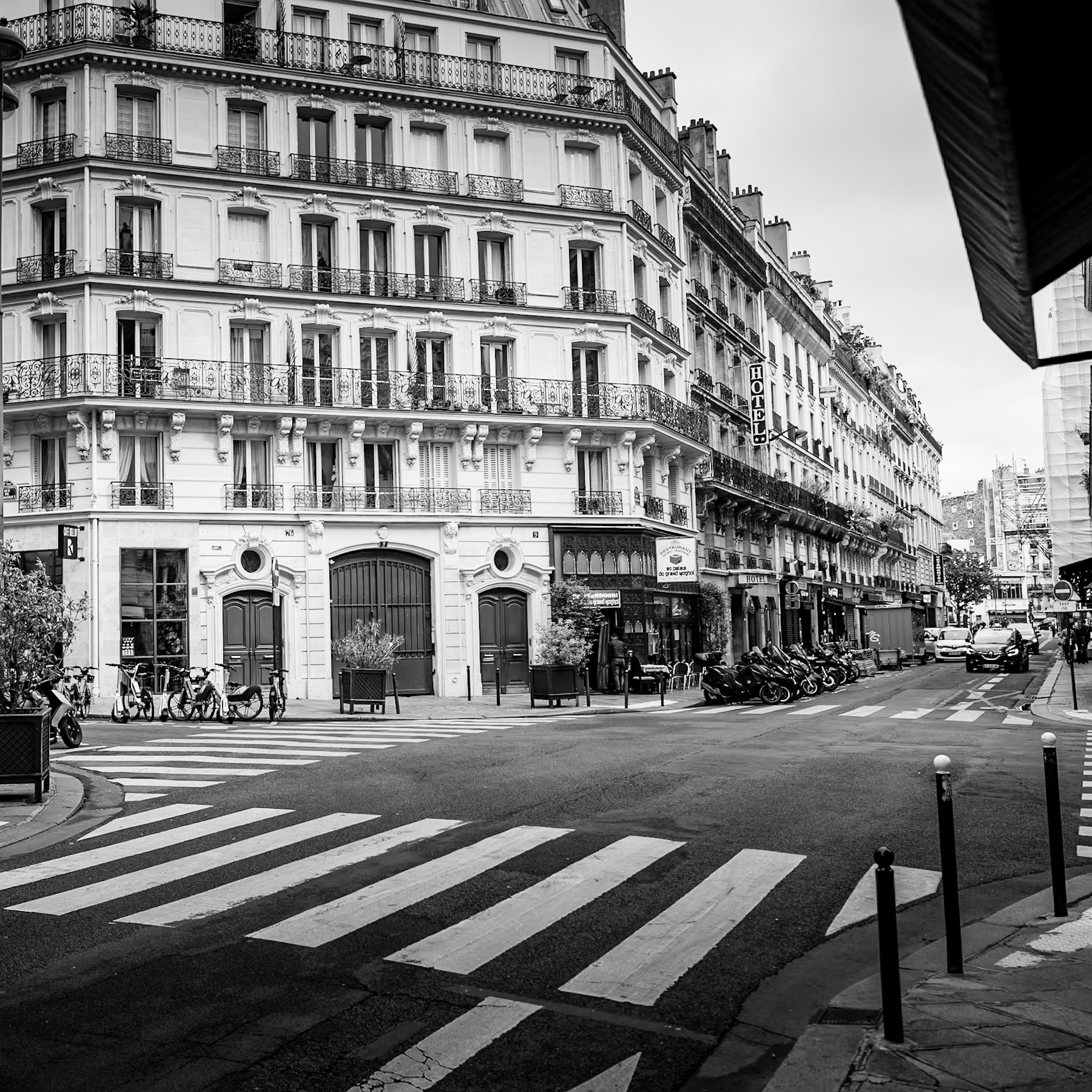
This black and white photograph captures a quintessential Parisian street scene, offering a window into the city’s enduring architectural heritage and its dynamic urban rhythm. The image is dominated by the elegant facades of Haussmannian buildings, a style that defines the visual identity of Paris and was a result of a grand urban renewal project undertaken in the mid-19th century under Baron Haussmann.
The buildings featured showcase the characteristic features of this architectural period: tall, multi-story structures with cream-colored stone facades, mansard roofs adorned with dormer windows, and ornate wrought-iron balconies that punctuate each level. The repeating rhythm of windows and balconies creates a sense of order and grandeur. The detailed stonework, the decorative cornices, and the classic proportions speak to a period of deliberate urban planning aimed at transforming Paris into a modern, aesthetically pleasing metropolis.
The street itself is a busy thoroughfare, indicated by the presence of a pedestrian crossing (zebra crossing) prominently in the foreground, a universal symbol of urban mobility. The black and white treatment of the photograph lends a timeless quality, making it difficult to pinpoint an exact era, yet the presence of parked motorcycles and scooters, alongside a car, suggests a more contemporary setting within this historic context. The contrast between the old-world architecture and the modern modes of transport highlights the continuous evolution of Parisian life.
The ground floors of the buildings reveal glimpses of commercial activity. A sign indicating „HOTEL“ vertically placed on one facade clearly points to the hospitality sector, a cornerstone of Paris’s global appeal. Below, shopfronts with large windows suggest cafes, restaurants, or boutiques, hinting at the vibrant street-level life that characterises the city. The presence of outdoor seating further reinforces this impression of a lively, engaging urban environment.
The composition of the photograph, with its strong lines and geometric shapes, draws the viewer’s eye along the street, creating a sense of depth and perspective. The interplay of light and shadow, particularly on the building facades and the road surface, adds a dramatic and artistic dimension to the scene. The overcast sky, common in Paris, contributes to the soft, diffused light, which further accentuates the architectural details without harsh contrasts.
Historically, the Haussmannian renovations aimed to improve sanitation, facilitate movement, and create a more unified and imposing urban landscape. The wide boulevards, uniform building heights, and elegant facades were intended to instill a sense of order and prestige. While these changes were met with some resistance at the time, they have become an indelible part of Paris’s character and are a major draw for tourists and residents alike. This photograph, therefore, is not just an image of a street; it is a visual narrative of Parisian history, urban development, and the enduring allure of its iconic architecture.
Keywords: Paris, Haussmannian Architecture, Parisian Streets, Urban Landscape, Architecture Photography, Black and White Photography, Travel Photography, Historical Paris, Cityscape, European Cities, Hotel, Restaurant, Pedestrian Crossing.
The buildings featured showcase the characteristic features of this architectural period: tall, multi-story structures with cream-colored stone facades, mansard roofs adorned with dormer windows, and ornate wrought-iron balconies that punctuate each level. The repeating rhythm of windows and balconies creates a sense of order and grandeur. The detailed stonework, the decorative cornices, and the classic proportions speak to a period of deliberate urban planning aimed at transforming Paris into a modern, aesthetically pleasing metropolis.
The street itself is a busy thoroughfare, indicated by the presence of a pedestrian crossing (zebra crossing) prominently in the foreground, a universal symbol of urban mobility. The black and white treatment of the photograph lends a timeless quality, making it difficult to pinpoint an exact era, yet the presence of parked motorcycles and scooters, alongside a car, suggests a more contemporary setting within this historic context. The contrast between the old-world architecture and the modern modes of transport highlights the continuous evolution of Parisian life.
The ground floors of the buildings reveal glimpses of commercial activity. A sign indicating „HOTEL“ vertically placed on one facade clearly points to the hospitality sector, a cornerstone of Paris’s global appeal. Below, shopfronts with large windows suggest cafes, restaurants, or boutiques, hinting at the vibrant street-level life that characterises the city. The presence of outdoor seating further reinforces this impression of a lively, engaging urban environment.
The composition of the photograph, with its strong lines and geometric shapes, draws the viewer’s eye along the street, creating a sense of depth and perspective. The interplay of light and shadow, particularly on the building facades and the road surface, adds a dramatic and artistic dimension to the scene. The overcast sky, common in Paris, contributes to the soft, diffused light, which further accentuates the architectural details without harsh contrasts.
Historically, the Haussmannian renovations aimed to improve sanitation, facilitate movement, and create a more unified and imposing urban landscape. The wide boulevards, uniform building heights, and elegant facades were intended to instill a sense of order and prestige. While these changes were met with some resistance at the time, they have become an indelible part of Paris’s character and are a major draw for tourists and residents alike. This photograph, therefore, is not just an image of a street; it is a visual narrative of Parisian history, urban development, and the enduring allure of its iconic architecture.
Keywords: Paris, Haussmannian Architecture, Parisian Streets, Urban Landscape, Architecture Photography, Black and White Photography, Travel Photography, Historical Paris, Cityscape, European Cities, Hotel, Restaurant, Pedestrian Crossing.
Schreibe einen Kommentar