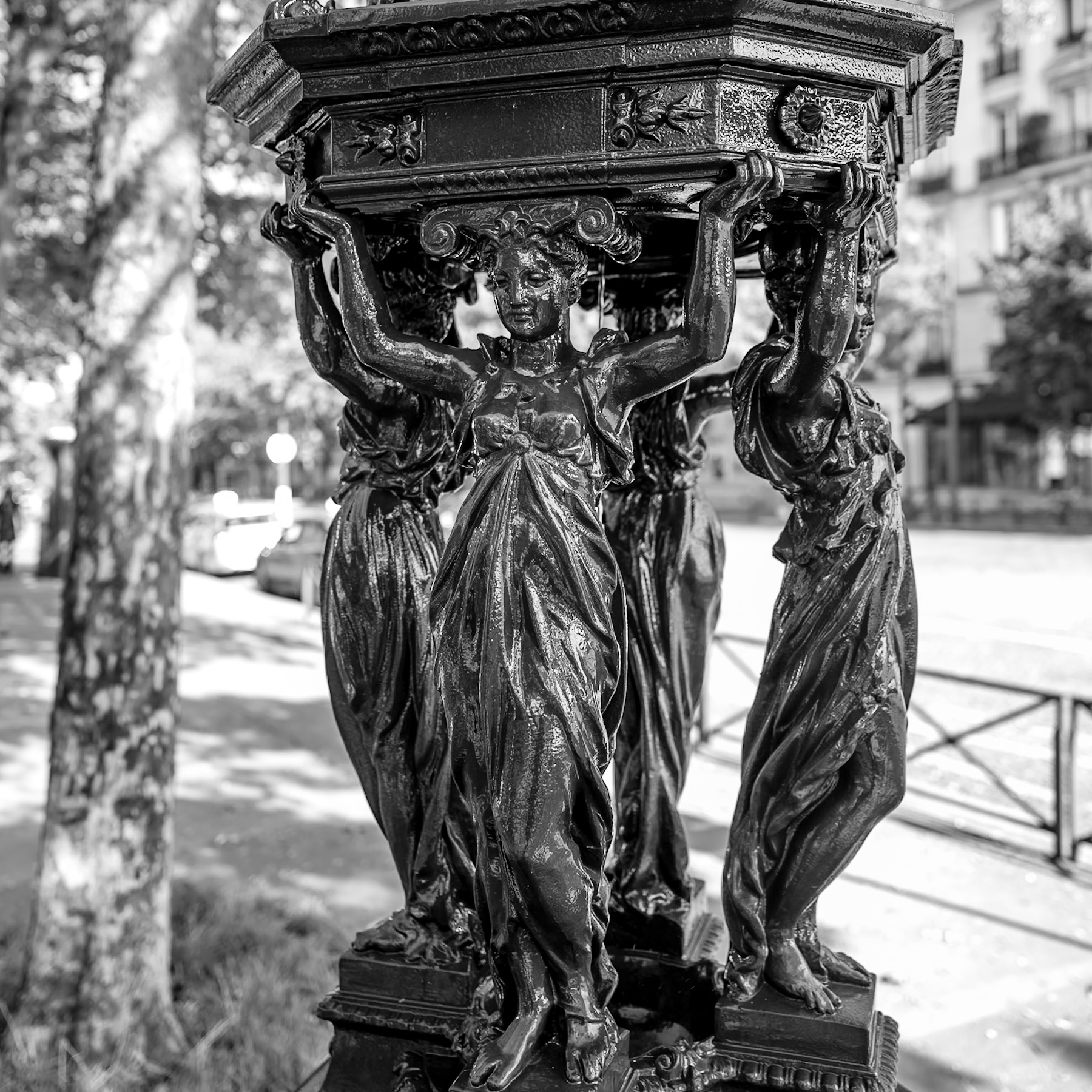
The image presents a detailed, black and white view of the upper section of a Wallace Fountain, a distinctive piece of public art and infrastructure found across Paris and beyond. The focus is on the intricate sculptural work, specifically the four female figures, known as „Caryatids,“ that support a decorative, ornate basin above. These figures, rendered in dark, weathered metal, are depicted with flowing drapery that emphasizes their musculature and graceful posture. Their arms are raised, straining to hold the heavy structure, a powerful visual metaphor for endurance and support.
The artistic style of these figures reflects the Second Empire aesthetic prevalent in Paris during the mid-19th century. This era, under Napoleon III, saw a significant urban renewal and beautification program, spearheaded by Baron Haussmann. The grand boulevards, uniform architecture, and proliferation of public art, including fountains, were hallmarks of this period. The Wallace Fountains, conceived by Sir Richard Wallace and designed by Charles-Auguste Lebourg, were not merely decorative elements; they served a vital social function.
Commissioned in the 1870s, these fountains were intended to provide free access to drinking water for the public, a progressive initiative in a rapidly expanding city. They were placed strategically throughout Paris, becoming an integral part of the urban landscape and a symbol of philanthropic endeavor. The choice of classical figures, such as the Caryatids, to adorn the fountains was deliberate. In classical architecture, Caryatids are female figures used as supporting columns. Their inclusion here evokes a sense of timelessness and enduring strength, aligning with the fountain’s purpose of providing a stable and essential resource.
The craftsmanship evident in the sculpture is remarkable. The detailed rendering of the faces, the folds of the fabric, and the muscular tension in the figures suggest a high level of skill from the foundry workers. The patina of the metal, captured in this monochrome image, adds a sense of age and gravitas, hinting at the many years these figures have stood in their public spaces, silently witnessing the ebb and flow of city life.
The background of the photograph, slightly blurred, suggests an urban setting with trees lining a walkway and buildings in the distance. This context reinforces the fountain’s role as a piece of public art integrated into the daily life of the city. The contrast between the enduring, classical forms of the sculpture and the transient nature of the urban environment behind it is striking.
The Wallace Fountains, and the sculptures that adorn them, represent a fascinating intersection of art, engineering, and social reform. They are enduring monuments to a period of significant change in Paris, offering not only a practical service but also a visual reminder of classical ideals and the artistic sensibilities of the 19th century. Each figure, diligently holding its load, becomes a silent testament to the historical context from which it emerged and the enduring value of public art.
Keywords: Wallace Fountain, Paris, Public Art, Sculpture, Caryatids, 19th Century Art, Second Empire, Baron Haussmann, Charles-Auguste Lebourg, Sir Richard Wallace, Urban Infrastructure, Philanthropy, Classical Sculpture, Architectural Detail, Black and White Photography.
The artistic style of these figures reflects the Second Empire aesthetic prevalent in Paris during the mid-19th century. This era, under Napoleon III, saw a significant urban renewal and beautification program, spearheaded by Baron Haussmann. The grand boulevards, uniform architecture, and proliferation of public art, including fountains, were hallmarks of this period. The Wallace Fountains, conceived by Sir Richard Wallace and designed by Charles-Auguste Lebourg, were not merely decorative elements; they served a vital social function.
Commissioned in the 1870s, these fountains were intended to provide free access to drinking water for the public, a progressive initiative in a rapidly expanding city. They were placed strategically throughout Paris, becoming an integral part of the urban landscape and a symbol of philanthropic endeavor. The choice of classical figures, such as the Caryatids, to adorn the fountains was deliberate. In classical architecture, Caryatids are female figures used as supporting columns. Their inclusion here evokes a sense of timelessness and enduring strength, aligning with the fountain’s purpose of providing a stable and essential resource.
The craftsmanship evident in the sculpture is remarkable. The detailed rendering of the faces, the folds of the fabric, and the muscular tension in the figures suggest a high level of skill from the foundry workers. The patina of the metal, captured in this monochrome image, adds a sense of age and gravitas, hinting at the many years these figures have stood in their public spaces, silently witnessing the ebb and flow of city life.
The background of the photograph, slightly blurred, suggests an urban setting with trees lining a walkway and buildings in the distance. This context reinforces the fountain’s role as a piece of public art integrated into the daily life of the city. The contrast between the enduring, classical forms of the sculpture and the transient nature of the urban environment behind it is striking.
The Wallace Fountains, and the sculptures that adorn them, represent a fascinating intersection of art, engineering, and social reform. They are enduring monuments to a period of significant change in Paris, offering not only a practical service but also a visual reminder of classical ideals and the artistic sensibilities of the 19th century. Each figure, diligently holding its load, becomes a silent testament to the historical context from which it emerged and the enduring value of public art.
Keywords: Wallace Fountain, Paris, Public Art, Sculpture, Caryatids, 19th Century Art, Second Empire, Baron Haussmann, Charles-Auguste Lebourg, Sir Richard Wallace, Urban Infrastructure, Philanthropy, Classical Sculpture, Architectural Detail, Black and White Photography.
Schreibe einen Kommentar