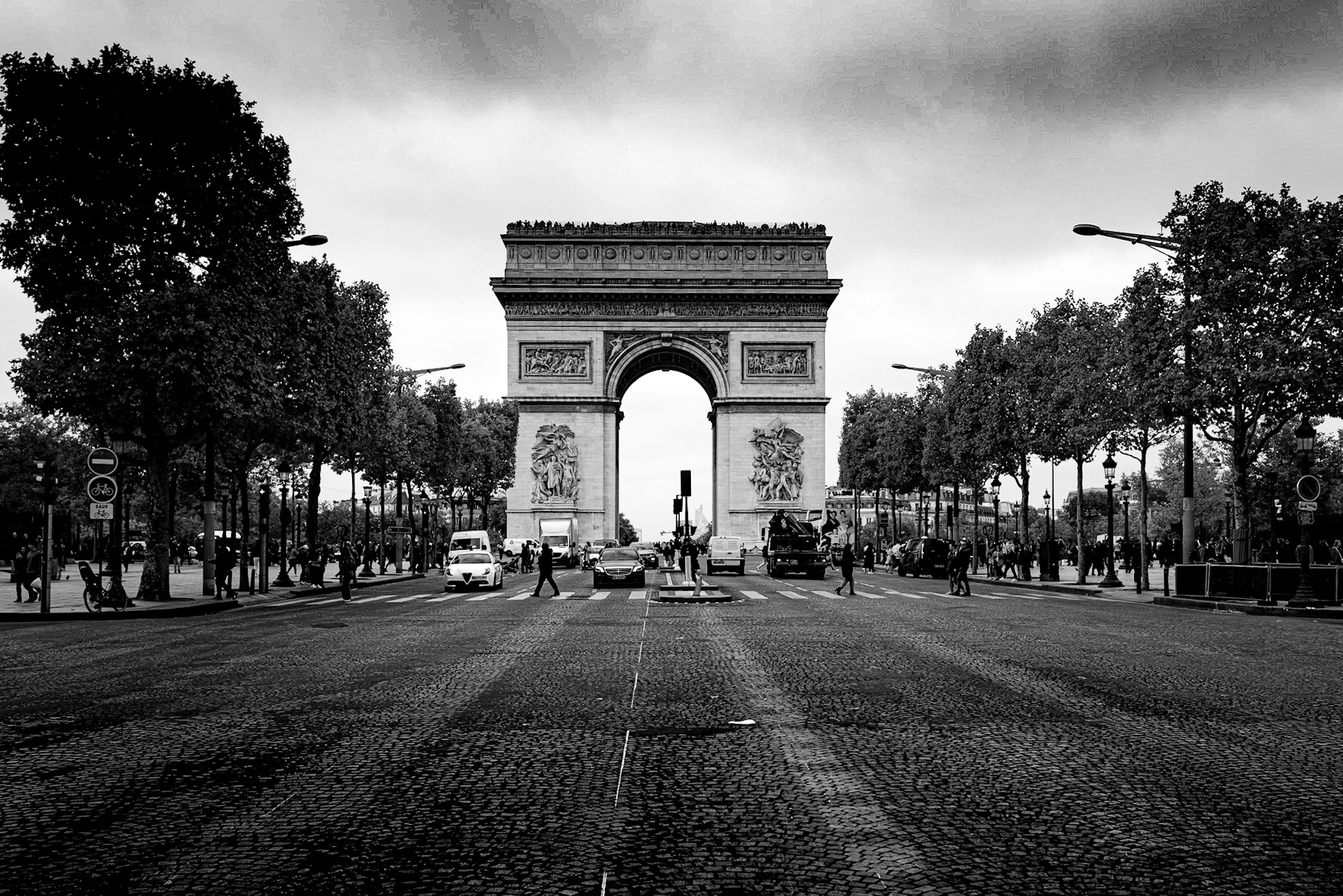
The photograph presents a classic, almost poetic view of the Arc de Triomphe in Paris, a monument that resonates deeply with French national identity and historical achievements. The black and white treatment imbues the scene with a sense of timelessness, drawing attention to the impressive architecture and the enduring story it tells.
**Architectural Majesty and Historical Roots**
The magnificent Arc de Triomphe commands the center of the image. Its grand design, detailed with elaborate sculptures and bas-reliefs, stands as a testament to the artistic and engineering skills of its era. Napoleon Bonaparte’s vision for this arch, commissioned in 1806 following his victory at Austerlitz, was to honor the French military. Its construction, however, was a lengthy endeavor, spanning thirty years and reflecting the turbulent political landscape of France during that period.
This architectural marvel is a prime example of Neoclassical style, drawing inspiration from the triumphal arches of ancient Rome. Particularly striking are the four principal sculptural ensembles at the base: François Rude’s „The Departure of the Volunteers of 1792“ (often referred to as La Marseillaise), Jean-Pierre Cortot’s „The Triumph of 1810,“ and Antoine Étex’s „The Resistance of 1814“ and „The Peace of 1815.“ These allegorical representations capture pivotal moments in French history, from the revolutionary spirit to eras of both conflict and accord.
**A Bustling Parisian Crossroads**
Despite the absence of color, the area surrounding the Arc pulses with life. The cobblestone streets, a hallmark of historic European cities, lead the eye towards the monument, their surfaces mirroring the subdued tones of the sky and adding tactile depth to the foreground. Modern Parisian life is evident in the presence of automobiles, including a notable white sedan navigating the intersection, and what appears to be a truck. Pedestrians, their forms softened by motion, can be seen crossing the streets, underscoring the dynamic energy of this renowned location.
The avenues are graced with trees, their branches reaching skyward, introducing a natural counterpoint to the urban environment. Tall, slender lampposts stand as sentinels, hinting at the transition from day to night. The overall composition, with the Arc as its undisputed focal point and the converging avenues drawing the viewer in, creates a profound sense of perspective and awe.
**Enduring Significance**
The Arc de Triomphe transcends its status as a mere historical artifact; it serves as a central stage for national celebrations, military processions, and solemn commemorative events. It is also the resting place of the Unknown Soldier from World War I, whose tomb is marked by the eternal flame, a perpetual symbol of sacrifice and remembrance. Situated at the western end of the iconic Champs-Élysées, it is undeniably one of Paris’s most paramount landmarks.
This photograph, with its stark yet evocative imagery, invites contemplation on the rich tapestry of history, art, and human experience that converges at this extraordinary site. It encapsulates the enduring spirit of Paris and the monumental achievements it commemorates, solidifying the Arc de Triomphe’s position as a timeless emblem of French heritage.
**Keywords:** Arc de Triomphe, Paris, France, Monument, History, Architecture, Napoleon Bonaparte, Champs-Élysées, Triumphal Arch, Neoclassical, French History, Landmark, Parisian Icon.
**Architectural Majesty and Historical Roots**
The magnificent Arc de Triomphe commands the center of the image. Its grand design, detailed with elaborate sculptures and bas-reliefs, stands as a testament to the artistic and engineering skills of its era. Napoleon Bonaparte’s vision for this arch, commissioned in 1806 following his victory at Austerlitz, was to honor the French military. Its construction, however, was a lengthy endeavor, spanning thirty years and reflecting the turbulent political landscape of France during that period.
This architectural marvel is a prime example of Neoclassical style, drawing inspiration from the triumphal arches of ancient Rome. Particularly striking are the four principal sculptural ensembles at the base: François Rude’s „The Departure of the Volunteers of 1792“ (often referred to as La Marseillaise), Jean-Pierre Cortot’s „The Triumph of 1810,“ and Antoine Étex’s „The Resistance of 1814“ and „The Peace of 1815.“ These allegorical representations capture pivotal moments in French history, from the revolutionary spirit to eras of both conflict and accord.
**A Bustling Parisian Crossroads**
Despite the absence of color, the area surrounding the Arc pulses with life. The cobblestone streets, a hallmark of historic European cities, lead the eye towards the monument, their surfaces mirroring the subdued tones of the sky and adding tactile depth to the foreground. Modern Parisian life is evident in the presence of automobiles, including a notable white sedan navigating the intersection, and what appears to be a truck. Pedestrians, their forms softened by motion, can be seen crossing the streets, underscoring the dynamic energy of this renowned location.
The avenues are graced with trees, their branches reaching skyward, introducing a natural counterpoint to the urban environment. Tall, slender lampposts stand as sentinels, hinting at the transition from day to night. The overall composition, with the Arc as its undisputed focal point and the converging avenues drawing the viewer in, creates a profound sense of perspective and awe.
**Enduring Significance**
The Arc de Triomphe transcends its status as a mere historical artifact; it serves as a central stage for national celebrations, military processions, and solemn commemorative events. It is also the resting place of the Unknown Soldier from World War I, whose tomb is marked by the eternal flame, a perpetual symbol of sacrifice and remembrance. Situated at the western end of the iconic Champs-Élysées, it is undeniably one of Paris’s most paramount landmarks.
This photograph, with its stark yet evocative imagery, invites contemplation on the rich tapestry of history, art, and human experience that converges at this extraordinary site. It encapsulates the enduring spirit of Paris and the monumental achievements it commemorates, solidifying the Arc de Triomphe’s position as a timeless emblem of French heritage.
**Keywords:** Arc de Triomphe, Paris, France, Monument, History, Architecture, Napoleon Bonaparte, Champs-Élysées, Triumphal Arch, Neoclassical, French History, Landmark, Parisian Icon.
Schreibe einen Kommentar