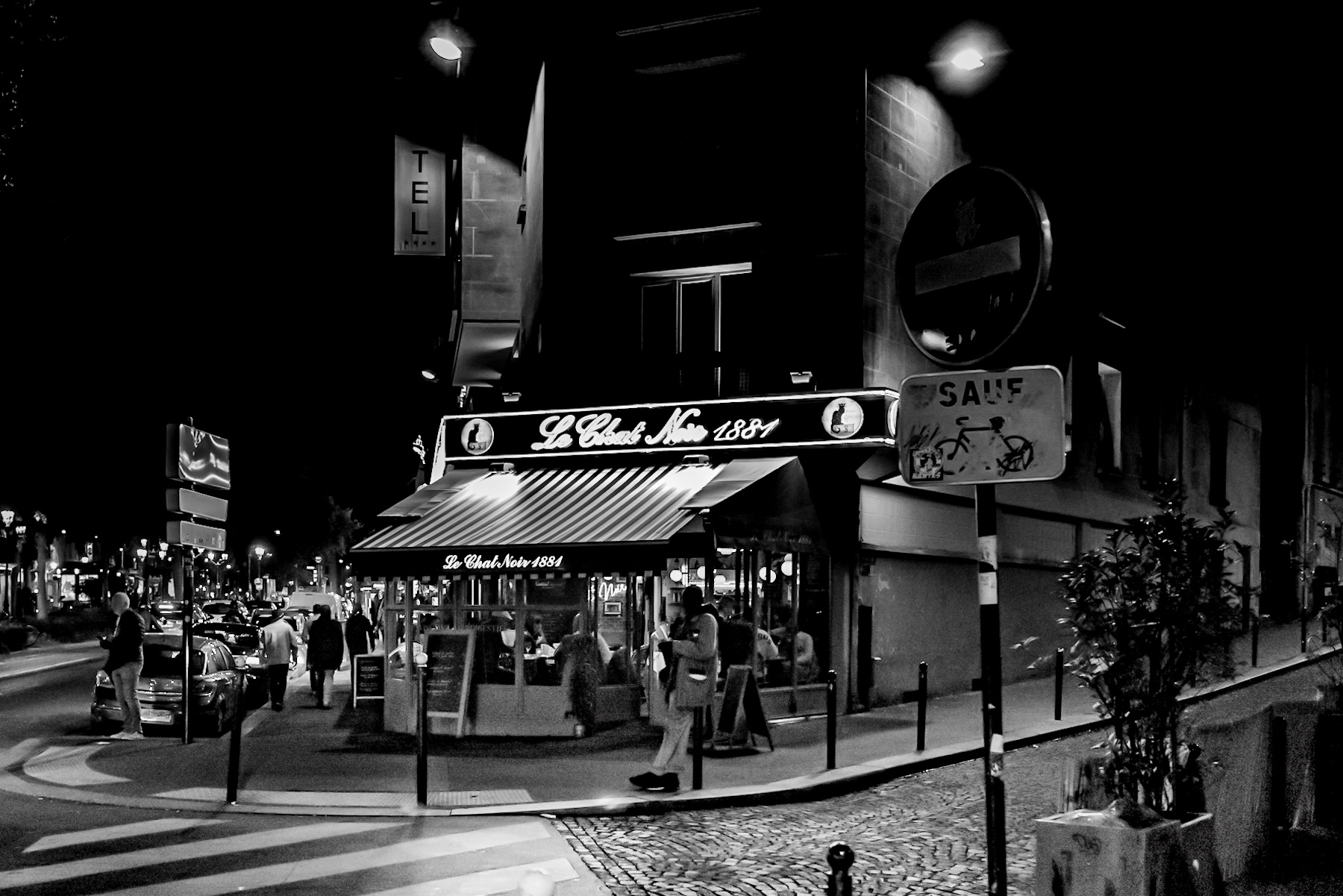
The black and white photograph captures a quintessential Parisian street scene at night. The iconic signage of „Le Chat Noir 1881“ illuminates the facade of a building, its neon glow casting a distinct atmosphere onto the cobblestone street. The awning of the establishment, striped and classic, hints at a bygone era. Figures, silhouetted against the ambient light, move along the sidewalk and cross the street, their presence adding a sense of life and movement to the nocturnal tableau. Cars are parked along the curb, their forms softened by the darkness and the limited light sources.
The sign itself, with its stylized lettering and the emblem of a black cat, immediately evokes the rich history associated with this name. „Le Chat Noir“ was not merely a cabaret; it was a legendary venue in Montmartre, Paris, during the late 19th and early 20th centuries. Founded in 1881 by Rodolphe Salis, it became the epicenter of bohemian culture, attracting artists, writers, poets, musicians, and intellectuals. It was a place where avant-garde ideas flourished, and where the spirit of artistic rebellion found a vibrant expression.
The date „1881“ prominently displayed on the sign is a direct reference to the founding year of the original cabaret. This historic establishment was known for its cabaret performances, shadow plays, and its role in fostering the careers of many prominent figures of the Belle Époque. It was a hub for the Absinthe-fueled artistic scene, a stark contrast to the more formal salons of the time. The black cat, the establishment’s symbol, became an internationally recognized icon of Montmartre’s artistic and bohemian identity.
The photograph, while depicting a contemporary scene, carries the weight of this historical legacy. The enduring presence of the name „Le Chat Noir“ suggests a continuation, perhaps a modern incarnation or a respectful homage to the original. The street signs, including one that appears to indicate „SAUF“ (except), and the traffic signals, are typical of urban environments, grounding the image in the present. Yet, the overall mood, enhanced by the monochrome palette and the dramatic interplay of light and shadow, lends a timeless quality to the scene.
The visual elements of the photograph – the architecture, the street lighting, the style of the signage, and the very act of people gathering at night – all contribute to a sense of urban narrative. It invites the viewer to contemplate the layers of history embedded within the Parisian landscape. The modern streetscape coexists with the echoes of a vibrant past, a past characterized by artistic innovation, social commentary, and a unique brand of Parisian charm. This image serves as a visual bridge, connecting the present-day experience of the city with its storied bohemian heritage, embodied by the enduring legend of Le Chat Noir.
The sign itself, with its stylized lettering and the emblem of a black cat, immediately evokes the rich history associated with this name. „Le Chat Noir“ was not merely a cabaret; it was a legendary venue in Montmartre, Paris, during the late 19th and early 20th centuries. Founded in 1881 by Rodolphe Salis, it became the epicenter of bohemian culture, attracting artists, writers, poets, musicians, and intellectuals. It was a place where avant-garde ideas flourished, and where the spirit of artistic rebellion found a vibrant expression.
The date „1881“ prominently displayed on the sign is a direct reference to the founding year of the original cabaret. This historic establishment was known for its cabaret performances, shadow plays, and its role in fostering the careers of many prominent figures of the Belle Époque. It was a hub for the Absinthe-fueled artistic scene, a stark contrast to the more formal salons of the time. The black cat, the establishment’s symbol, became an internationally recognized icon of Montmartre’s artistic and bohemian identity.
The photograph, while depicting a contemporary scene, carries the weight of this historical legacy. The enduring presence of the name „Le Chat Noir“ suggests a continuation, perhaps a modern incarnation or a respectful homage to the original. The street signs, including one that appears to indicate „SAUF“ (except), and the traffic signals, are typical of urban environments, grounding the image in the present. Yet, the overall mood, enhanced by the monochrome palette and the dramatic interplay of light and shadow, lends a timeless quality to the scene.
The visual elements of the photograph – the architecture, the street lighting, the style of the signage, and the very act of people gathering at night – all contribute to a sense of urban narrative. It invites the viewer to contemplate the layers of history embedded within the Parisian landscape. The modern streetscape coexists with the echoes of a vibrant past, a past characterized by artistic innovation, social commentary, and a unique brand of Parisian charm. This image serves as a visual bridge, connecting the present-day experience of the city with its storied bohemian heritage, embodied by the enduring legend of Le Chat Noir.
Schreibe einen Kommentar