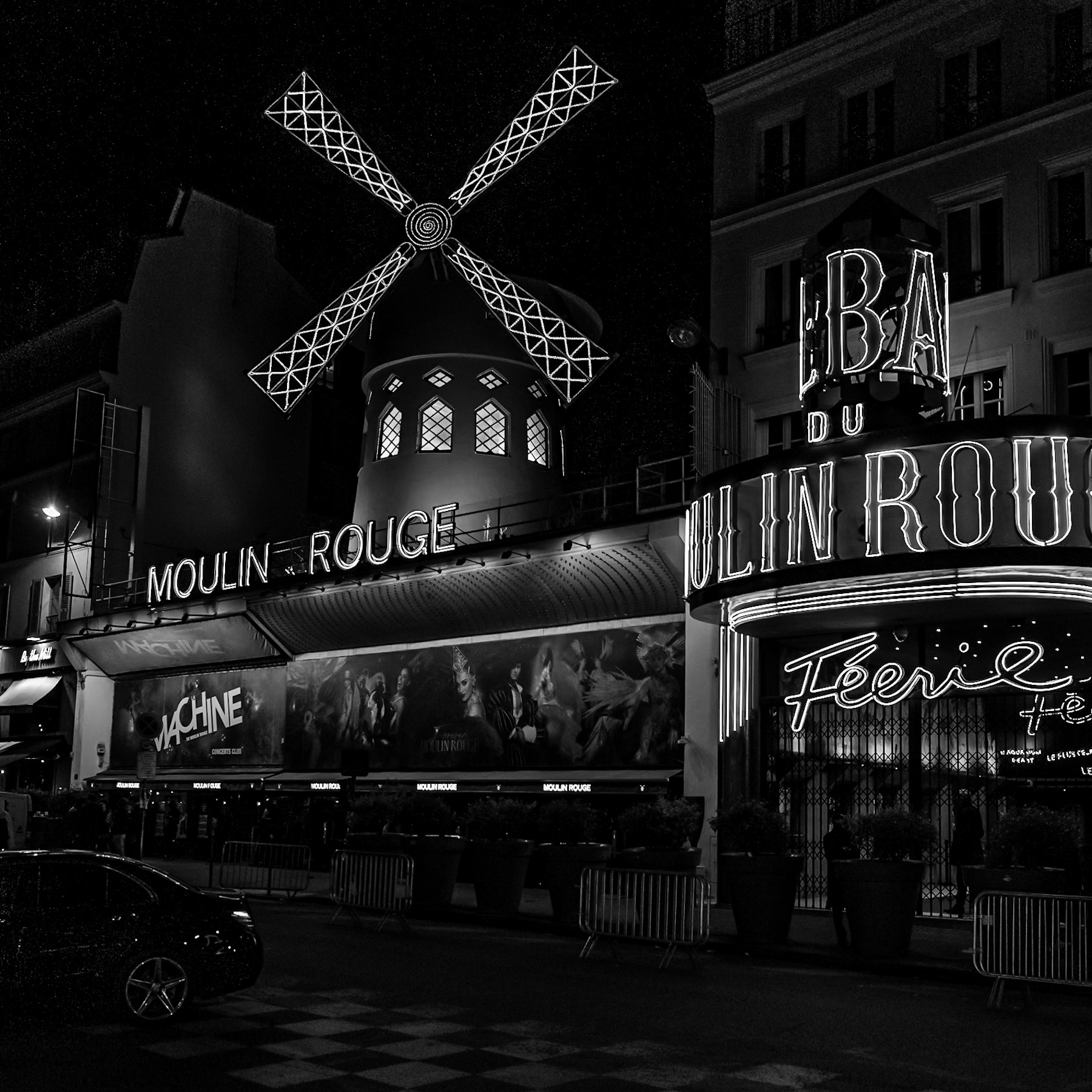
The image captures the unmistakable silhouette of the Moulin Rouge in Paris at night. Bathed in the stark contrast of black and white, the iconic windmill, a symbol of the establishment, stands prominently against the dark sky, its lattice structure illuminated by a web of lights. Below, the theatre’s facade glows with the vibrant neon signs that have become synonymous with this legendary venue. The prominent „MOULIN ROUGE“ lettering, rendered in bright, stylized script, immediately identifies the location. Further along, the neon sign for „Féerie,“ the name of their current show, adds another layer of luminous allure.
The Moulin Rouge, located in the Pigalle district at the foot of Montmartre, first opened its doors in 1889. It quickly became a hub for entertainment, attracting artists, writers, and the Parisian elite. The era was one of burgeoning artistic movements and a liberalization of social norms, and the Moulin Rouge was at the forefront of this cultural shift. It was a place where the avant-garde could flourish, and its cabaret performances, featuring can-can dancers and elaborate shows, became legendary.
Historically, the Moulin Rouge was not just a place for entertainment; it was an inspiration. Artists like Henri de Toulouse-Lautrec immortalized the venue and its performers in his iconic posters and paintings, capturing the energy, the glamour, and the sometimes gritty reality of Parisian nightlife during the Belle Époque. The image, with its dramatic lighting and bold signage, evokes this historical connection, suggesting the enduring legacy of the Moulin Rouge as a place of spectacle and artistic expression.
The scene depicted in the photograph is a testament to the venue’s continued prominence. The „MACHINE CONCERTS CLUB“ sign hints at the diverse range of entertainment offered, while the large posters on the facade showcase the visual artistry that is central to the Moulin Rouge experience. The presence of potted plants and elegant fencing suggests a well-maintained and inviting entrance, preparing visitors for the magic that lies within. Even in monochrome, the interplay of light and shadow creates a sense of depth and intrigue, inviting the viewer to imagine the sounds, sights, and atmosphere of this Parisian landmark. The Moulin Rouge remains a powerful symbol of Paris, a place where history, art, and entertainment converge to create unforgettable experiences.
The Moulin Rouge, located in the Pigalle district at the foot of Montmartre, first opened its doors in 1889. It quickly became a hub for entertainment, attracting artists, writers, and the Parisian elite. The era was one of burgeoning artistic movements and a liberalization of social norms, and the Moulin Rouge was at the forefront of this cultural shift. It was a place where the avant-garde could flourish, and its cabaret performances, featuring can-can dancers and elaborate shows, became legendary.
Historically, the Moulin Rouge was not just a place for entertainment; it was an inspiration. Artists like Henri de Toulouse-Lautrec immortalized the venue and its performers in his iconic posters and paintings, capturing the energy, the glamour, and the sometimes gritty reality of Parisian nightlife during the Belle Époque. The image, with its dramatic lighting and bold signage, evokes this historical connection, suggesting the enduring legacy of the Moulin Rouge as a place of spectacle and artistic expression.
The scene depicted in the photograph is a testament to the venue’s continued prominence. The „MACHINE CONCERTS CLUB“ sign hints at the diverse range of entertainment offered, while the large posters on the facade showcase the visual artistry that is central to the Moulin Rouge experience. The presence of potted plants and elegant fencing suggests a well-maintained and inviting entrance, preparing visitors for the magic that lies within. Even in monochrome, the interplay of light and shadow creates a sense of depth and intrigue, inviting the viewer to imagine the sounds, sights, and atmosphere of this Parisian landmark. The Moulin Rouge remains a powerful symbol of Paris, a place where history, art, and entertainment converge to create unforgettable experiences.
Schreibe einen Kommentar