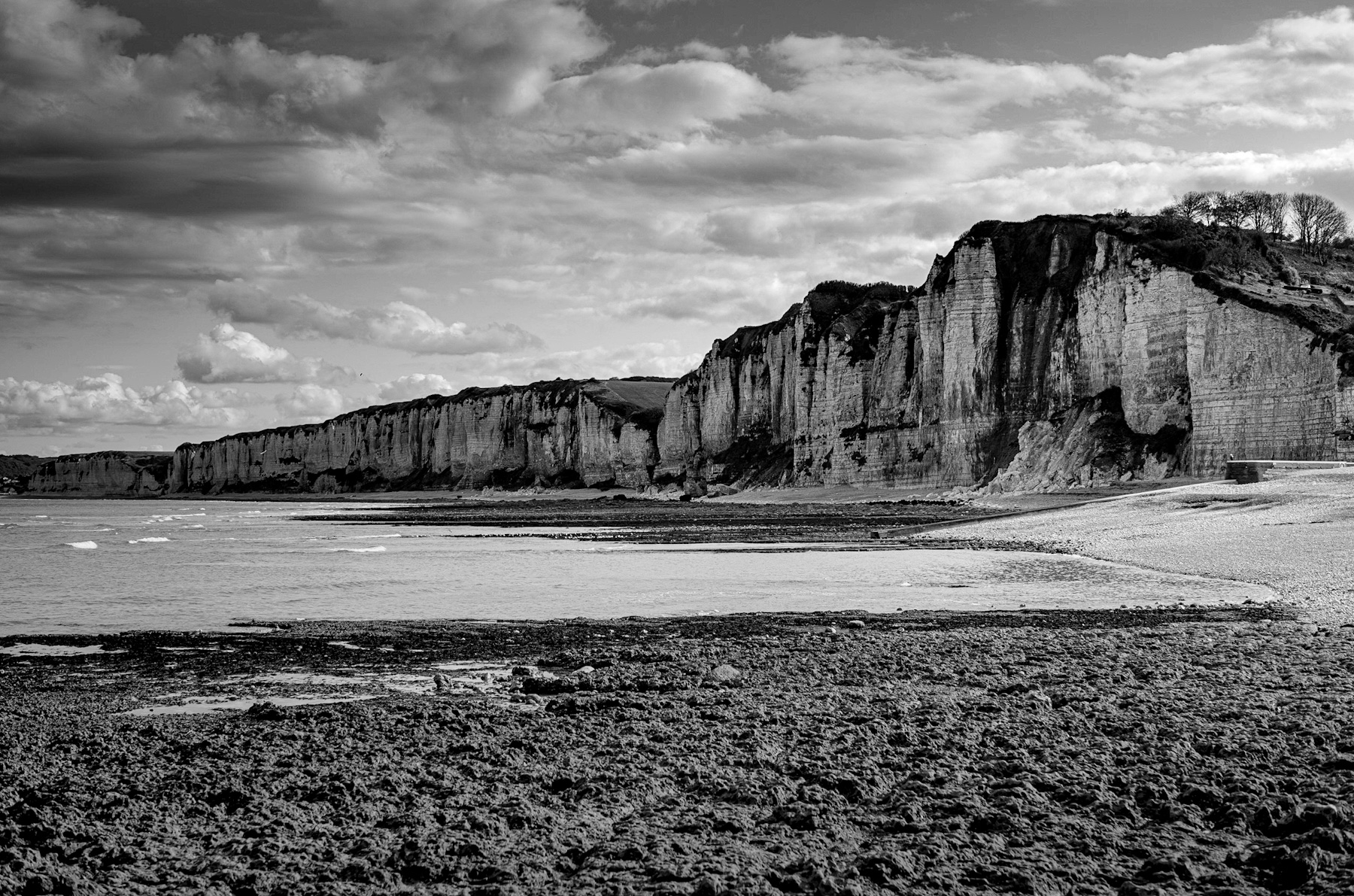
The photograph presents a commanding vista of a rugged coastline, rendered in stark black and white. Towering chalk cliffs dominate the horizon, their vertical striations and eroded surfaces testifying to millennia of geological processes. Below, a wide expanse of beach transitions from a pebbled shoreline to a darker, perhaps seaweed-strewn or rocky foreground, meeting the gently undulating waves of the sea. The sky, filled with an array of clouds ranging from luminous whites to deep greys, adds dramatic depth, emphasizing the raw power and timelessness of this natural spectacle.
### The Majestic Coastal Landscape
This captured scene exemplifies the dramatic beauty characteristic of the **Normandy coast**, particularly the **Pays de Caux** region in France. The monumental **chalk cliffs**, formed over millions of years from ancient marine sediments, rise abruptly from the English Channel, presenting a formidable natural barrier. Their pale, almost luminous rock faces contrast sharply with the dark vegetation clinging to their summits and slopes, creating a compelling visual texture. The expansive beach below, exposed at low tide, reveals a diverse terrain of shingle, sand, and darker, rugged areas, hinting at a rich intertidal ecosystem. The rhythmic ebb and flow of the ocean at the water’s edge suggests a perpetual interaction between land and sea, a constant sculptor of this enduring landscape. The monochromatic palette accentuates the textures and forms, stripping away the distraction of color to reveal the fundamental grandeur of the environment. This **coastal landscape** serves as a powerful subject for **black and white photography**, highlighting its dramatic contours and geological features.
### Echoes of History: The Atlantic Wall
Beyond its natural splendor, this specific type of **French cliffs** landscape carries profound historical weight, particularly concerning **World War II**. The **Normandy cliffs** were integral to the **Atlantic Wall**, Hitler’s extensive system of coastal defenses built to repel an Allied invasion. While the main D-Day landings occurred further west on the sandy beaches, the entire Normandy coastline, including these formidable chalk cliffs, was heavily fortified. German forces established observation posts, gun emplacements, and bunkers both atop and within these cliffs, leveraging the natural topography for strategic advantage. The sheer verticality and challenging terrain made these sections of the coast formidable obstacles, influencing Allied invasion strategies. The landscape depicted here, therefore, stands as a silent testament to a pivotal period in global history, its **geological formations** having once been a critical component in the defense and eventual liberation of Europe.
### A Landscape of Resilience and Reflection
The enduring presence of these **European cliffs** also resonates with broader themes of resilience and natural power. Geologically, they represent millions of years of earth’s history, continuously shaped by wind and waves. Historically, they have witnessed countless human endeavors, from ancient maritime trade routes to modern-day tourism. Artists like Claude Monet found endless inspiration in the shifting light and dramatic forms of these very cliffs, immortalizing them in their works. Today, this coastal stretch remains a significant draw for visitors seeking both natural beauty and a connection to profound historical narratives. The black and white rendering of the photograph underscores this sense of timelessness, inviting contemplation on the natural world’s enduring presence amidst the transient narratives of human history.
This image of the **Normandy coastline** is more than a scenic view; it is a layered narrative. It speaks of deep geological time, the relentless forces of nature, and the indelible marks of **WWII history**. The dramatic cliffs, the expansive beach, and the atmospheric sky combine to create a powerful visual statement, reminding observers of the profound stories embedded within our world’s landscapes.
### The Majestic Coastal Landscape
This captured scene exemplifies the dramatic beauty characteristic of the **Normandy coast**, particularly the **Pays de Caux** region in France. The monumental **chalk cliffs**, formed over millions of years from ancient marine sediments, rise abruptly from the English Channel, presenting a formidable natural barrier. Their pale, almost luminous rock faces contrast sharply with the dark vegetation clinging to their summits and slopes, creating a compelling visual texture. The expansive beach below, exposed at low tide, reveals a diverse terrain of shingle, sand, and darker, rugged areas, hinting at a rich intertidal ecosystem. The rhythmic ebb and flow of the ocean at the water’s edge suggests a perpetual interaction between land and sea, a constant sculptor of this enduring landscape. The monochromatic palette accentuates the textures and forms, stripping away the distraction of color to reveal the fundamental grandeur of the environment. This **coastal landscape** serves as a powerful subject for **black and white photography**, highlighting its dramatic contours and geological features.
### Echoes of History: The Atlantic Wall
Beyond its natural splendor, this specific type of **French cliffs** landscape carries profound historical weight, particularly concerning **World War II**. The **Normandy cliffs** were integral to the **Atlantic Wall**, Hitler’s extensive system of coastal defenses built to repel an Allied invasion. While the main D-Day landings occurred further west on the sandy beaches, the entire Normandy coastline, including these formidable chalk cliffs, was heavily fortified. German forces established observation posts, gun emplacements, and bunkers both atop and within these cliffs, leveraging the natural topography for strategic advantage. The sheer verticality and challenging terrain made these sections of the coast formidable obstacles, influencing Allied invasion strategies. The landscape depicted here, therefore, stands as a silent testament to a pivotal period in global history, its **geological formations** having once been a critical component in the defense and eventual liberation of Europe.
### A Landscape of Resilience and Reflection
The enduring presence of these **European cliffs** also resonates with broader themes of resilience and natural power. Geologically, they represent millions of years of earth’s history, continuously shaped by wind and waves. Historically, they have witnessed countless human endeavors, from ancient maritime trade routes to modern-day tourism. Artists like Claude Monet found endless inspiration in the shifting light and dramatic forms of these very cliffs, immortalizing them in their works. Today, this coastal stretch remains a significant draw for visitors seeking both natural beauty and a connection to profound historical narratives. The black and white rendering of the photograph underscores this sense of timelessness, inviting contemplation on the natural world’s enduring presence amidst the transient narratives of human history.
This image of the **Normandy coastline** is more than a scenic view; it is a layered narrative. It speaks of deep geological time, the relentless forces of nature, and the indelible marks of **WWII history**. The dramatic cliffs, the expansive beach, and the atmospheric sky combine to create a powerful visual statement, reminding observers of the profound stories embedded within our world’s landscapes.
Schreibe einen Kommentar