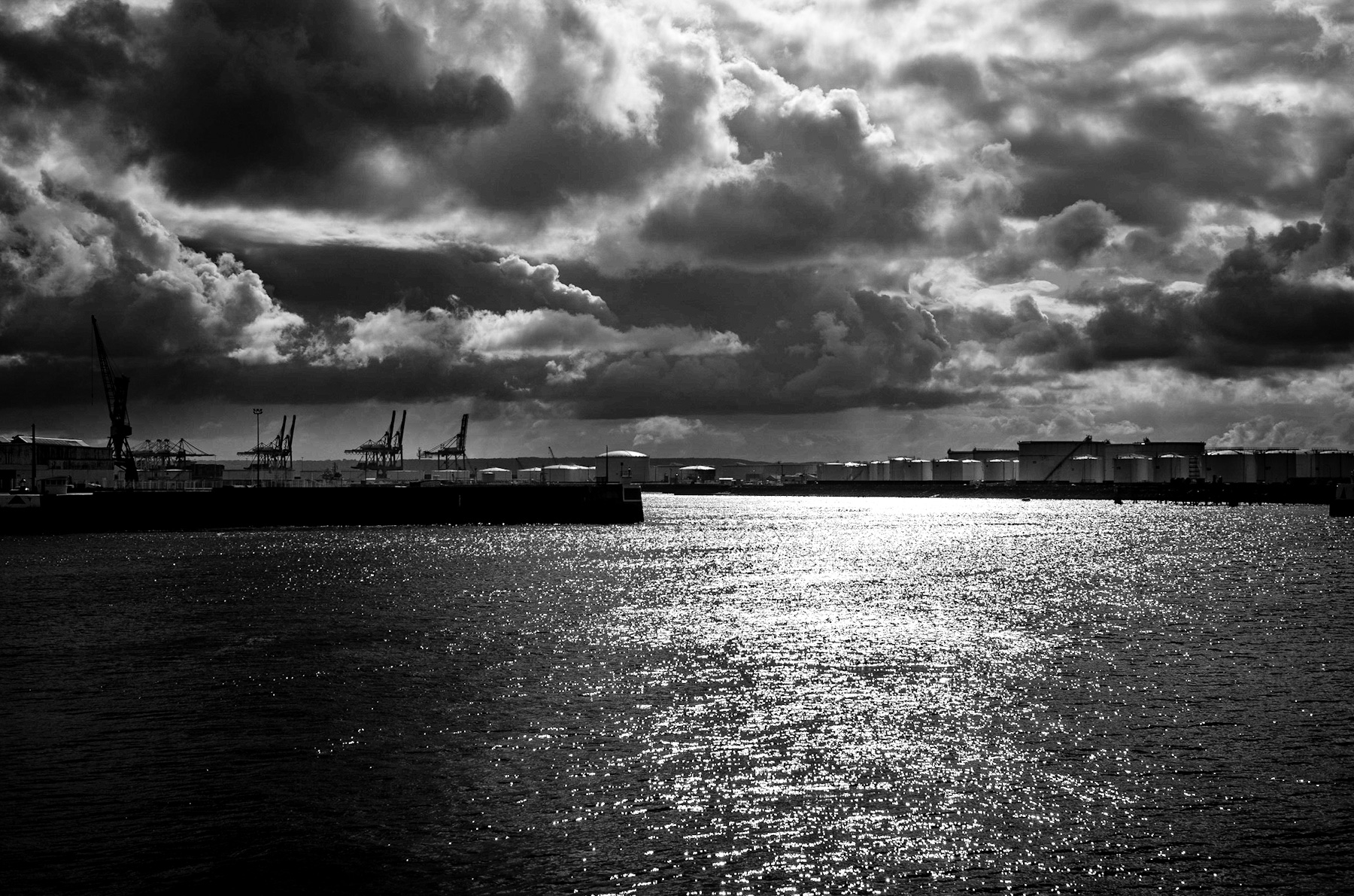
The presented image captures a compelling black and white vista of an industrial waterfront, a scene where human engineering meets the elemental forces of nature. The composition, characterized by stark contrasts and deep shadows under a dramatic sky, highlights the functional architecture of global commerce and energy infrastructure.
A Landscape of Logistics and Power
In the foreground, the water shimmers with reflected light, creating a textured surface that draws the eye across the expanse. Beyond this, the dark silhouette of the landmass reveals a complex array of industrial elements. To the left, a series of towering container cranes stand as sentinels of global trade. These colossal machines, integral to modern port operations, symbolize the efficiency and scale of contemporary shipping industry and maritime logistics. Their presence underscores the continuous movement of goods that underpins the global supply chain, connecting producers and consumers across continents.
Further along the horizon, to the right, an extensive line of large cylindrical storage tanks dominates the landscape. These structures are typically associated with the energy sector, housing vast quantities of crude oil, refined petroleum products, or various chemicals. Their sheer number and uniform appearance speak to the immense capacity required to manage the world’s energy demands and industrial processes. This segment of the image directly represents the critical role of industrial infrastructure in sustaining modern economies.
Historical Echoes in Modern Industry
The historical context of such port infrastructure is deeply rooted in the evolution of trade and industry. From ancient trading posts to the bustling harbors of the Industrial Revolution, ports have consistently served as vital gateways for the exchange of goods and resources. The advent of steam power in the 18th and 19th centuries, followed by the internal combustion engine, revolutionized transport and trade, significantly increasing the volume and speed of maritime commerce.
The cranes in the image are direct descendants of earlier, less sophisticated lifting mechanisms, evolving to handle the standardized shipping containers that transformed global freight in the mid-20th century. This innovation drastically reduced loading and unloading times, making international trade more efficient and affordable. Similarly, the storage tanks represent a legacy stretching back to the early days of the oil industry in the late 19th century, when the need for bulk storage of petroleum became paramount. These facilities have continuously adapted to meet the escalating requirements of a fossil-fuel-dependent world, playing a pivotal role in economic development and geopolitical dynamics.
The Monochrome Perspective
The choice of black and white photography for this scene lends a timeless quality, stripping away the distractions of color to emphasize form, texture, and light. This aesthetic choice highlights the raw, unadorned power of these industrial elements and their stark contrast against the natural environment. The dramatic, cloudy sky further enhances this effect, creating a sense of scale and perhaps a subtle commentary on the powerful, sometimes overwhelming, impact of human industry on the landscape. It encourages contemplation of the enduring nature of these industrial hubs, linking their present function to their long and impactful maritime history.
This image serves as a visual narrative of the intricate relationship between human innovation, resource management, and the relentless pulse of global commerce, reflecting centuries of industrial landscape development.
A Landscape of Logistics and Power
In the foreground, the water shimmers with reflected light, creating a textured surface that draws the eye across the expanse. Beyond this, the dark silhouette of the landmass reveals a complex array of industrial elements. To the left, a series of towering container cranes stand as sentinels of global trade. These colossal machines, integral to modern port operations, symbolize the efficiency and scale of contemporary shipping industry and maritime logistics. Their presence underscores the continuous movement of goods that underpins the global supply chain, connecting producers and consumers across continents.
Further along the horizon, to the right, an extensive line of large cylindrical storage tanks dominates the landscape. These structures are typically associated with the energy sector, housing vast quantities of crude oil, refined petroleum products, or various chemicals. Their sheer number and uniform appearance speak to the immense capacity required to manage the world’s energy demands and industrial processes. This segment of the image directly represents the critical role of industrial infrastructure in sustaining modern economies.
Historical Echoes in Modern Industry
The historical context of such port infrastructure is deeply rooted in the evolution of trade and industry. From ancient trading posts to the bustling harbors of the Industrial Revolution, ports have consistently served as vital gateways for the exchange of goods and resources. The advent of steam power in the 18th and 19th centuries, followed by the internal combustion engine, revolutionized transport and trade, significantly increasing the volume and speed of maritime commerce.
The cranes in the image are direct descendants of earlier, less sophisticated lifting mechanisms, evolving to handle the standardized shipping containers that transformed global freight in the mid-20th century. This innovation drastically reduced loading and unloading times, making international trade more efficient and affordable. Similarly, the storage tanks represent a legacy stretching back to the early days of the oil industry in the late 19th century, when the need for bulk storage of petroleum became paramount. These facilities have continuously adapted to meet the escalating requirements of a fossil-fuel-dependent world, playing a pivotal role in economic development and geopolitical dynamics.
The Monochrome Perspective
The choice of black and white photography for this scene lends a timeless quality, stripping away the distractions of color to emphasize form, texture, and light. This aesthetic choice highlights the raw, unadorned power of these industrial elements and their stark contrast against the natural environment. The dramatic, cloudy sky further enhances this effect, creating a sense of scale and perhaps a subtle commentary on the powerful, sometimes overwhelming, impact of human industry on the landscape. It encourages contemplation of the enduring nature of these industrial hubs, linking their present function to their long and impactful maritime history.
This image serves as a visual narrative of the intricate relationship between human innovation, resource management, and the relentless pulse of global commerce, reflecting centuries of industrial landscape development.
Schreibe einen Kommentar