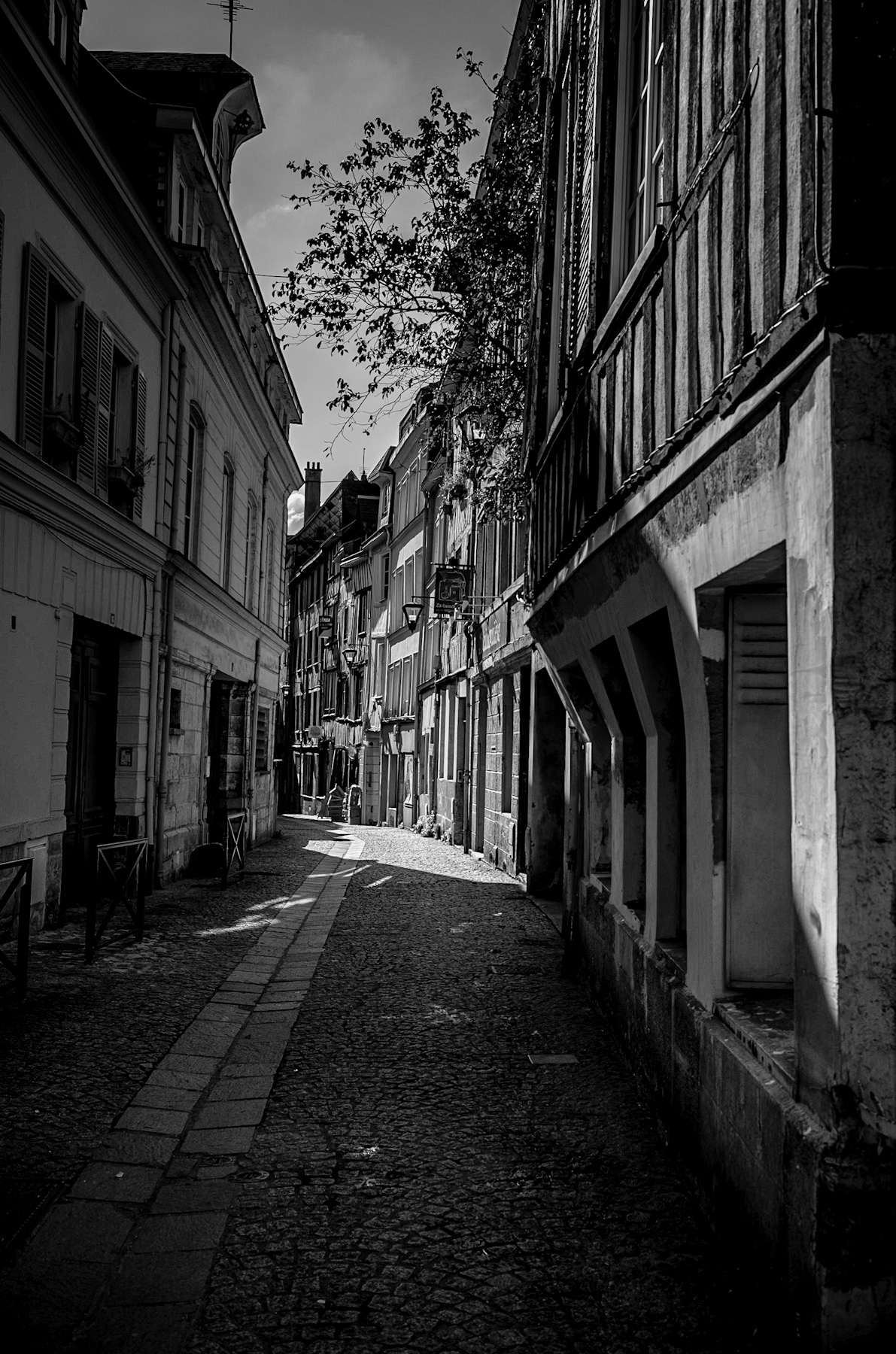
The monochromatic lens reveals a captivating view of a narrow, historic street, a testament to centuries of urban development. This image, rendered in stark black and white, accentuates the textures and contrasts of an ancient European thoroughfare, inviting contemplation of its rich past and timeless appeal.
Architectural Layers of History
The street is flanked by buildings that narrate a complex architectural history. On the right, structures display distinct half-timbered (or *colombage*) construction on their upper floors, characterized by exposed wooden beams forming geometric patterns. This building style, prevalent across much of medieval and early modern Europe, particularly in regions like France, Germany, and England, speaks to an era when timber was a primary building material. The ground floor on this side appears to be constructed from stone or rendered masonry, featuring deep-set, arched window openings that suggest an original commercial or workshop function, common in densely populated urban centres. These elements collectively transport the viewer to a period predating modern construction techniques, highlighting craftsmanship and local materials.
In contrast, the buildings on the left side, while equally historic, present a more classical or perhaps later architectural style. Their facades are smoother, likely rendered or stone-faced, with evenly spaced windows often adorned with traditional shutters. This juxtaposition of architectural styles within a single street segment illustrates the organic evolution of urban landscapes, where buildings from different epochs stand side-by-side, each adding a layer to the city’s visual narrative. The tall, steep roofs and visible chimneys further underscore their age and traditional European design.
The Cobblestone Path and Urban Fabric
The very foundation of the street, a meticulously laid cobblestone path, is a central feature of the image. A smoother, rectangular strip of paving runs down the centre, possibly a later addition for easier passage or drainage, contrasting with the irregular, ancient cobblestones on either side. These narrow, winding streets are characteristic of medieval town planning, designed for pedestrians, horse-drawn carts, and local commerce rather than modern vehicular traffic. Their compact nature fostered close-knit communities and facilitated defence within city walls.
The dramatic interplay of light and shadow, enhanced by the black and white rendition, sculpts the scene. A bright strip of sunlight cuts across the cobblestones, illuminating textures and guiding the eye deeper into the alley, while deep shadows cling to the building facades, creating a sense of depth and mystery. A lone tree branch, reaching towards the sky, introduces a natural element, softening the rigid lines of the architecture and hinting at the enduring presence of nature amidst urban density.
Enduring Urban Heritage
This photograph transcends a mere depiction of a street; it captures the essence of urban heritage. It speaks to the resilience of historical structures and the enduring human desire for community spaces. Such alleys were once bustling with daily life – merchants, artisans, and residents going about their routines. Today, they serve as tangible links to the past, offering a quiet escape from the modern world and a profound appreciation for architectural preservation. The image is a powerful reminder of how historical urban environments continue to shape our understanding of culture, design, and the passage of time.
This street, with its intricate details and profound historical echoes, represents countless similar lanes across Europe, each a silent guardian of stories from bygone eras, inviting explorers and dreamers to walk through history.
Architectural Layers of History
The street is flanked by buildings that narrate a complex architectural history. On the right, structures display distinct half-timbered (or *colombage*) construction on their upper floors, characterized by exposed wooden beams forming geometric patterns. This building style, prevalent across much of medieval and early modern Europe, particularly in regions like France, Germany, and England, speaks to an era when timber was a primary building material. The ground floor on this side appears to be constructed from stone or rendered masonry, featuring deep-set, arched window openings that suggest an original commercial or workshop function, common in densely populated urban centres. These elements collectively transport the viewer to a period predating modern construction techniques, highlighting craftsmanship and local materials.
In contrast, the buildings on the left side, while equally historic, present a more classical or perhaps later architectural style. Their facades are smoother, likely rendered or stone-faced, with evenly spaced windows often adorned with traditional shutters. This juxtaposition of architectural styles within a single street segment illustrates the organic evolution of urban landscapes, where buildings from different epochs stand side-by-side, each adding a layer to the city’s visual narrative. The tall, steep roofs and visible chimneys further underscore their age and traditional European design.
The Cobblestone Path and Urban Fabric
The very foundation of the street, a meticulously laid cobblestone path, is a central feature of the image. A smoother, rectangular strip of paving runs down the centre, possibly a later addition for easier passage or drainage, contrasting with the irregular, ancient cobblestones on either side. These narrow, winding streets are characteristic of medieval town planning, designed for pedestrians, horse-drawn carts, and local commerce rather than modern vehicular traffic. Their compact nature fostered close-knit communities and facilitated defence within city walls.
The dramatic interplay of light and shadow, enhanced by the black and white rendition, sculpts the scene. A bright strip of sunlight cuts across the cobblestones, illuminating textures and guiding the eye deeper into the alley, while deep shadows cling to the building facades, creating a sense of depth and mystery. A lone tree branch, reaching towards the sky, introduces a natural element, softening the rigid lines of the architecture and hinting at the enduring presence of nature amidst urban density.
Enduring Urban Heritage
This photograph transcends a mere depiction of a street; it captures the essence of urban heritage. It speaks to the resilience of historical structures and the enduring human desire for community spaces. Such alleys were once bustling with daily life – merchants, artisans, and residents going about their routines. Today, they serve as tangible links to the past, offering a quiet escape from the modern world and a profound appreciation for architectural preservation. The image is a powerful reminder of how historical urban environments continue to shape our understanding of culture, design, and the passage of time.
This street, with its intricate details and profound historical echoes, represents countless similar lanes across Europe, each a silent guardian of stories from bygone eras, inviting explorers and dreamers to walk through history.
Schreibe einen Kommentar