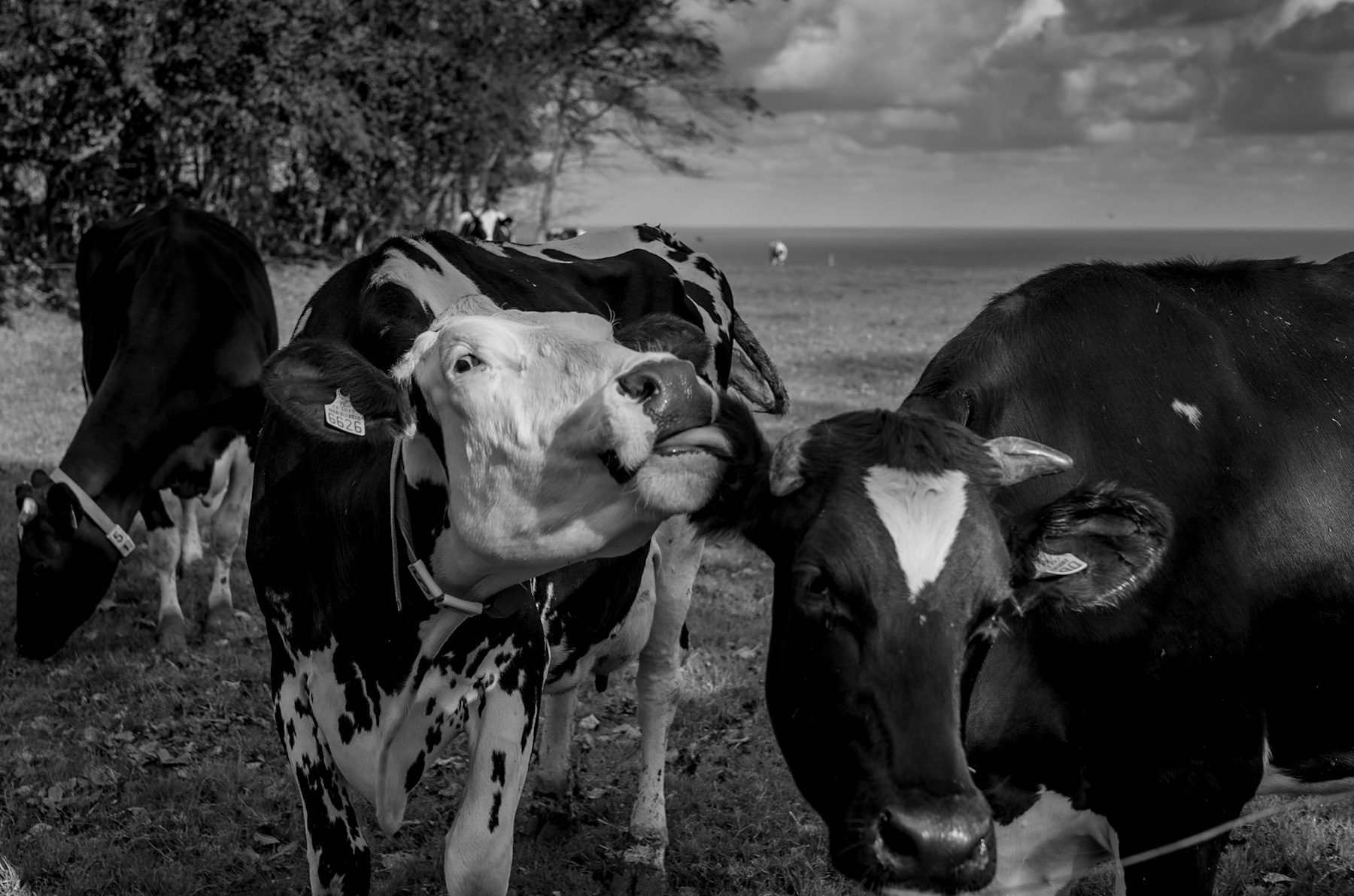
The striking black and white imagery of a herd of cattle immediately draws the viewer into a serene, yet dynamic, pastoral scene. Dominating the foreground, a cow with distinctive white and black markings turns its head, seemingly in mid-lick or an inquisitive gesture, its tongue playfully extended. Beside it, another bovine with a prominent white triangular blaze on its forehead gazes directly forward, anchoring the composition. In the background, additional cows graze peacefully, their forms silhouetted against a distant horizon where land meets a vast expanse of water under a dramatic, cloudy sky.
This monochrome palette lends a timeless quality to the photograph, stripping away distractions and highlighting the textures of their coats, the subtle nuances of light and shadow, and the rugged beauty of the landscape. The expressive interaction between the two foreground cows captures a moment of natural behavior, reminding us of the sentient lives within these domesticated animals. The visible ear tag on one cow, bearing the number „6626,“ is a subtle nod to modern agricultural practices, even as the overall impression harks back to simpler times.
A Glimpse into Ancient Agricultural Roots
The presence of cattle in human civilization is profoundly ancient, tracing back to the Neolithic Revolution approximately 10,500 years ago. Their domestication marked a pivotal shift in human history, moving societies from a hunter-gatherer existence to settled agrarian communities. Early humans recognized the immense value of these animals, not just for meat, but also for milk, hides, and crucially, as working beasts for plowing fields and transportation. This foundational relationship enabled the development of complex societies and laid the groundwork for modern agriculture and sustainable farming practices.
The Rise of Dairy and Iconic Breeds
The black and white patterns seen on these animals strongly suggest they are Holstein-Friesian cattle, a breed renowned globally for its exceptional dairy production. Originating from the provinces of North Holland and Friesland in the Netherlands, and Schleswig-Holstein in Germany, these cows have been selectively bred over centuries to become the world’s highest-producing dairy animals. Their widespread adoption has significantly shaped the global dairy industry, making milk and dairy products accessible staples in diets worldwide. The image subtly connects to this rich agricultural history, portraying animals that are direct descendants of those critical to this agricultural evolution.
Modern Context and Timeless Connection
The expansive, grassy field leading to a watery horizon in the background evokes the traditional grazing lands often associated with cattle farming. Such coastal or near-coastal pastures have historically provided rich forage, contributing to the health and productivity of herds. While modern farming has introduced technological advancements like detailed animal identification through ear tags and improved animal welfare practices, the fundamental interaction between cattle and their environment, as depicted here, remains largely unchanged. It speaks to an enduring rhythm of rural life and the continuous cycle of nature, connecting contemporary livestock management with centuries of farming heritage.
This photograph, with its compelling monochrome aesthetic and candid portrayal of bovine life, serves as more than just a snapshot. It is a visual testament to the deep-rooted historical partnership between humans and cattle, a connection that has nourished and shaped civilizations for millennia. From ancient domestication to their pivotal role in contemporary food systems, these animals continue to be silent, yet powerful, anchors in our agricultural narrative. The image invites contemplation on this enduring legacy, reminding us of the simple beauty and complex history woven into the fabric of our natural world, celebrating pastoral life through timeless black and white photography.
This monochrome palette lends a timeless quality to the photograph, stripping away distractions and highlighting the textures of their coats, the subtle nuances of light and shadow, and the rugged beauty of the landscape. The expressive interaction between the two foreground cows captures a moment of natural behavior, reminding us of the sentient lives within these domesticated animals. The visible ear tag on one cow, bearing the number „6626,“ is a subtle nod to modern agricultural practices, even as the overall impression harks back to simpler times.
A Glimpse into Ancient Agricultural Roots
The presence of cattle in human civilization is profoundly ancient, tracing back to the Neolithic Revolution approximately 10,500 years ago. Their domestication marked a pivotal shift in human history, moving societies from a hunter-gatherer existence to settled agrarian communities. Early humans recognized the immense value of these animals, not just for meat, but also for milk, hides, and crucially, as working beasts for plowing fields and transportation. This foundational relationship enabled the development of complex societies and laid the groundwork for modern agriculture and sustainable farming practices.
The Rise of Dairy and Iconic Breeds
The black and white patterns seen on these animals strongly suggest they are Holstein-Friesian cattle, a breed renowned globally for its exceptional dairy production. Originating from the provinces of North Holland and Friesland in the Netherlands, and Schleswig-Holstein in Germany, these cows have been selectively bred over centuries to become the world’s highest-producing dairy animals. Their widespread adoption has significantly shaped the global dairy industry, making milk and dairy products accessible staples in diets worldwide. The image subtly connects to this rich agricultural history, portraying animals that are direct descendants of those critical to this agricultural evolution.
Modern Context and Timeless Connection
The expansive, grassy field leading to a watery horizon in the background evokes the traditional grazing lands often associated with cattle farming. Such coastal or near-coastal pastures have historically provided rich forage, contributing to the health and productivity of herds. While modern farming has introduced technological advancements like detailed animal identification through ear tags and improved animal welfare practices, the fundamental interaction between cattle and their environment, as depicted here, remains largely unchanged. It speaks to an enduring rhythm of rural life and the continuous cycle of nature, connecting contemporary livestock management with centuries of farming heritage.
This photograph, with its compelling monochrome aesthetic and candid portrayal of bovine life, serves as more than just a snapshot. It is a visual testament to the deep-rooted historical partnership between humans and cattle, a connection that has nourished and shaped civilizations for millennia. From ancient domestication to their pivotal role in contemporary food systems, these animals continue to be silent, yet powerful, anchors in our agricultural narrative. The image invites contemplation on this enduring legacy, reminding us of the simple beauty and complex history woven into the fabric of our natural world, celebrating pastoral life through timeless black and white photography.
Schreibe einen Kommentar