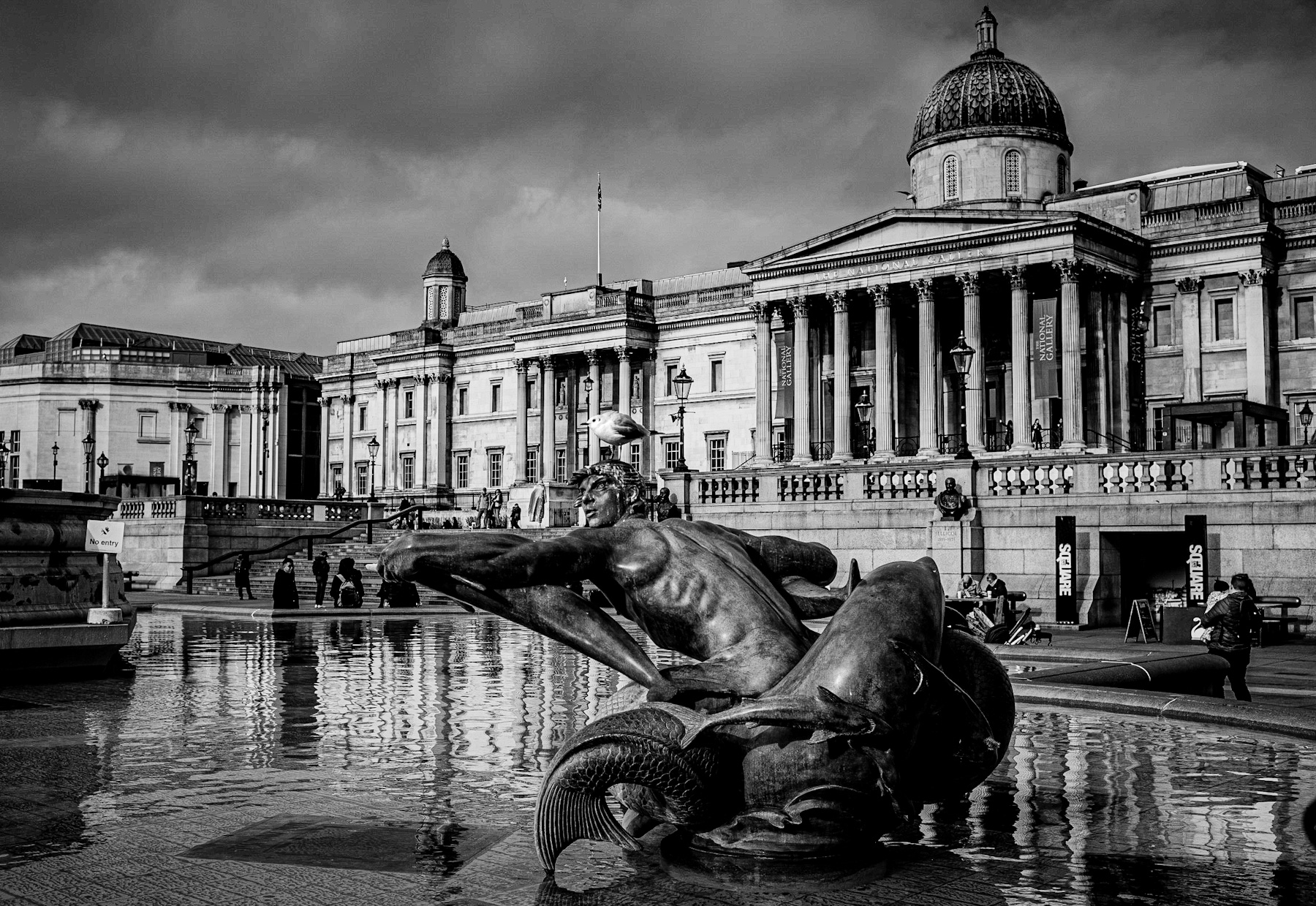
The captured image presents a powerful monochromatic view of **Trafalgar Square**, one of **London’s** most celebrated public spaces. Dominated by the majestic facade of the **National Gallery** in the background, the scene is anchored by one of the square’s iconic **fountains**, featuring a striking bronze sculpture. The absence of colour amplifies the architectural grandeur and the dynamic interplay of light and shadow under a dramatic, cloudy sky, lending a timeless quality to this bustling urban landscape.
**A Glimpse into the Visual Narrative**
In the foreground, the focus rests on a magnificent **Triton statue**, a merman-like figure wrestling with a large fish or sea creature, its muscular form rendered with impressive detail. A lone seagull perches momentarily on the statue’s head in some perspectives, a small detail adding a touch of natural life to the monumental art. The fountain’s water, gently rippling, reflects the overcast sky, creating a textured surface that contrasts with the solid bronze. This aquatic element provides a serene counterpoint to the architectural formality beyond.
Behind the fountain, the grand steps of the **National Gallery** rise, inviting visitors into its hallowed halls. The building’s neoclassical architecture is prominent, characterized by its imposing columns, intricate detailing, and the distinctive dome that crowns its structure. Banners for „National Gallery“ are visible, subtly reinforcing the building’s identity. Pedestrians dot the square and the gallery steps, their presence hinting at the continuous flow of life and activity that defines this central London landmark. The black and white palette emphasizes the textures of stone and water, highlighting the craftsmanship of both the sculpture and the architecture.
**Echoes of British History and Cultural Heritage**
**Trafalgar Square** itself is steeped in **British history**, commemorating the Battle of Trafalgar in 1805, a pivotal naval victory for Britain during the Napoleonic Wars. Named in 1830, the square was largely developed in the 1840s, evolving into a major civic space. The **National Gallery**, established in 1824 and opened in its current **William Wilkins**-designed building in 1838, stands as a testament to Britain’s commitment to art and culture. It houses a world-renowned collection of Western European paintings, spanning from the 13th to the 19th centuries, making it a vital institution for art enthusiasts and scholars globally.
The fountains, while part of the original square design from the 1840s, underwent a significant redesign in the 1930s by architect **Sir Edwin Lutyens**. The current bronze sculptures, including the depicted Triton, replaced the earlier Victorian designs, introducing a more classical, robust aesthetic featuring mermaids, tritons, and dolphins. These additions enhance the square’s artistic appeal and contribute to its identity as a place where art, history, and public life converge.
**An Enduring Public Space**
Beyond its historical and artistic significance, **Trafalgar Square** functions as a vibrant public arena, a focal point for celebrations, protests, and everyday gatherings. Its strategic location and the grandeur of its surroundings make it an enduring symbol of London. The image, through its careful composition and monochromatic treatment, encapsulates not just a moment in time but also the timeless essence of this **iconic landmark**, inviting contemplation on the layers of history and culture embedded within its fabric. It serves as a reminder of London’s rich **cultural heritage** and its continuous evolution as a global city.
**A Glimpse into the Visual Narrative**
In the foreground, the focus rests on a magnificent **Triton statue**, a merman-like figure wrestling with a large fish or sea creature, its muscular form rendered with impressive detail. A lone seagull perches momentarily on the statue’s head in some perspectives, a small detail adding a touch of natural life to the monumental art. The fountain’s water, gently rippling, reflects the overcast sky, creating a textured surface that contrasts with the solid bronze. This aquatic element provides a serene counterpoint to the architectural formality beyond.
Behind the fountain, the grand steps of the **National Gallery** rise, inviting visitors into its hallowed halls. The building’s neoclassical architecture is prominent, characterized by its imposing columns, intricate detailing, and the distinctive dome that crowns its structure. Banners for „National Gallery“ are visible, subtly reinforcing the building’s identity. Pedestrians dot the square and the gallery steps, their presence hinting at the continuous flow of life and activity that defines this central London landmark. The black and white palette emphasizes the textures of stone and water, highlighting the craftsmanship of both the sculpture and the architecture.
**Echoes of British History and Cultural Heritage**
**Trafalgar Square** itself is steeped in **British history**, commemorating the Battle of Trafalgar in 1805, a pivotal naval victory for Britain during the Napoleonic Wars. Named in 1830, the square was largely developed in the 1840s, evolving into a major civic space. The **National Gallery**, established in 1824 and opened in its current **William Wilkins**-designed building in 1838, stands as a testament to Britain’s commitment to art and culture. It houses a world-renowned collection of Western European paintings, spanning from the 13th to the 19th centuries, making it a vital institution for art enthusiasts and scholars globally.
The fountains, while part of the original square design from the 1840s, underwent a significant redesign in the 1930s by architect **Sir Edwin Lutyens**. The current bronze sculptures, including the depicted Triton, replaced the earlier Victorian designs, introducing a more classical, robust aesthetic featuring mermaids, tritons, and dolphins. These additions enhance the square’s artistic appeal and contribute to its identity as a place where art, history, and public life converge.
**An Enduring Public Space**
Beyond its historical and artistic significance, **Trafalgar Square** functions as a vibrant public arena, a focal point for celebrations, protests, and everyday gatherings. Its strategic location and the grandeur of its surroundings make it an enduring symbol of London. The image, through its careful composition and monochromatic treatment, encapsulates not just a moment in time but also the timeless essence of this **iconic landmark**, inviting contemplation on the layers of history and culture embedded within its fabric. It serves as a reminder of London’s rich **cultural heritage** and its continuous evolution as a global city.
Schreibe einen Kommentar