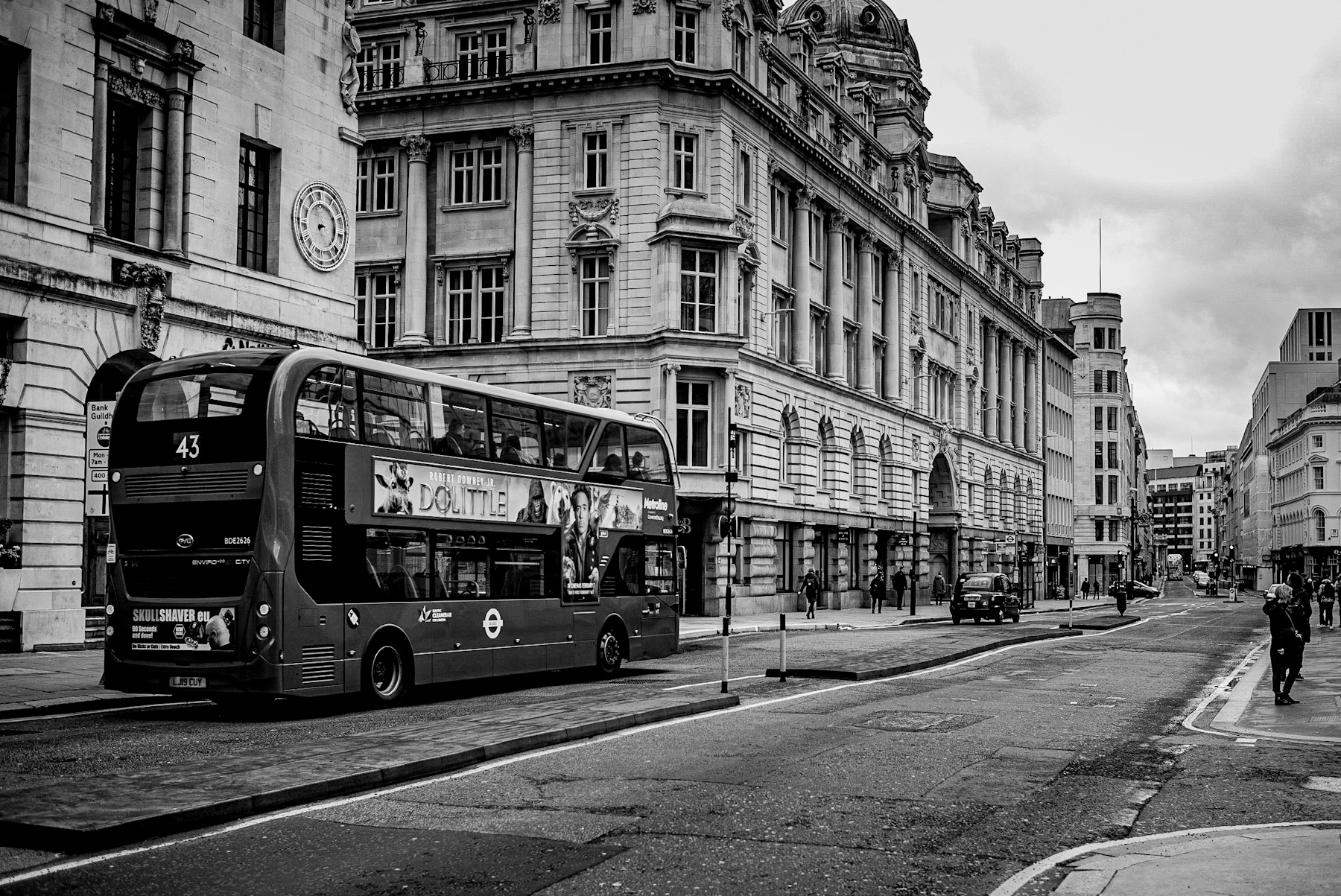
This compelling black and white photograph captures a quintessential London street scene, where the city’s rich past seamlessly intertwines with its dynamic present. The monochrome palette strips away transient colours, allowing the viewer to focus on the intricate architectural details, the iconic forms of urban transport, and the timeless essence of a global metropolis.
At the heart of the image stands a modern double-decker bus, its robust form dominating the left foreground. Bearing the route number „43“ and an advertisement for „Dolittle,“ this vehicle represents the continuous evolution of London’s public transport system. The double-decker bus itself is an enduring symbol of the city, tracing its lineage back to horse-drawn omnibuses of the 19th century. Early motorbuses, introduced in the early 20th century, quickly became a staple, their design evolving from open-top models to the enclosed, efficient vehicles seen today. This specific model, a BYD Enviro 400 City, highlights the ongoing shift towards more sustainable, electric-powered transport, a significant leap from the diesel engines that once characterised London’s streets.
Flanking the street, particularly on the right, are magnificent buildings that speak volumes about London’s architectural heritage. Their ornate facades, adorned with classical columns, intricate mouldings, and grand windows, suggest a construction period spanning the late Victorian or Edwardian eras. These styles reflect a period of immense prosperity and imperial power, when London was at the zenith of its influence as a financial and commercial hub. The sheer scale and decorative elements of these structures underscore the city’s ambition and its commitment to monumental civic and corporate architecture. A prominent clock on the building to the left further anchors the scene in a sense of enduring time, a silent witness to centuries of urban life.
The street itself, with its broad asphalt, defined pavements, and the subtle presence of pedestrians and a classic black cab further down, embodies the constant flow of city life. The City of London, where such grand buildings are commonplace, has been the financial heart of Britain for centuries, surviving fires, wars, and economic shifts. The very ground these modern vehicles traverse and these buildings stand upon holds layers of history, from Roman settlements to medieval guilds and the trading powerhouses of later centuries.
The choice of black and white photography enhances this historical narrative. By removing colour, the image accentuates textures, contrasts, and the interplay of light and shadow, giving the scene a timeless quality reminiscent of historical photographs. It invites contemplation on how much has changed, yet how much remains fundamentally the same in London’s urban fabric. The juxtaposition of a state-of-the-art bus and venerable architecture illustrates London’s unique ability to honour its past while relentlessly embracing the future. This photograph serves as a visual testament to the city’s enduring spirit, where every street corner tells a story of innovation, resilience, and profound historical depth.
At the heart of the image stands a modern double-decker bus, its robust form dominating the left foreground. Bearing the route number „43“ and an advertisement for „Dolittle,“ this vehicle represents the continuous evolution of London’s public transport system. The double-decker bus itself is an enduring symbol of the city, tracing its lineage back to horse-drawn omnibuses of the 19th century. Early motorbuses, introduced in the early 20th century, quickly became a staple, their design evolving from open-top models to the enclosed, efficient vehicles seen today. This specific model, a BYD Enviro 400 City, highlights the ongoing shift towards more sustainable, electric-powered transport, a significant leap from the diesel engines that once characterised London’s streets.
Flanking the street, particularly on the right, are magnificent buildings that speak volumes about London’s architectural heritage. Their ornate facades, adorned with classical columns, intricate mouldings, and grand windows, suggest a construction period spanning the late Victorian or Edwardian eras. These styles reflect a period of immense prosperity and imperial power, when London was at the zenith of its influence as a financial and commercial hub. The sheer scale and decorative elements of these structures underscore the city’s ambition and its commitment to monumental civic and corporate architecture. A prominent clock on the building to the left further anchors the scene in a sense of enduring time, a silent witness to centuries of urban life.
The street itself, with its broad asphalt, defined pavements, and the subtle presence of pedestrians and a classic black cab further down, embodies the constant flow of city life. The City of London, where such grand buildings are commonplace, has been the financial heart of Britain for centuries, surviving fires, wars, and economic shifts. The very ground these modern vehicles traverse and these buildings stand upon holds layers of history, from Roman settlements to medieval guilds and the trading powerhouses of later centuries.
The choice of black and white photography enhances this historical narrative. By removing colour, the image accentuates textures, contrasts, and the interplay of light and shadow, giving the scene a timeless quality reminiscent of historical photographs. It invites contemplation on how much has changed, yet how much remains fundamentally the same in London’s urban fabric. The juxtaposition of a state-of-the-art bus and venerable architecture illustrates London’s unique ability to honour its past while relentlessly embracing the future. This photograph serves as a visual testament to the city’s enduring spirit, where every street corner tells a story of innovation, resilience, and profound historical depth.
Schreibe einen Kommentar