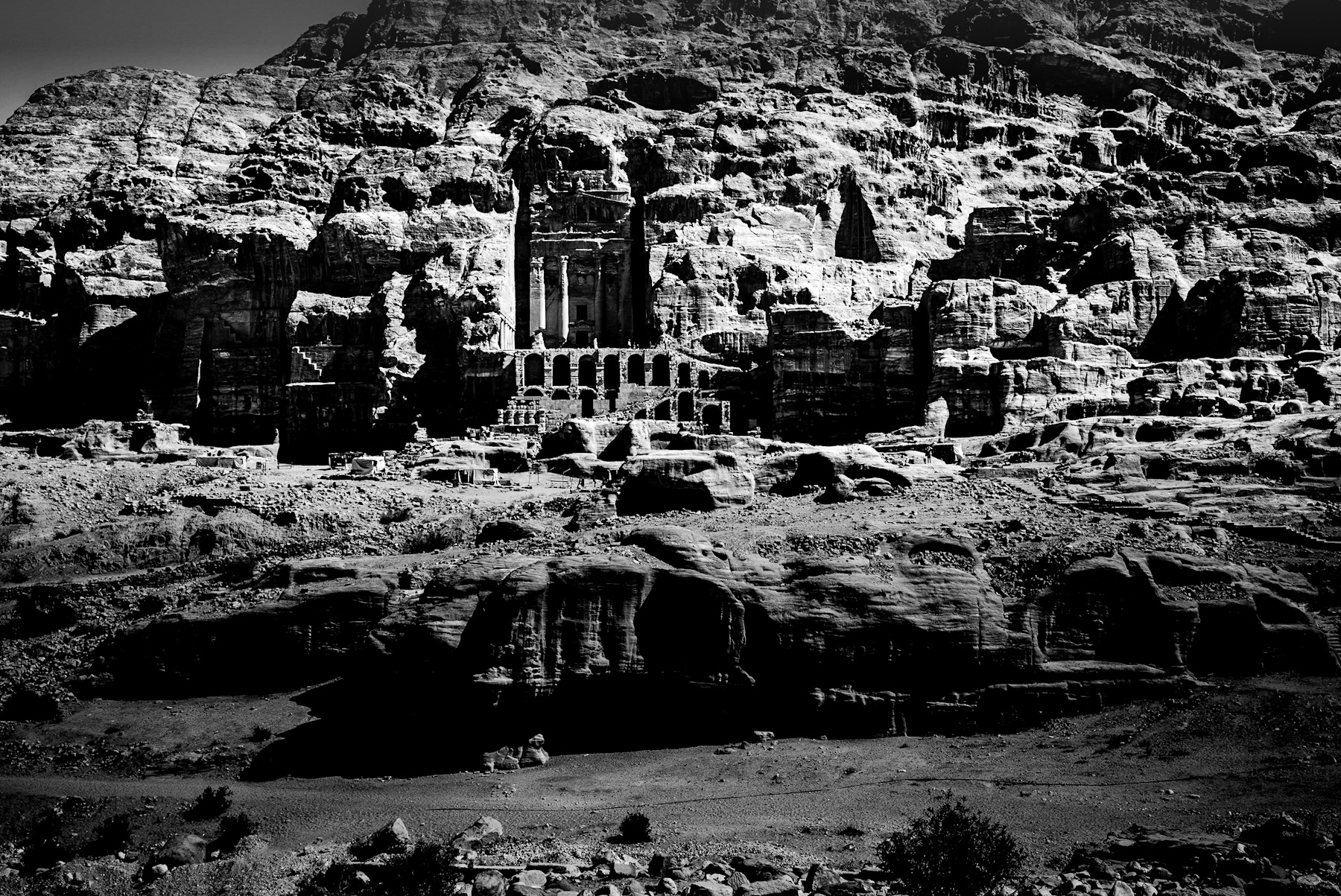
The monochrome photograph captures a monumental façade carved directly into the rugged sandstone cliffs of Petra, Jordan. This dramatic image showcases the sheer scale and intricate detail of Nabataean rock-cut architecture, specifically highlighting what is widely recognized as the Urn Tomb, a jewel within the sprawling complex of the Royal Tombs. The stark black and white rendering emphasizes the textures of the weathered rock and the interplay of sunlight and deep shadows, lending a timeless, almost ethereal quality to this ancient marvel.
In the foreground, the rough, uneven terrain suggests the natural desert environment, interspersed with smaller rock formations and remnants of human activity, perhaps archaeological digs or pathways. As the eye moves upwards, the colossal scale of the cliff face becomes apparent, with the central Urn Tomb dominating the composition. Its classical architectural elements—columns, pediments, and a grand entrance—are meticulously carved into the living rock, demonstrating an extraordinary level of craftsmanship and engineering prowess. Below the main tomb, a series of arched chambers and lower structures, also carved from the rock, suggest further uses, possibly as dwellings or additional burial sites, hinting at the extensive infrastructure that once supported this vibrant ancient city.
Emerging from the desert landscape, Petra was once the thriving capital of the Nabataean Kingdom, an influential Arab people who controlled major trade routes connecting Arabia with the Mediterranean world from the 4th century BCE to the 1st century CE. Their wealth, derived from frankincense, myrrh, and spices, funded the construction of this extraordinary city, which served not only as a commercial hub but also as a testament to their sophisticated culture and artistic sensibilities. The Nabataeans were masters of hydraulic engineering, developing complex systems to manage and conserve water in this arid region, allowing their city to flourish.
The prominent structure in the image, the Urn Tomb, is part of the larger complex known as the Royal Tombs of Petra. Characterized by its monumental façade, featuring a two-story arrangement of columns and a central entrance, it culminates in a large urn-shaped finial atop its pediment – a distinctive element that gives the tomb its modern name. This grand edifice, likely constructed in the mid-1st century CE, is believed to have served as the burial place for a Nabataean king, possibly Malichus II or Aretas IV, underscoring the power and sophistication of the Nabataean elite. Its architectural style is a fascinating blend of Hellenistic and Roman influences, seamlessly integrated with indigenous Nabataean artistic traditions. The impressive scale and intricate details of the Urn Tomb reflect the Nabataeans‘ reverence for their rulers and their belief in an afterlife.
Centuries later, during the Byzantine era, the Urn Tomb underwent a significant transformation, being converted into a cathedral, a testament to the site’s enduring importance and adaptability throughout different historical periods. Today, Petra stands as a UNESCO World Heritage site, an archaeological marvel that continues to captivate researchers and visitors alike. The black and white rendition of this scene enhances the timeless quality of the stone, drawing attention to the textures and shadows that define these ancient structures. It serves as a powerful reminder of human ingenuity and the civilizations that once flourished in challenging desert environments. Exploring these ancient wonders of Jordan offers a profound connection to a rich and complex past, inviting contemplation on the rise and fall of empires and the enduring legacy etched in stone.
In the foreground, the rough, uneven terrain suggests the natural desert environment, interspersed with smaller rock formations and remnants of human activity, perhaps archaeological digs or pathways. As the eye moves upwards, the colossal scale of the cliff face becomes apparent, with the central Urn Tomb dominating the composition. Its classical architectural elements—columns, pediments, and a grand entrance—are meticulously carved into the living rock, demonstrating an extraordinary level of craftsmanship and engineering prowess. Below the main tomb, a series of arched chambers and lower structures, also carved from the rock, suggest further uses, possibly as dwellings or additional burial sites, hinting at the extensive infrastructure that once supported this vibrant ancient city.
Emerging from the desert landscape, Petra was once the thriving capital of the Nabataean Kingdom, an influential Arab people who controlled major trade routes connecting Arabia with the Mediterranean world from the 4th century BCE to the 1st century CE. Their wealth, derived from frankincense, myrrh, and spices, funded the construction of this extraordinary city, which served not only as a commercial hub but also as a testament to their sophisticated culture and artistic sensibilities. The Nabataeans were masters of hydraulic engineering, developing complex systems to manage and conserve water in this arid region, allowing their city to flourish.
The prominent structure in the image, the Urn Tomb, is part of the larger complex known as the Royal Tombs of Petra. Characterized by its monumental façade, featuring a two-story arrangement of columns and a central entrance, it culminates in a large urn-shaped finial atop its pediment – a distinctive element that gives the tomb its modern name. This grand edifice, likely constructed in the mid-1st century CE, is believed to have served as the burial place for a Nabataean king, possibly Malichus II or Aretas IV, underscoring the power and sophistication of the Nabataean elite. Its architectural style is a fascinating blend of Hellenistic and Roman influences, seamlessly integrated with indigenous Nabataean artistic traditions. The impressive scale and intricate details of the Urn Tomb reflect the Nabataeans‘ reverence for their rulers and their belief in an afterlife.
Centuries later, during the Byzantine era, the Urn Tomb underwent a significant transformation, being converted into a cathedral, a testament to the site’s enduring importance and adaptability throughout different historical periods. Today, Petra stands as a UNESCO World Heritage site, an archaeological marvel that continues to captivate researchers and visitors alike. The black and white rendition of this scene enhances the timeless quality of the stone, drawing attention to the textures and shadows that define these ancient structures. It serves as a powerful reminder of human ingenuity and the civilizations that once flourished in challenging desert environments. Exploring these ancient wonders of Jordan offers a profound connection to a rich and complex past, inviting contemplation on the rise and fall of empires and the enduring legacy etched in stone.
Schreibe einen Kommentar