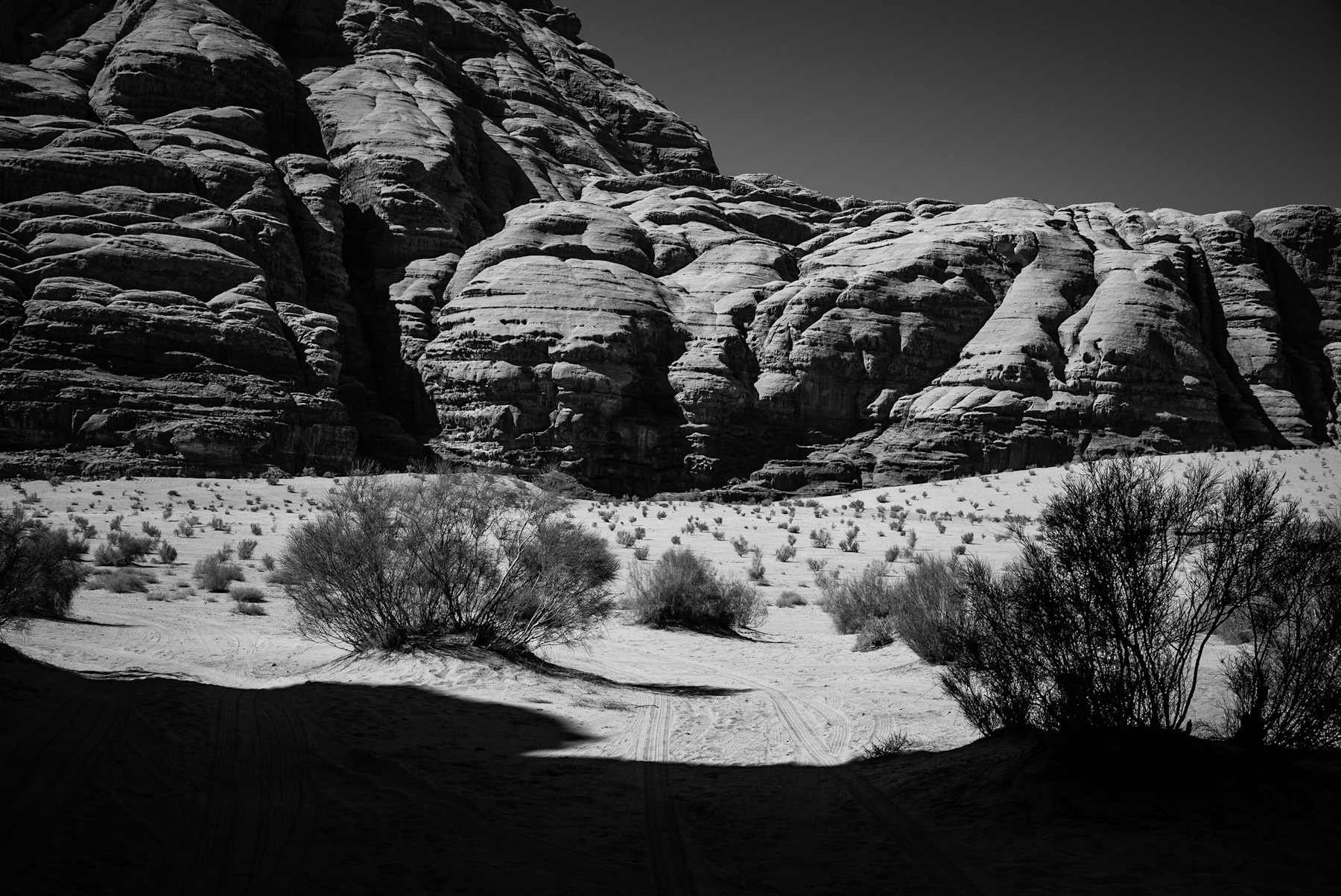
The image presents a stark, majestic desert landscape rendered in powerful black and white, immediately drawing the viewer into a realm of ancient grandeur. Towering rock formations dominate the upper frame, their surfaces intricately layered and sculpted by millennia of wind and erosion. These colossal structures, likely sandstone, display a complex topography of ridges, crevices, and rounded contours, emphasizing their immense scale and geological history. The absence of color enhances the dramatic interplay of light and shadow, revealing textures and forms that might otherwise be less pronounced. Deep shadows carve out valleys and accentuate the ruggedness, hinting at the harsh, intense sunlight characteristic of such arid regions.
Below these formidable peaks, a vast expanse of sandy terrain stretches forward. The foreground is marked by gentle undulations and subtle ripples in the sand, suggesting the constant movement of desert winds. Sparse, resilient desert shrubs, characterized by their dense, twiggy branches, are scattered across this sandy plain. Their silhouette, particularly those closer to the viewer, adds a sense of depth and scale, contrasting with the smooth, bright sand. Visible tire tracks cut across the sandy surface, a subtle yet significant detail that introduces a contemporary human element into this otherwise timeless vista, indicating passage and exploration in a remote environment. The dark, sweeping shadow in the lower left foreground further frames the scene, adding to the dramatic contrast and depth of field.
Geologically, landscapes such as this are a testament to vast stretches of Earth’s history. Formed over millions of years through sedimentary processes and subsequent erosion, these rock formations often consist of sandstone, a material susceptible to the sculpting power of wind and occasional water. The distinct layering visible in the rock faces tells a story of ancient seabeds, river deltas, or vast sand dunes, compacted and uplifted over geological eras. The arid environment, while seemingly barren, is a dynamic system where geological forces continue to shape the terrain, creating the iconic features seen in this photograph.
Historically, these desert environments, particularly those found in the Arabian Peninsula, are rich with human narrative. Regions like Wadi Rum in Jordan, which this landscape closely resembles, have served as a crucible for civilizations and a backdrop for pivotal historical events. Evidence of ancient cultures, including the Thamudic and Nabataean peoples, can be found in rock carvings and inscriptions, testifying to millennia of human presence and adaptation to these challenging conditions. These deserts were vital pathways for ancient trade routes, connecting civilizations and facilitating cultural exchange across vast distances.
Perhaps the most renowned historical association for such landscapes in the modern era is with T.E. Lawrence, or Lawrence of Arabia. During the Arab Revolt against the Ottoman Empire in World War I, these deserts provided strategic cover and logistical challenges for the Arab forces. Lawrence’s exploits, chronicled in his work „Seven Pillars of Wisdom,“ vividly portray the arduous yet awe-inspiring nature of this terrain, highlighting its role in shaping the course of history. The Bedouin tribes, with their deep understanding of desert survival and their enduring nomadic traditions, have been the perennial inhabitants and guardians of these lands, their heritage intertwined with every dune and rock formation.
The black and white rendition of this desert landscape strips away the distractions of color, inviting a deeper contemplation of its form, texture, and the profound historical echoes it holds. It emphasizes the raw power of nature and the enduring spirit of human endeavor against a backdrop of ancient stone and shifting sands. This image captures not just a place, but a legacy, where geological time meets human history in a timeless, majestic embrace.
Below these formidable peaks, a vast expanse of sandy terrain stretches forward. The foreground is marked by gentle undulations and subtle ripples in the sand, suggesting the constant movement of desert winds. Sparse, resilient desert shrubs, characterized by their dense, twiggy branches, are scattered across this sandy plain. Their silhouette, particularly those closer to the viewer, adds a sense of depth and scale, contrasting with the smooth, bright sand. Visible tire tracks cut across the sandy surface, a subtle yet significant detail that introduces a contemporary human element into this otherwise timeless vista, indicating passage and exploration in a remote environment. The dark, sweeping shadow in the lower left foreground further frames the scene, adding to the dramatic contrast and depth of field.
Geologically, landscapes such as this are a testament to vast stretches of Earth’s history. Formed over millions of years through sedimentary processes and subsequent erosion, these rock formations often consist of sandstone, a material susceptible to the sculpting power of wind and occasional water. The distinct layering visible in the rock faces tells a story of ancient seabeds, river deltas, or vast sand dunes, compacted and uplifted over geological eras. The arid environment, while seemingly barren, is a dynamic system where geological forces continue to shape the terrain, creating the iconic features seen in this photograph.
Historically, these desert environments, particularly those found in the Arabian Peninsula, are rich with human narrative. Regions like Wadi Rum in Jordan, which this landscape closely resembles, have served as a crucible for civilizations and a backdrop for pivotal historical events. Evidence of ancient cultures, including the Thamudic and Nabataean peoples, can be found in rock carvings and inscriptions, testifying to millennia of human presence and adaptation to these challenging conditions. These deserts were vital pathways for ancient trade routes, connecting civilizations and facilitating cultural exchange across vast distances.
Perhaps the most renowned historical association for such landscapes in the modern era is with T.E. Lawrence, or Lawrence of Arabia. During the Arab Revolt against the Ottoman Empire in World War I, these deserts provided strategic cover and logistical challenges for the Arab forces. Lawrence’s exploits, chronicled in his work „Seven Pillars of Wisdom,“ vividly portray the arduous yet awe-inspiring nature of this terrain, highlighting its role in shaping the course of history. The Bedouin tribes, with their deep understanding of desert survival and their enduring nomadic traditions, have been the perennial inhabitants and guardians of these lands, their heritage intertwined with every dune and rock formation.
The black and white rendition of this desert landscape strips away the distractions of color, inviting a deeper contemplation of its form, texture, and the profound historical echoes it holds. It emphasizes the raw power of nature and the enduring spirit of human endeavor against a backdrop of ancient stone and shifting sands. This image captures not just a place, but a legacy, where geological time meets human history in a timeless, majestic embrace.
Schreibe einen Kommentar