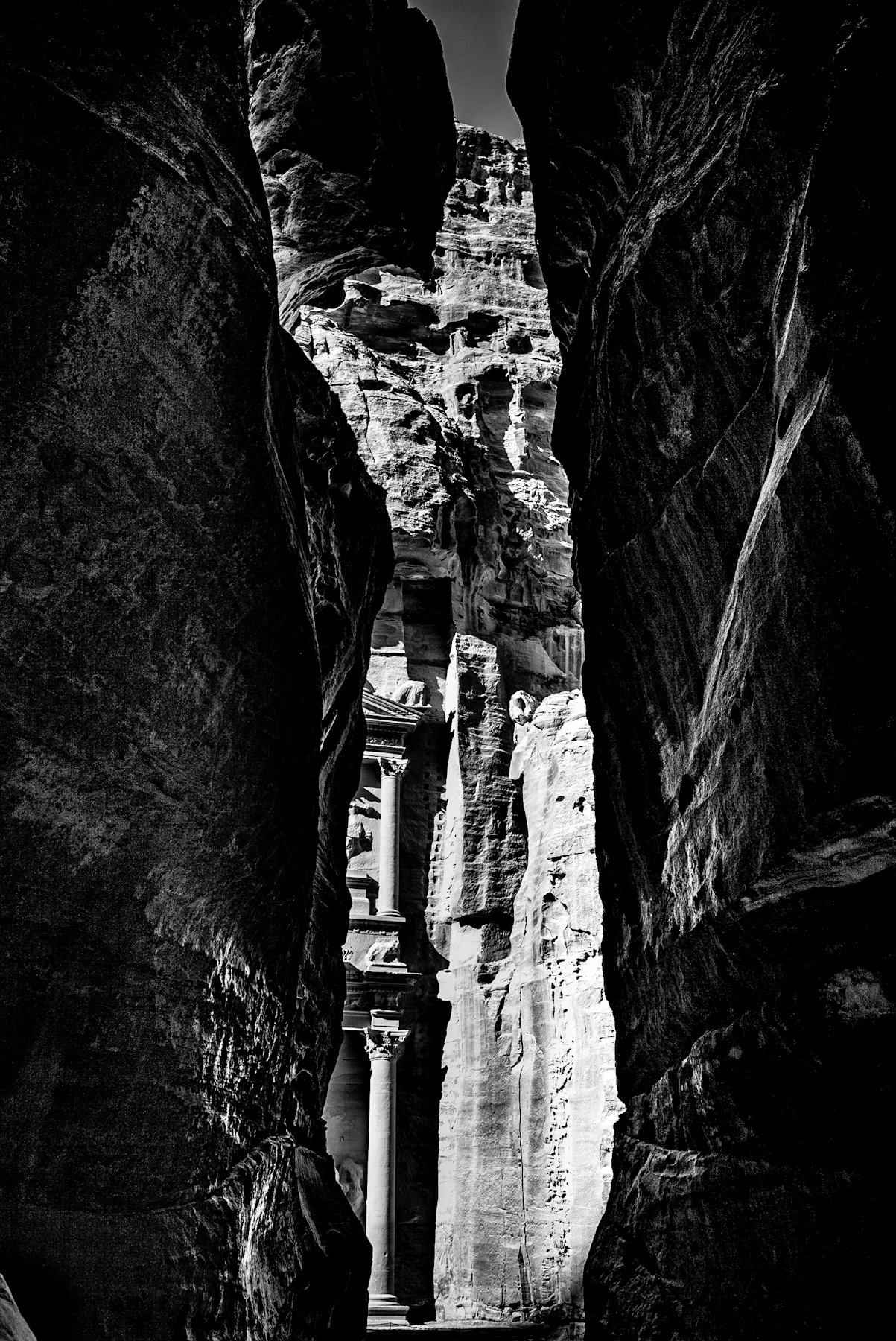
The accompanying image presents a captivating black and white perspective of Al-Khazneh, commonly known as The Treasury, one of the most iconic structures within the ancient city of Petra, Jordan. Framed dramatically by the towering, shadowed walls of the Siq, the narrow gorge that serves as the primary entrance to Petra, the photograph masterfully captures the architectural marvel emerging from the sandstone cliffs.
A Striking Visual Narrative
The monochromatic palette of the image accentuates the profound textures and contrasts inherent in Petra’s landscape. Deep shadows on the foreground rock faces on either side create a powerful visual funnel, drawing the eye directly to the illuminated facade of The Treasury. The intricate details of its Hellenistic architecture, including the towering columns and carved pediments, become apparent despite the partial concealment. The play of light and shadow emphasizes the sheer scale of both the natural rock formations and the man-made structure, highlighting the unique integration of art and environment. The raw, striated surfaces of the Siq walls contrast with the refined, classical lines of the monument, underscoring the journey from the natural world into a realm of ancient human ingenuity.
Petra: Echoes of an Ancient Civilization
Petra, a UNESCO World Heritage Site and one of the New7Wonders of the World, stands as a testament to the ingenuity of the Nabataeans, an ancient Arab people who established it as their capital around the 4th century BCE. Strategically located along vital trade routes connecting Arabia, Egypt, and the Levant, Petra flourished as a bustling hub for incense, spices, and other goods. Its unique desert environment also necessitated advanced hydraulic engineering, with the Nabataeans developing sophisticated systems to collect and store water.
Al-Khazneh: The Treasury’s Enduring Mystery
Al-Khazneh, meaning „The Treasury,“ is perhaps the most famous and well-preserved structure in Petra. Carved directly into the vibrant sandstone cliff face, its name derives from local Bedouin legends suggesting it once held pharaoh’s treasure. While its exact purpose remains debated by archaeologists, the prevailing theory is that it served as the mausoleum for Nabataean King Aretas IV in the 1st century CE, or perhaps as a temple.
Architecturally, The Treasury showcases a remarkable fusion of Nabataean rock-carving traditions with classical Greek and Roman influences. Its elaborate facade features six Corinthian columns, intricate friezes, and statues of mythical figures and deities. The structure’s grandeur and its unexpected reveal at the end of the winding Siq were undoubtedly intended to impress visitors and assert the power and sophistication of the Nabataean kingdom.
The Journey Through the Siq
The experience of approaching The Treasury, as hinted at by the photograph’s perspective, is an integral part of its allure. The Siq itself is a natural geological fault, a narrow canyon stretching over a kilometer, with towering cliffs reaching up to 80 meters high. As one navigates its winding path, the anticipation builds, culminating in the dramatic reveal of Al-Khazneh through the final crack in the rock. This sensory journey, from the confined, shadowed passage to the sudden emergence into the sunlit grandeur of The Treasury, creates an unforgettable encounter with history and architectural brilliance.
Petra continues to draw visitors from across the globe, eager to witness the legacy of a remarkable civilization carved into the very earth itself. The image provides a powerful reminder of this ancient wonder’s enduring presence and its capacity to inspire awe.
A Striking Visual Narrative
The monochromatic palette of the image accentuates the profound textures and contrasts inherent in Petra’s landscape. Deep shadows on the foreground rock faces on either side create a powerful visual funnel, drawing the eye directly to the illuminated facade of The Treasury. The intricate details of its Hellenistic architecture, including the towering columns and carved pediments, become apparent despite the partial concealment. The play of light and shadow emphasizes the sheer scale of both the natural rock formations and the man-made structure, highlighting the unique integration of art and environment. The raw, striated surfaces of the Siq walls contrast with the refined, classical lines of the monument, underscoring the journey from the natural world into a realm of ancient human ingenuity.
Petra: Echoes of an Ancient Civilization
Petra, a UNESCO World Heritage Site and one of the New7Wonders of the World, stands as a testament to the ingenuity of the Nabataeans, an ancient Arab people who established it as their capital around the 4th century BCE. Strategically located along vital trade routes connecting Arabia, Egypt, and the Levant, Petra flourished as a bustling hub for incense, spices, and other goods. Its unique desert environment also necessitated advanced hydraulic engineering, with the Nabataeans developing sophisticated systems to collect and store water.
Al-Khazneh: The Treasury’s Enduring Mystery
Al-Khazneh, meaning „The Treasury,“ is perhaps the most famous and well-preserved structure in Petra. Carved directly into the vibrant sandstone cliff face, its name derives from local Bedouin legends suggesting it once held pharaoh’s treasure. While its exact purpose remains debated by archaeologists, the prevailing theory is that it served as the mausoleum for Nabataean King Aretas IV in the 1st century CE, or perhaps as a temple.
Architecturally, The Treasury showcases a remarkable fusion of Nabataean rock-carving traditions with classical Greek and Roman influences. Its elaborate facade features six Corinthian columns, intricate friezes, and statues of mythical figures and deities. The structure’s grandeur and its unexpected reveal at the end of the winding Siq were undoubtedly intended to impress visitors and assert the power and sophistication of the Nabataean kingdom.
The Journey Through the Siq
The experience of approaching The Treasury, as hinted at by the photograph’s perspective, is an integral part of its allure. The Siq itself is a natural geological fault, a narrow canyon stretching over a kilometer, with towering cliffs reaching up to 80 meters high. As one navigates its winding path, the anticipation builds, culminating in the dramatic reveal of Al-Khazneh through the final crack in the rock. This sensory journey, from the confined, shadowed passage to the sudden emergence into the sunlit grandeur of The Treasury, creates an unforgettable encounter with history and architectural brilliance.
Petra continues to draw visitors from across the globe, eager to witness the legacy of a remarkable civilization carved into the very earth itself. The image provides a powerful reminder of this ancient wonder’s enduring presence and its capacity to inspire awe.
Schreibe einen Kommentar