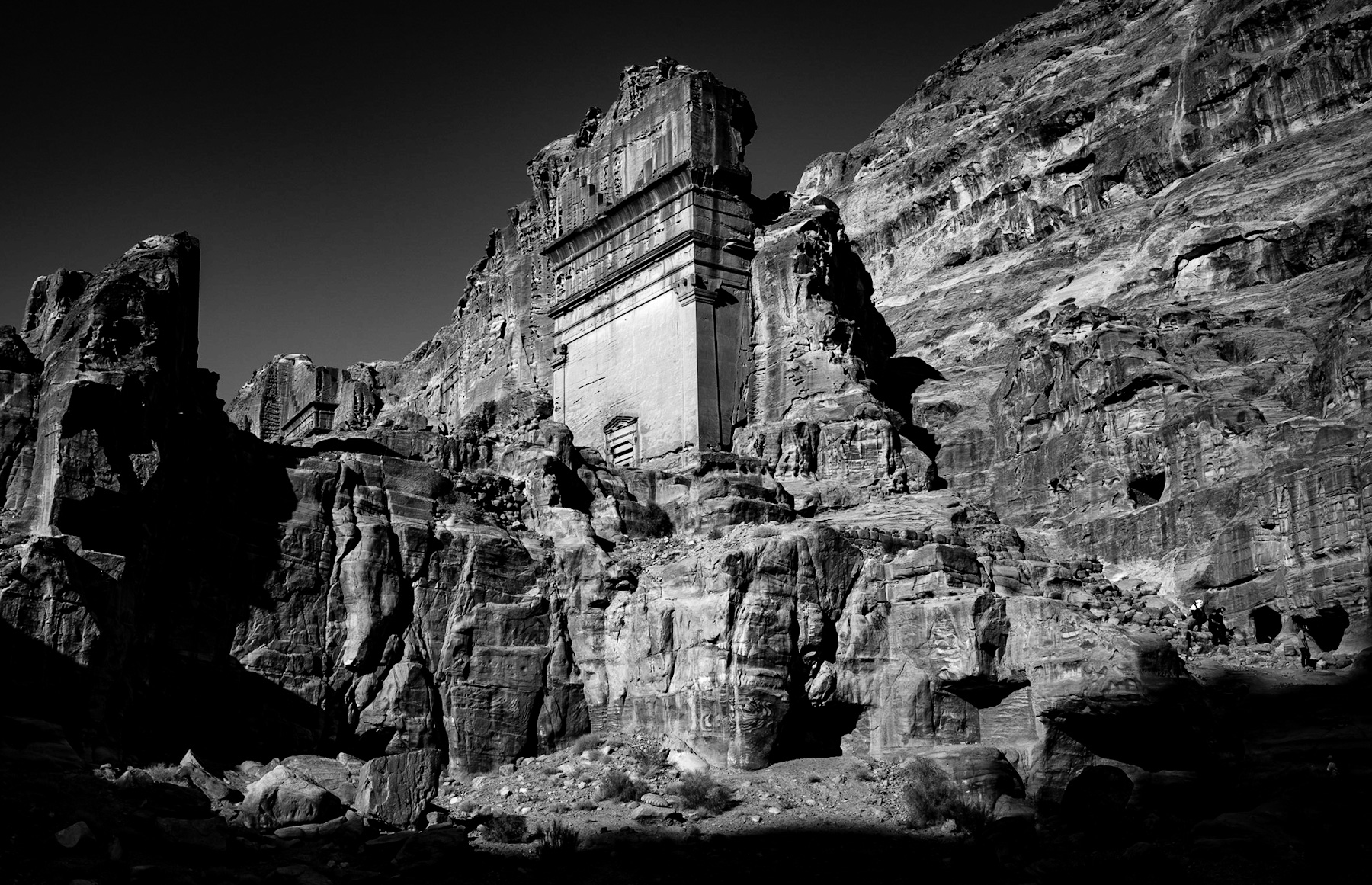
The dramatic black and white photograph captures a monumental rock-cut façade, carved directly into the rugged sandstone cliffs of Petra, Jordan. This striking image highlights the architectural prowess and enduring legacy of the Nabataean civilization, master sculptors of the desert landscape. The high contrast emphasizes the intricate textures of the rock and the deep shadows, lending a timeless quality to this ancient marvel.
The Architectural Masterpiece
At the heart of the image stands a colossal structure, meticulously hewn from the living rock face. This particular monument, likely one of Petra’s renowned **Royal Tombs**, possibly the Urn Tomb, showcases a blend of indigenous Nabataean artistry and Hellenistic influences. The structure features a large, relatively unadorned lower section with a smaller, recessed entrance, leading to an upper register characterized by more elaborate decorative elements. Though details are softened by the monochrome palette, the scale and precision of the carving are undeniable, reflecting advanced engineering and artistic skill.
The surrounding cliffs, deeply eroded by time and wind, frame the central edifice, revealing other smaller caves and carved openings that dot the landscape. These often served as dwellings, burial chambers, or storage spaces, illustrating the comprehensive integration of the city within its natural environment. The interplay of light and shadow across the uneven terrain further accentuates the depth and grandeur of Petra’s unique topography.
Petra: A Hub of Ancient Civilization
Petra, often referred to as the „Rose City“ due to the distinctive color of its sandstone, was the capital of the Nabataeans, an ancient Arab people who settled in southern Jordan around the 4th century BCE. Strategically located at the crossroads of major trade routes, particularly the **incense route**, Petra flourished as a vital economic and cultural center. The Nabataeans controlled the flow of goods like frankincense, myrrh, and spices, accumulating immense wealth that financed their ambitious architectural projects.
The city’s formidable rock-cut architecture, for which it is most famous, includes temples, tombs, and water management systems. These structures were not merely functional but also served as powerful statements of Nabataean prosperity and their sophisticated understanding of monumental design. The tombs, such as the one depicted, were often designed to impress and to house the remains of kings, queens, and prominent citizens, reflecting their beliefs about the afterlife and their societal hierarchy.
A Legacy Carved in Stone
The Nabataean civilization eventually came under Roman rule in 106 CE, after which Petra’s significance as a trade hub gradually declined. Earthquakes also contributed to its eventual abandonment, leading to its status as a „lost city“ for centuries before its rediscovery by Johann Ludwig Burckhardt in 1812. Today, Petra is a **UNESCO World Heritage Site** and one of the New7Wonders of the World, attracting visitors globally to witness its breathtaking beauty and profound historical significance.
The image serves as a powerful reminder of a sophisticated desert civilization that mastered its environment, leaving behind an indelible mark on the landscape. It invites contemplation on the ingenuity of ancient peoples and the enduring power of human creativity, urging exploration into the depths of **ancient Nabataean city** life and its architectural marvels. Discovering **Petra architecture** offers a unique journey through time, revealing the rich tapestry of Middle Eastern history.
The Architectural Masterpiece
At the heart of the image stands a colossal structure, meticulously hewn from the living rock face. This particular monument, likely one of Petra’s renowned **Royal Tombs**, possibly the Urn Tomb, showcases a blend of indigenous Nabataean artistry and Hellenistic influences. The structure features a large, relatively unadorned lower section with a smaller, recessed entrance, leading to an upper register characterized by more elaborate decorative elements. Though details are softened by the monochrome palette, the scale and precision of the carving are undeniable, reflecting advanced engineering and artistic skill.
The surrounding cliffs, deeply eroded by time and wind, frame the central edifice, revealing other smaller caves and carved openings that dot the landscape. These often served as dwellings, burial chambers, or storage spaces, illustrating the comprehensive integration of the city within its natural environment. The interplay of light and shadow across the uneven terrain further accentuates the depth and grandeur of Petra’s unique topography.
Petra: A Hub of Ancient Civilization
Petra, often referred to as the „Rose City“ due to the distinctive color of its sandstone, was the capital of the Nabataeans, an ancient Arab people who settled in southern Jordan around the 4th century BCE. Strategically located at the crossroads of major trade routes, particularly the **incense route**, Petra flourished as a vital economic and cultural center. The Nabataeans controlled the flow of goods like frankincense, myrrh, and spices, accumulating immense wealth that financed their ambitious architectural projects.
The city’s formidable rock-cut architecture, for which it is most famous, includes temples, tombs, and water management systems. These structures were not merely functional but also served as powerful statements of Nabataean prosperity and their sophisticated understanding of monumental design. The tombs, such as the one depicted, were often designed to impress and to house the remains of kings, queens, and prominent citizens, reflecting their beliefs about the afterlife and their societal hierarchy.
A Legacy Carved in Stone
The Nabataean civilization eventually came under Roman rule in 106 CE, after which Petra’s significance as a trade hub gradually declined. Earthquakes also contributed to its eventual abandonment, leading to its status as a „lost city“ for centuries before its rediscovery by Johann Ludwig Burckhardt in 1812. Today, Petra is a **UNESCO World Heritage Site** and one of the New7Wonders of the World, attracting visitors globally to witness its breathtaking beauty and profound historical significance.
The image serves as a powerful reminder of a sophisticated desert civilization that mastered its environment, leaving behind an indelible mark on the landscape. It invites contemplation on the ingenuity of ancient peoples and the enduring power of human creativity, urging exploration into the depths of **ancient Nabataean city** life and its architectural marvels. Discovering **Petra architecture** offers a unique journey through time, revealing the rich tapestry of Middle Eastern history.
Schreibe einen Kommentar