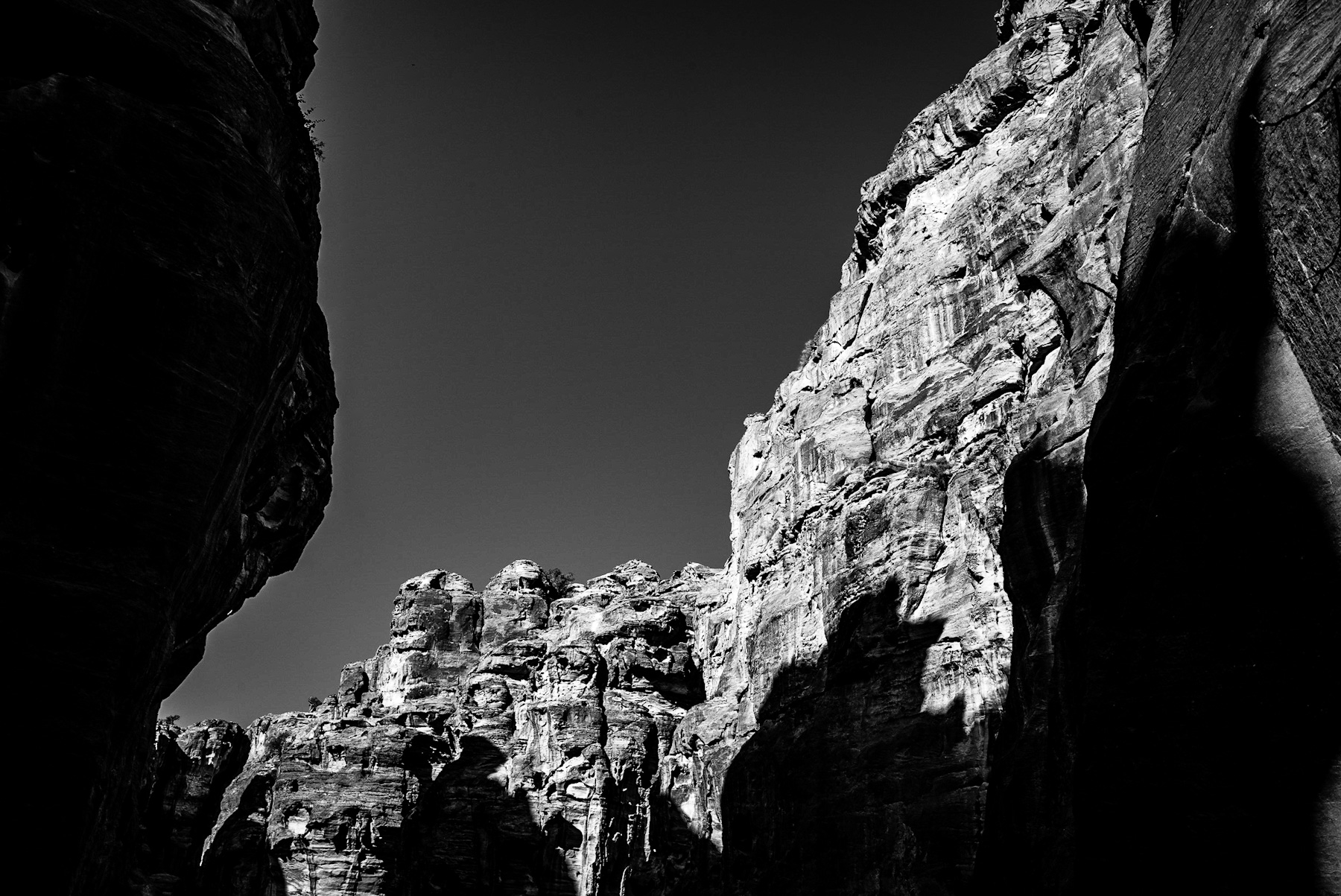
The captured image transports viewers into a realm of profound geological and historical significance. Rendered in striking black and white, it showcases colossal rock formations that dwarf the observer, creating an immediate sense of awe and ancient mystery. This visual narrative is a testament to nature’s enduring power and the silent echoes of a once-thriving civilization.
### Visual Majesty: Light, Shadow, and Texture
The photograph meticulously frames a narrow passage, defined by towering sandstone cliffs on both sides. The monochromatic palette accentuates the dramatic interplay of light and shadow, carving deep contours and highlighting the rugged textures of the rock face. On the left, a colossal cliff looms, almost entirely shrouded in deep shadow, its formidable presence creating a powerful silhouette against the lighter expanse of the sky. Conversely, the right-hand cliff reveals intricate geological layers and erosion patterns, bathed in dappled sunlight and punctuated by sharp, angular shadows that underscore its immense scale. In the distance, a series of smaller, craggy peaks hint at the vastness of the landscape beyond. The high contrast and absence of color distill the scene to its fundamental forms, emphasizing the raw power and enduring beauty of nature’s architecture. Every ridge and crevice tells a story of millennia of geological processes, sculpted by wind and water.
### The Historic Gateway to Petra: The Siq
This visual narrative is unmistakably set within the legendary Siq, the principal entrance to the ancient city of Petra in modern-day Jordan. Far more than a mere geological feature, the Siq served as the grand ceremonial gateway for the Nabataeans, an ingenious Arab people who established Petra as their thriving capital around the 4th century BC. This narrow, winding gorge, reaching heights of up to 80 meters, was not only a natural defensive barrier but also a vital artery for the lucrative frankincense, myrrh, and spice trade routes that crisscrossed the ancient world. The journey through the Siq was designed to build anticipation, slowly revealing glimpses of the magnificent rock-cut architecture that defines Petra, culminating in the breathtaking sight of Al-Khazneh (The Treasury).
### A Legacy Carved in Stone: The Nabataean Civilization
The Nabataeans were not only master traders but also ingenious engineers, developing sophisticated hydraulic systems to harness precious water in this arid region, allowing their civilization to flourish. Their architectural prowess is magnificently displayed in the intricate facades carved directly into the sandstone cliffs, turning the very landscape into monumental art. Traversing the Siq today is an immersive journey, echoing the footsteps of countless merchants, pilgrims, and Roman legionaries from millennia past. The imposing scale of the canyon and the quiet grandeur of the cliffs evoke a profound connection to this „lost city,“ which remained hidden from the Western world until its rediscovery in 1812 by Swiss explorer Johann Ludwig Burckhardt. The black and white rendition of this iconic passage enhances its timeless quality, stripping away modern distractions to reveal the enduring spirit of a civilization deeply intertwined with its natural environment. It is a powerful reminder of human ingenuity and nature’s majestic power, converging in a place of unparalleled historical and aesthetic value, inviting contemplation on the passage of time and the echoes of ancient civilizations. Petra, a UNESCO World Heritage Site and one of the New7Wonders of the World, continues to captivate and inspire, with the Siq standing as its dramatic, unforgettable prelude.
### Visual Majesty: Light, Shadow, and Texture
The photograph meticulously frames a narrow passage, defined by towering sandstone cliffs on both sides. The monochromatic palette accentuates the dramatic interplay of light and shadow, carving deep contours and highlighting the rugged textures of the rock face. On the left, a colossal cliff looms, almost entirely shrouded in deep shadow, its formidable presence creating a powerful silhouette against the lighter expanse of the sky. Conversely, the right-hand cliff reveals intricate geological layers and erosion patterns, bathed in dappled sunlight and punctuated by sharp, angular shadows that underscore its immense scale. In the distance, a series of smaller, craggy peaks hint at the vastness of the landscape beyond. The high contrast and absence of color distill the scene to its fundamental forms, emphasizing the raw power and enduring beauty of nature’s architecture. Every ridge and crevice tells a story of millennia of geological processes, sculpted by wind and water.
### The Historic Gateway to Petra: The Siq
This visual narrative is unmistakably set within the legendary Siq, the principal entrance to the ancient city of Petra in modern-day Jordan. Far more than a mere geological feature, the Siq served as the grand ceremonial gateway for the Nabataeans, an ingenious Arab people who established Petra as their thriving capital around the 4th century BC. This narrow, winding gorge, reaching heights of up to 80 meters, was not only a natural defensive barrier but also a vital artery for the lucrative frankincense, myrrh, and spice trade routes that crisscrossed the ancient world. The journey through the Siq was designed to build anticipation, slowly revealing glimpses of the magnificent rock-cut architecture that defines Petra, culminating in the breathtaking sight of Al-Khazneh (The Treasury).
### A Legacy Carved in Stone: The Nabataean Civilization
The Nabataeans were not only master traders but also ingenious engineers, developing sophisticated hydraulic systems to harness precious water in this arid region, allowing their civilization to flourish. Their architectural prowess is magnificently displayed in the intricate facades carved directly into the sandstone cliffs, turning the very landscape into monumental art. Traversing the Siq today is an immersive journey, echoing the footsteps of countless merchants, pilgrims, and Roman legionaries from millennia past. The imposing scale of the canyon and the quiet grandeur of the cliffs evoke a profound connection to this „lost city,“ which remained hidden from the Western world until its rediscovery in 1812 by Swiss explorer Johann Ludwig Burckhardt. The black and white rendition of this iconic passage enhances its timeless quality, stripping away modern distractions to reveal the enduring spirit of a civilization deeply intertwined with its natural environment. It is a powerful reminder of human ingenuity and nature’s majestic power, converging in a place of unparalleled historical and aesthetic value, inviting contemplation on the passage of time and the echoes of ancient civilizations. Petra, a UNESCO World Heritage Site and one of the New7Wonders of the World, continues to captivate and inspire, with the Siq standing as its dramatic, unforgettable prelude.
Schreibe einen Kommentar