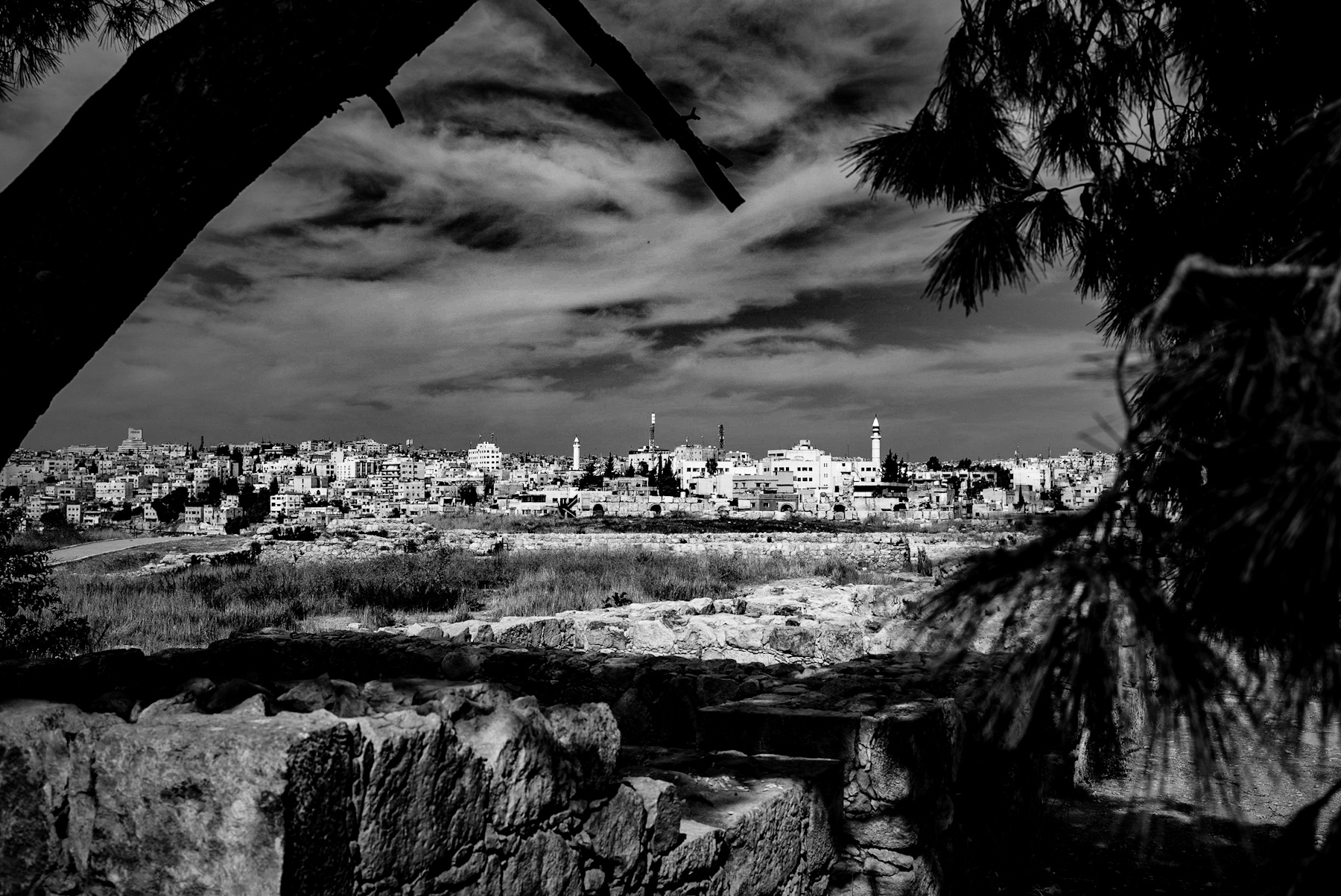
Step into a black and white panorama where history unfurls before your eyes. Through the gnarled embrace of an ancient tree trunk and the delicate lace of pine branches, a dense urban landscape emerges. This monochromatic lens isn’t just a filter; it’s a powerful tool, stripping away the superficial to reveal textures, contrasts, and a profound sense of depth. Above it all, a dramatic, cloud-streaked sky adds a timeless quality, inviting us to ponder millennia of human endeavor.
What the Ancient Stones Whisper
In the immediate foreground, the rugged stone foundations and scattered remnants of an earlier civilization dominate. These aren’t just rocks; they’re the skeletal remains of significant buildings, perhaps a grand temple, a Roman forum, or a Byzantine fortification. Weathered by countless seasons, these substantial blocks tell stories of empires long past. Dry, sparse vegetation weaves through them, underscoring their age and the countless lives that have walked these grounds. This archaeological layer is a powerful reminder: beneath our modern cities often lie the secrets and foundations of distant pasts.
The Enduring Heartbeat of the City
Beyond the ancient ruins, the landscape gently slopes upwards to a sprawling cityscape. Here, tightly packed, light-colored buildings climb the distant hills, forming a vibrant tapestry of generations. Their architecture, while contemporary in some aspects, clearly retains a traditional Middle Eastern aesthetic – think flat roofs and cuboid forms. Rising elegantly towards the heavens are several slender minarets, unmistakable markers of Islamic heritage and worship. They signify a centuries-old Muslim presence that has shaped the city’s cultural and spiritual identity. To the far left, a distinct, perhaps more recent, building with a stepped or pyramidal roof stands out, symbolizing the ongoing evolution and architectural diversity within this ancient setting.
Where Centuries Converge: A Living History Lesson
This photograph masterfully illustrates the profound interplay between past and present. The juxtaposition of ancient ruins in the foreground with a vibrant, living city in the background encapsulates the continuous narrative of human settlement. Many cities in the Levant and wider Middle East, from Amman to Jerusalem or Damascus, are built upon successive layers of civilizations. Roman, Byzantine, Umayyad, Abbasid, Ottoman, and modern eras have each left their indelible mark, often literally building upon the foundations of their predecessors. This image isn’t just a view; it’s an invitation to contemplate how historical events, architectural styles, and cultural shifts have collectively shaped the urban landscape we observe today. It powerfully conveys the resilience of these cities, their ability to adapt and thrive through successive empires and societal changes.
Beyond Color: The Power of Monochrome
The choice of black and white photography here is more than an aesthetic preference; it’s a narrative device. It strips away the distractions of color, allowing us to focus intensely on form, texture, and light. The dramatic contrast between the dark, textured foreground and the brighter, more reflective city buildings enhances the sense of depth and historical weight. The starkness of the monochrome palette underscores the timelessness of the scene, suggesting that while specific details may change, the fundamental experience of an ancient city enduring through time remains constant. This visual approach transforms a mere geographical location into a profound meditation on human legacy and the passage of epochs.
What the Ancient Stones Whisper
In the immediate foreground, the rugged stone foundations and scattered remnants of an earlier civilization dominate. These aren’t just rocks; they’re the skeletal remains of significant buildings, perhaps a grand temple, a Roman forum, or a Byzantine fortification. Weathered by countless seasons, these substantial blocks tell stories of empires long past. Dry, sparse vegetation weaves through them, underscoring their age and the countless lives that have walked these grounds. This archaeological layer is a powerful reminder: beneath our modern cities often lie the secrets and foundations of distant pasts.
The Enduring Heartbeat of the City
Beyond the ancient ruins, the landscape gently slopes upwards to a sprawling cityscape. Here, tightly packed, light-colored buildings climb the distant hills, forming a vibrant tapestry of generations. Their architecture, while contemporary in some aspects, clearly retains a traditional Middle Eastern aesthetic – think flat roofs and cuboid forms. Rising elegantly towards the heavens are several slender minarets, unmistakable markers of Islamic heritage and worship. They signify a centuries-old Muslim presence that has shaped the city’s cultural and spiritual identity. To the far left, a distinct, perhaps more recent, building with a stepped or pyramidal roof stands out, symbolizing the ongoing evolution and architectural diversity within this ancient setting.
Where Centuries Converge: A Living History Lesson
This photograph masterfully illustrates the profound interplay between past and present. The juxtaposition of ancient ruins in the foreground with a vibrant, living city in the background encapsulates the continuous narrative of human settlement. Many cities in the Levant and wider Middle East, from Amman to Jerusalem or Damascus, are built upon successive layers of civilizations. Roman, Byzantine, Umayyad, Abbasid, Ottoman, and modern eras have each left their indelible mark, often literally building upon the foundations of their predecessors. This image isn’t just a view; it’s an invitation to contemplate how historical events, architectural styles, and cultural shifts have collectively shaped the urban landscape we observe today. It powerfully conveys the resilience of these cities, their ability to adapt and thrive through successive empires and societal changes.
Beyond Color: The Power of Monochrome
The choice of black and white photography here is more than an aesthetic preference; it’s a narrative device. It strips away the distractions of color, allowing us to focus intensely on form, texture, and light. The dramatic contrast between the dark, textured foreground and the brighter, more reflective city buildings enhances the sense of depth and historical weight. The starkness of the monochrome palette underscores the timelessness of the scene, suggesting that while specific details may change, the fundamental experience of an ancient city enduring through time remains constant. This visual approach transforms a mere geographical location into a profound meditation on human legacy and the passage of epochs.
Schreibe einen Kommentar