Kategorie: Travel

  • Echoes of Paris: A Glimpse into Parisian History and Commerce

    Echoes of Paris: A Glimpse into Parisian History and Commerce

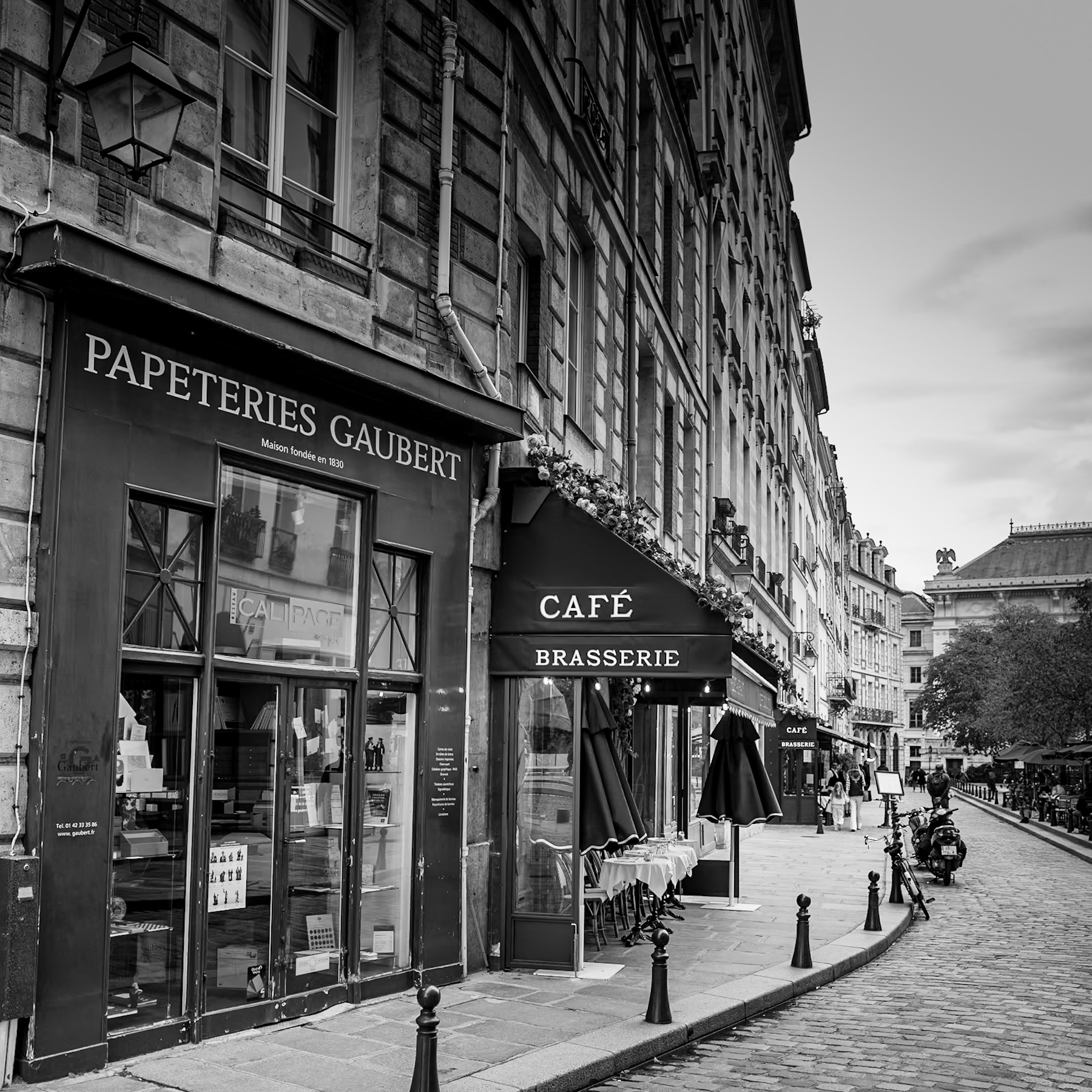
    This monochromatic photograph captures a quintessential Parisian street scene, evoking a sense of timeless elegance and historical depth. The image focuses on the facades of buildings lining a cobblestone street, with a particular emphasis on two establishments: „PAPETERIES GAUBERT“ and a „CAFÉ BRASSERIE.“ The composition, rendered in stark black and white, enhances the architectural details and the textures of the urban environment, inviting the viewer to step back in time.
    A Legacy in Stationery: Papeteries Gaubert
    The prominent sign for „PAPETERIES GAUBERT“ immediately draws attention. Beneath the main lettering, the inscription „Maison fondée en 1830“ reveals the establishment’s long-standing history. Founded in 1830, this stationery shop has witnessed nearly two centuries of Parisian life. The year 1830 marks a significant period in French history, the July Revolution, which led to the overthrow of Charles X and the establishment of the July Monarchy. Businesses that endured through such turbulent times often possess a unique resilience and connection to their community.
    The storefront itself, with its large display windows, offers a peek into the world of fine stationery. Although the details are softened by the grayscale, one can discern stacks of paper, elegant boxes, and what appear to be calligraphic tools or art supplies. The ornate window frames and the classic gas lamp mounted on the wall above further contribute to an atmosphere of old-world charm, suggesting a place where craftsmanship and tradition are valued. The presence of a website address and a telephone number indicates that while the establishment is steeped in history, it has also adapted to modern times.
    The Allure of the Parisian Café
    Adjacent to the papeterie, the awning of a „CAFÉ BRASSERIE“ signals a different facet of Parisian daily life. The word „CAFÉ“ is emblazoned above „BRASSERIE,“ a common designation for establishments that offer both coffee and light meals or drinks. The tables are set with white tablecloths, and closed umbrellas suggest either early morning, the end of the day, or perhaps a pause from the weather. This scene is a familiar tableau in Paris, where cafés serve as social hubs, places for conversation, reflection, and observation.
    Historically, Parisian cafés have played a crucial role in the city’s cultural and intellectual life. From the Enlightenment salons to the literary cafés of the Belle Époque, these establishments have been meeting grounds for artists, writers, philosophers, and revolutionaries. The presence of such a café next to a historic stationery shop creates a narrative of continuity – a place where ideas might have been penned on fine paper and then discussed over coffee.
    Architectural Harmony and the Cobblestone Street
    The buildings themselves are a testament to Parisian architectural heritage. Their stone facades, adorned with intricate detailing and numerous windows, are characteristic of Haussmannian architecture, though some elements might predate that era. The rhythmic repetition of windows and the imposing scale of the buildings create a sense of grandeur and urban density. The cobblestone street, a defining feature of many historic European cities, adds to the visual texture and the sense of authenticity. The slight sheen on the cobblestones might indicate recent rain, adding a subtle atmospheric quality to the image.
    The overall impression is one of a city that cherishes its past while continuing to function in the present. The photograph captures a moment that is both specific to this location and universally evocative of the Parisian experience – a blend of commerce, culture, and enduring architectural beauty. It’s a visual invitation to explore the stories held within these historic streets and the businesses that have become part of their fabric.
  • A Timeless Icon: The Eiffel Tower Through the Lens of History and Nature

    A Timeless Icon: The Eiffel Tower Through the Lens of History and Nature

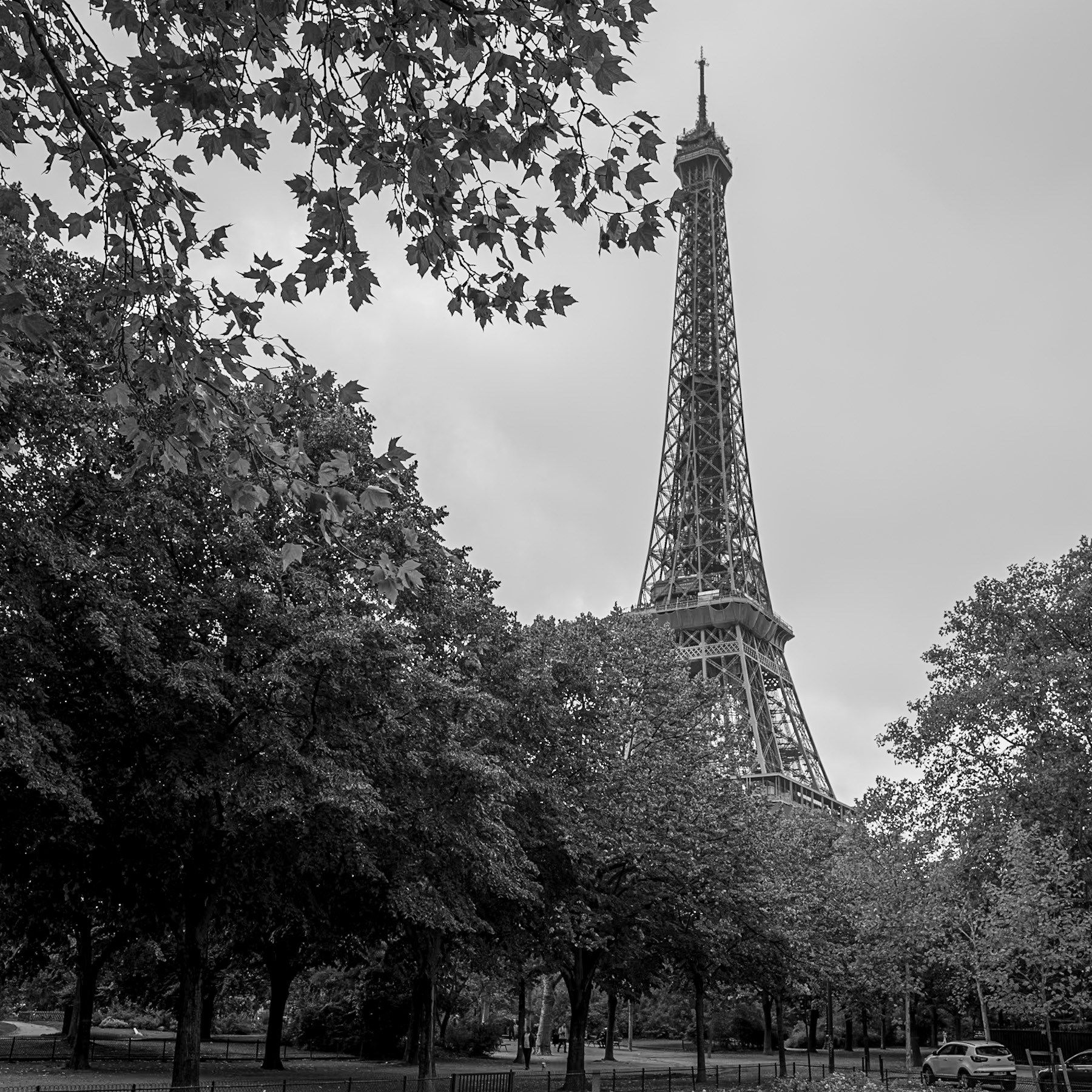
    The image captures the iconic Eiffel Tower, a symbol of Paris and an enduring testament to human ingenuity. Framed by the lush foliage of mature trees, the monochromatic tones lend a classic and timeless quality to the scene, inviting reflection on its rich history and its place within the urban landscape.
    A Monument Born of Innovation:
    Erected for the 1889 Exposition Universelle (World’s Fair), the Eiffel Tower was a bold statement of France’s industrial prowess and engineering capabilities. Designed by Gustave Eiffel and his company, it was initially met with considerable criticism from artistic and literary circles who deemed it a monstrous eyesore. However, its innovative lattice-work design, a marvel of its time, and its sheer scale quickly captured the public imagination. Standing at 300 meters (984 feet), it was the tallest man-made structure in the world for over 40 years.
    Beyond the Fair: Enduring Significance:
    Despite its initial controversy, the Eiffel Tower transcended its temporary purpose. It proved invaluable for communication purposes, serving as a crucial radio transmission tower during World War I. This practical utility helped solidify its place in Parisian life and its acceptance by the public. Over the decades, it has become an indispensable part of the Parisian skyline, a beacon for tourists and locals alike, and a potent symbol of romance, art, and culture.
    Nature’s Embrace:
    The photograph skillfully integrates the grandeur of the tower with the organic beauty of its surroundings. The trees, with their full canopies, create a natural frame, softening the industrial harshness of the iron structure. This juxtaposition highlights the harmonious coexistence of man-made marvels and the natural world. The dappled light filtering through the leaves suggests a tranquil moment, offering a serene perspective on a monument often associated with bustling city life.
    SEO Keywords: Eiffel Tower, Paris, Gustave Eiffel, Exposition Universelle, World’s Fair, Parisian landmark, French history, architecture, engineering, iconic monument, travel, France, black and white photography, urban landscape, nature.
  • The Iconic Moulin Rouge: A Beacon of Parisian Nightlife and Artistic History

    The Iconic Moulin Rouge: A Beacon of Parisian Nightlife and Artistic History

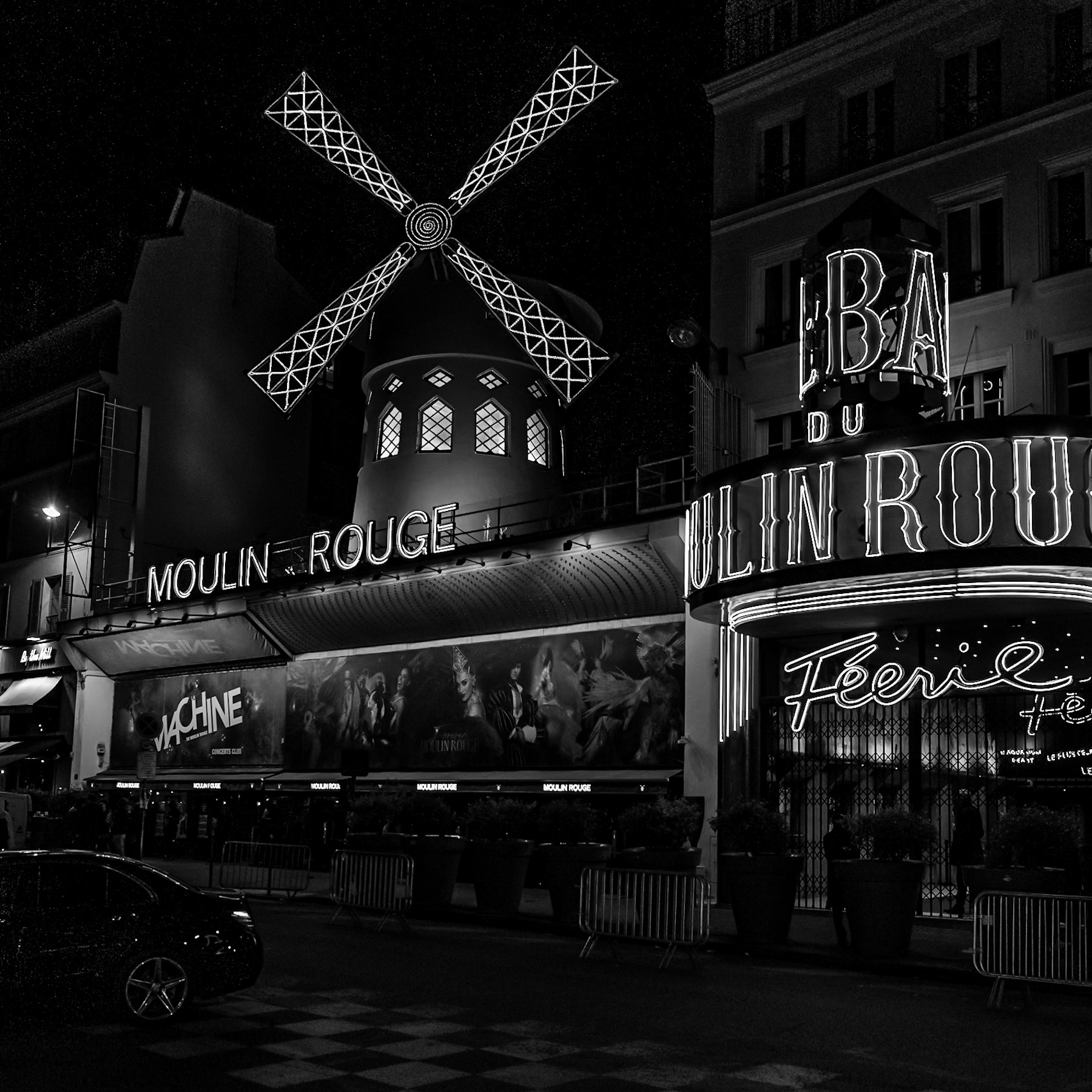
    The image captures the unmistakable silhouette of the Moulin Rouge in Paris at night. Bathed in the stark contrast of black and white, the iconic windmill, a symbol of the establishment, stands prominently against the dark sky, its lattice structure illuminated by a web of lights. Below, the theatre’s facade glows with the vibrant neon signs that have become synonymous with this legendary venue. The prominent „MOULIN ROUGE“ lettering, rendered in bright, stylized script, immediately identifies the location. Further along, the neon sign for „Féerie,“ the name of their current show, adds another layer of luminous allure.
    The Moulin Rouge, located in the Pigalle district at the foot of Montmartre, first opened its doors in 1889. It quickly became a hub for entertainment, attracting artists, writers, and the Parisian elite. The era was one of burgeoning artistic movements and a liberalization of social norms, and the Moulin Rouge was at the forefront of this cultural shift. It was a place where the avant-garde could flourish, and its cabaret performances, featuring can-can dancers and elaborate shows, became legendary.
    Historically, the Moulin Rouge was not just a place for entertainment; it was an inspiration. Artists like Henri de Toulouse-Lautrec immortalized the venue and its performers in his iconic posters and paintings, capturing the energy, the glamour, and the sometimes gritty reality of Parisian nightlife during the Belle Époque. The image, with its dramatic lighting and bold signage, evokes this historical connection, suggesting the enduring legacy of the Moulin Rouge as a place of spectacle and artistic expression.
    The scene depicted in the photograph is a testament to the venue’s continued prominence. The „MACHINE CONCERTS CLUB“ sign hints at the diverse range of entertainment offered, while the large posters on the facade showcase the visual artistry that is central to the Moulin Rouge experience. The presence of potted plants and elegant fencing suggests a well-maintained and inviting entrance, preparing visitors for the magic that lies within. Even in monochrome, the interplay of light and shadow creates a sense of depth and intrigue, inviting the viewer to imagine the sounds, sights, and atmosphere of this Parisian landmark. The Moulin Rouge remains a powerful symbol of Paris, a place where history, art, and entertainment converge to create unforgettable experiences.
  • Echoes of the Past: A Glimpse into the Paris Catacombs

    Echoes of the Past: A Glimpse into the Paris Catacombs

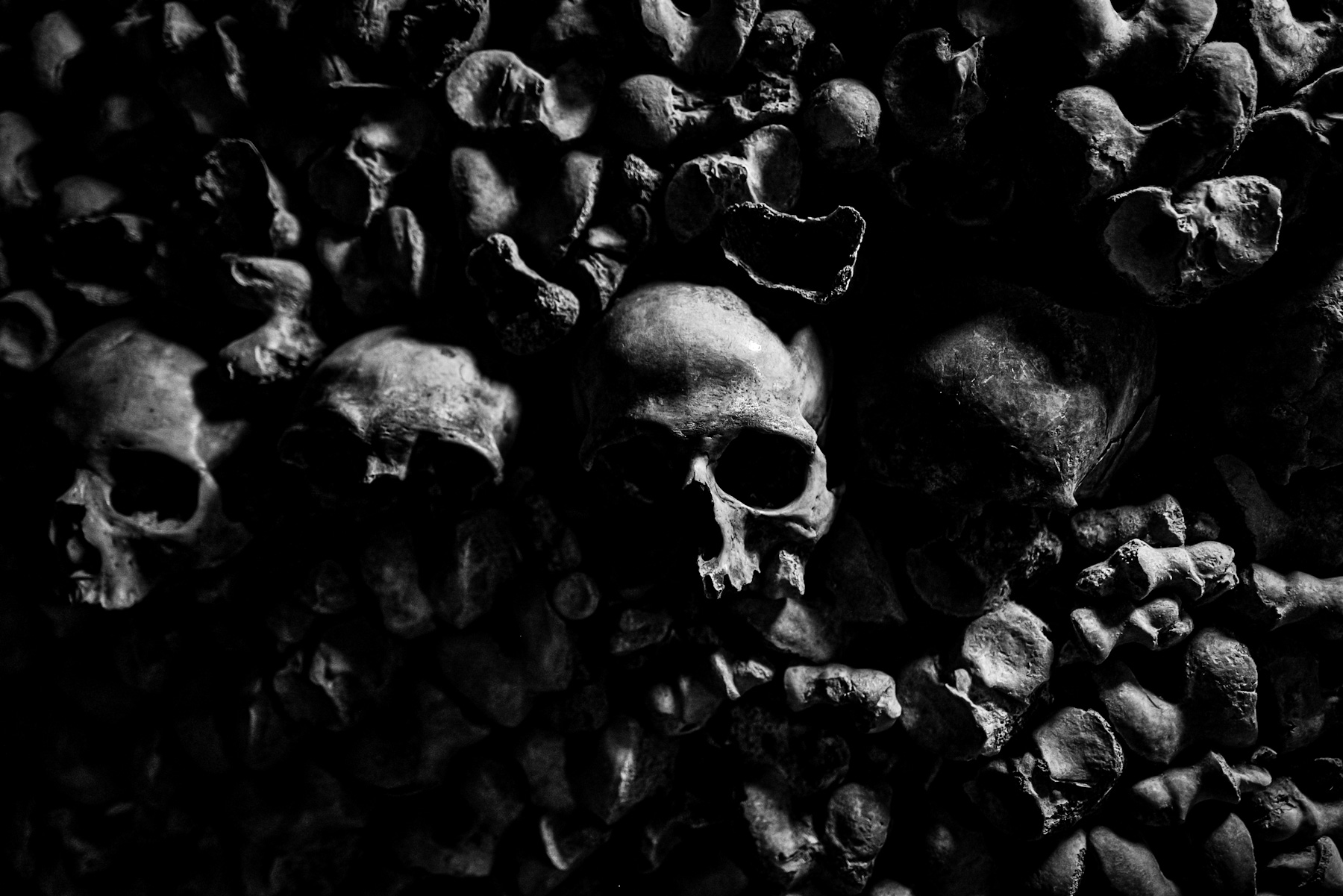
    The image presents a stark and powerful tableau, a dense arrangement of human skulls and bones that evokes a profound sense of history and mortality. Rendered in monochromatic tones, the texture and form of each skeletal element are emphasized, drawing the viewer into a scene that is both macabre and historically significant. The lighting, with its deep shadows and focused highlights, amplifies the dramatic impact, suggesting the enclosed and perhaps solemn atmosphere of its origin.
    This visual narrative is intrinsically linked to the Paris Catacombs, an ossuary holding the remains of more than six million Parisians. The origins of this vast underground network lie not in a desire for morbid display, but in a pressing public health crisis that gripped Paris in the late 18th century. The city’s overflowing cemeteries, particularly Les Innocents, had become a significant source of disease and unsanitary conditions. The stench and potential for contamination were unbearable, prompting authorities to seek a radical solution.
    In 1786, the decision was made to transfer the bones from these overcrowded burial sites to the abandoned limestone quarries that honeycombed the southern part of Paris. This monumental undertaking, which continued for decades, involved the systematic exhumation and relocation of countless remains. The bones were meticulously sorted and arranged, transforming the dark, subterranean tunnels into an organized repository of Parisian history.
    The image captures the essence of this transformation. The skulls, with their vacant eye sockets, and the jumbled arrangement of femurs, tibias, and other bones, are not merely a collection of human remnants. They represent generations of Parisians, their lives, their struggles, and their eventual resting place. The careful, albeit somber, arrangement often seen in the Catacombs, where skulls might be stacked in patterns or bones form decorative columns, speaks to a deliberate effort to impose order upon the vastness of death.
    The artistic rendering in the photograph, with its emphasis on form and shadow, invites contemplation on themes of mortality, memory, and the transient nature of human existence. It serves as a powerful reminder of the collective past that lies beneath the bustling modern city of Paris. The Catacombs, and by extension images like this, offer a unique perspective on urban history, demonstrating how pragmatic solutions to public health issues can inadvertently create enduring and thought-provoking landmarks. This dense tapestry of bones is a testament to the enduring legacy of those who came before, a silent, yet eloquent, chronicle of life and death in the heart of France.
    Keywords: Paris Catacombs, ossuary, human remains, skulls, bones, history, mortality, Paris, Les Innocents, 18th century, underground, cemetery, public health, macabre, memorial, historical landmark, urban history, remembrance.
  • Le Chat Noir: A Parisian Nightscape and Its Bohemian Echoes

    Le Chat Noir: A Parisian Nightscape and Its Bohemian Echoes

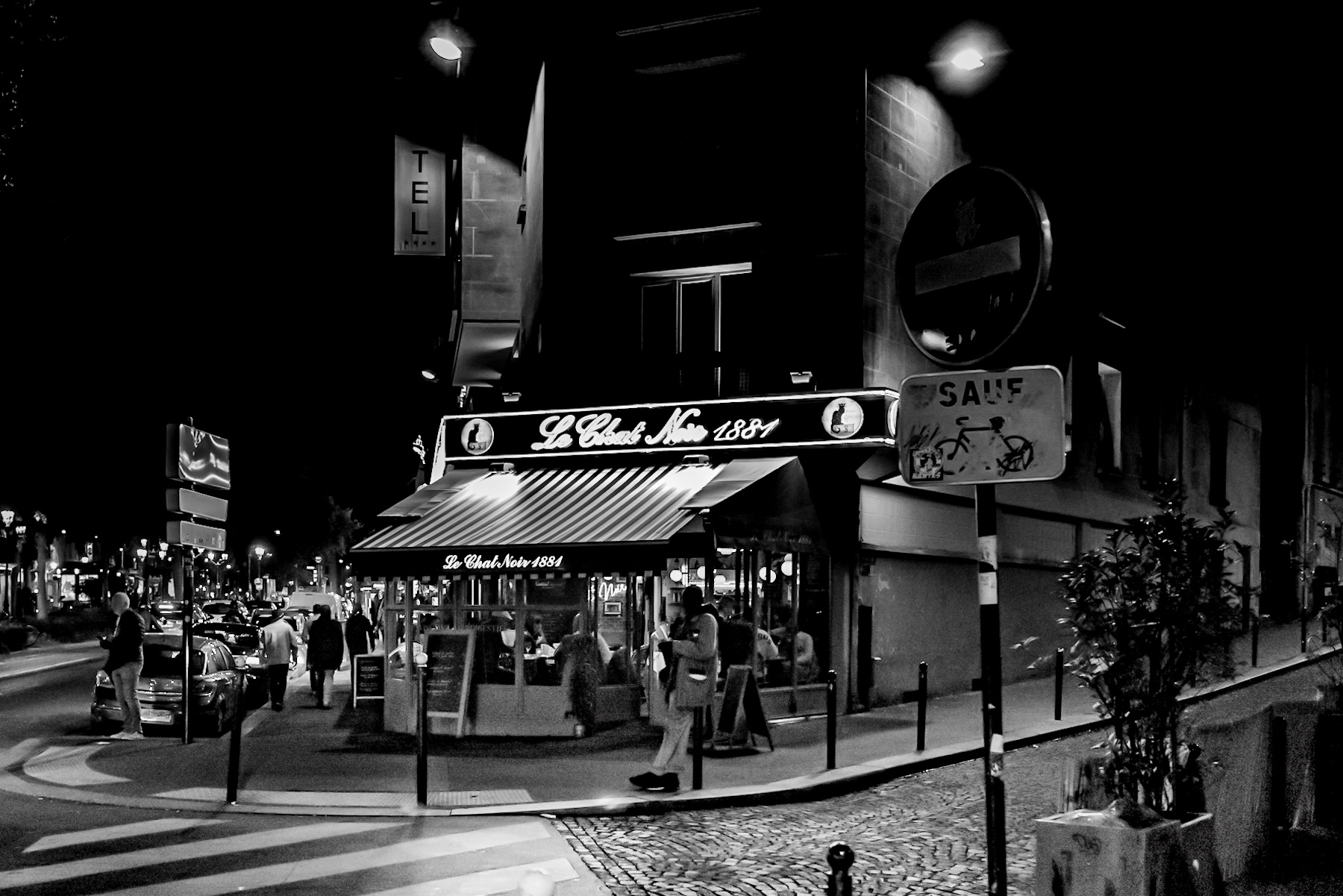
    The black and white photograph captures a quintessential Parisian street scene at night. The iconic signage of „Le Chat Noir 1881“ illuminates the facade of a building, its neon glow casting a distinct atmosphere onto the cobblestone street. The awning of the establishment, striped and classic, hints at a bygone era. Figures, silhouetted against the ambient light, move along the sidewalk and cross the street, their presence adding a sense of life and movement to the nocturnal tableau. Cars are parked along the curb, their forms softened by the darkness and the limited light sources.
    The sign itself, with its stylized lettering and the emblem of a black cat, immediately evokes the rich history associated with this name. „Le Chat Noir“ was not merely a cabaret; it was a legendary venue in Montmartre, Paris, during the late 19th and early 20th centuries. Founded in 1881 by Rodolphe Salis, it became the epicenter of bohemian culture, attracting artists, writers, poets, musicians, and intellectuals. It was a place where avant-garde ideas flourished, and where the spirit of artistic rebellion found a vibrant expression.
    The date „1881“ prominently displayed on the sign is a direct reference to the founding year of the original cabaret. This historic establishment was known for its cabaret performances, shadow plays, and its role in fostering the careers of many prominent figures of the Belle Époque. It was a hub for the Absinthe-fueled artistic scene, a stark contrast to the more formal salons of the time. The black cat, the establishment’s symbol, became an internationally recognized icon of Montmartre’s artistic and bohemian identity.
    The photograph, while depicting a contemporary scene, carries the weight of this historical legacy. The enduring presence of the name „Le Chat Noir“ suggests a continuation, perhaps a modern incarnation or a respectful homage to the original. The street signs, including one that appears to indicate „SAUF“ (except), and the traffic signals, are typical of urban environments, grounding the image in the present. Yet, the overall mood, enhanced by the monochrome palette and the dramatic interplay of light and shadow, lends a timeless quality to the scene.
    The visual elements of the photograph – the architecture, the street lighting, the style of the signage, and the very act of people gathering at night – all contribute to a sense of urban narrative. It invites the viewer to contemplate the layers of history embedded within the Parisian landscape. The modern streetscape coexists with the echoes of a vibrant past, a past characterized by artistic innovation, social commentary, and a unique brand of Parisian charm. This image serves as a visual bridge, connecting the present-day experience of the city with its storied bohemian heritage, embodied by the enduring legend of Le Chat Noir.
  • The Arc de Triomphe: A Timeless Symbol of French History and Grandeur

    The Arc de Triomphe: A Timeless Symbol of French History and Grandeur

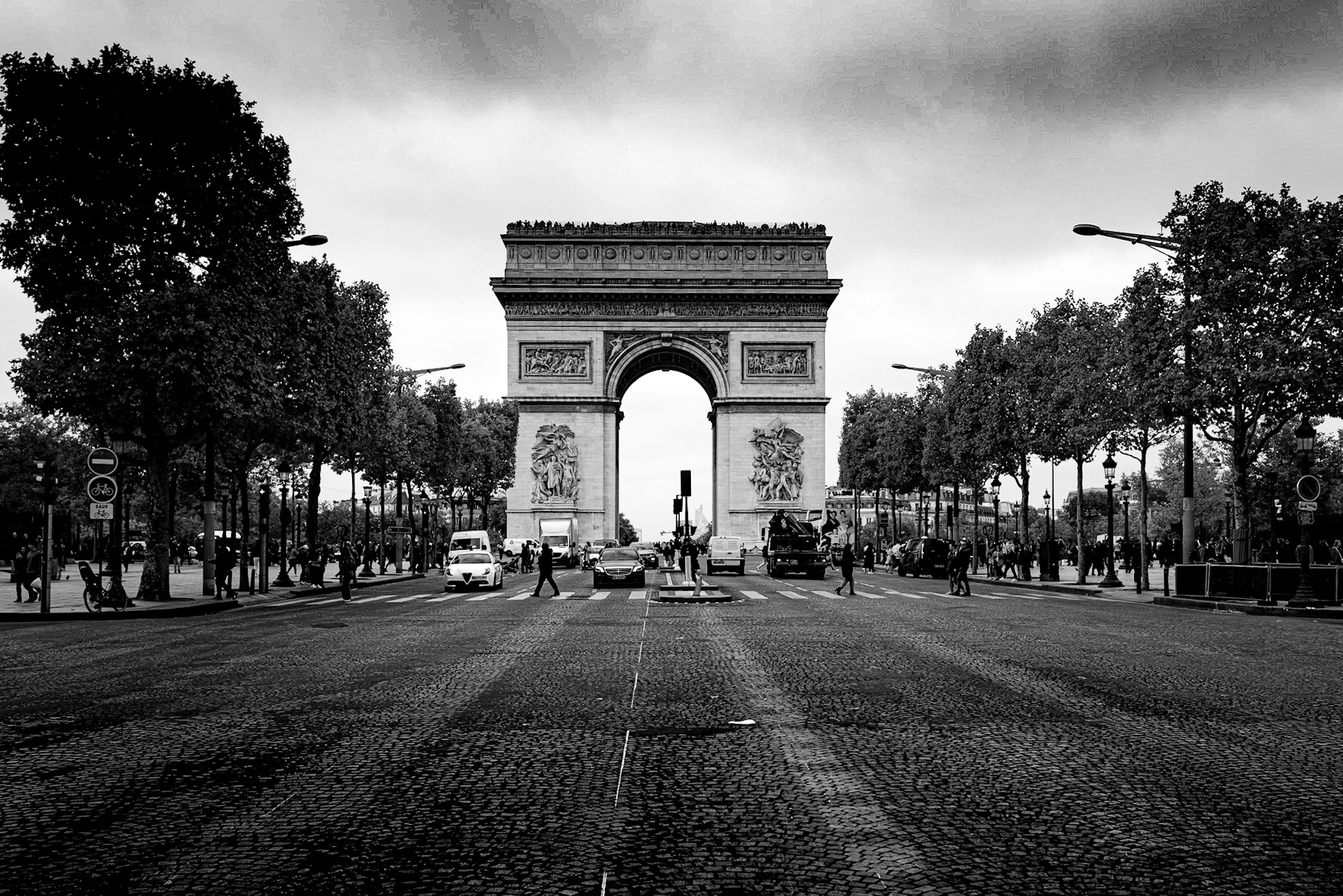
    The photograph presents a classic, almost poetic view of the Arc de Triomphe in Paris, a monument that resonates deeply with French national identity and historical achievements. The black and white treatment imbues the scene with a sense of timelessness, drawing attention to the impressive architecture and the enduring story it tells.
    **Architectural Majesty and Historical Roots**
    The magnificent Arc de Triomphe commands the center of the image. Its grand design, detailed with elaborate sculptures and bas-reliefs, stands as a testament to the artistic and engineering skills of its era. Napoleon Bonaparte’s vision for this arch, commissioned in 1806 following his victory at Austerlitz, was to honor the French military. Its construction, however, was a lengthy endeavor, spanning thirty years and reflecting the turbulent political landscape of France during that period.
    This architectural marvel is a prime example of Neoclassical style, drawing inspiration from the triumphal arches of ancient Rome. Particularly striking are the four principal sculptural ensembles at the base: François Rude’s „The Departure of the Volunteers of 1792“ (often referred to as La Marseillaise), Jean-Pierre Cortot’s „The Triumph of 1810,“ and Antoine Étex’s „The Resistance of 1814“ and „The Peace of 1815.“ These allegorical representations capture pivotal moments in French history, from the revolutionary spirit to eras of both conflict and accord.
    **A Bustling Parisian Crossroads**
    Despite the absence of color, the area surrounding the Arc pulses with life. The cobblestone streets, a hallmark of historic European cities, lead the eye towards the monument, their surfaces mirroring the subdued tones of the sky and adding tactile depth to the foreground. Modern Parisian life is evident in the presence of automobiles, including a notable white sedan navigating the intersection, and what appears to be a truck. Pedestrians, their forms softened by motion, can be seen crossing the streets, underscoring the dynamic energy of this renowned location.
    The avenues are graced with trees, their branches reaching skyward, introducing a natural counterpoint to the urban environment. Tall, slender lampposts stand as sentinels, hinting at the transition from day to night. The overall composition, with the Arc as its undisputed focal point and the converging avenues drawing the viewer in, creates a profound sense of perspective and awe.
    **Enduring Significance**
    The Arc de Triomphe transcends its status as a mere historical artifact; it serves as a central stage for national celebrations, military processions, and solemn commemorative events. It is also the resting place of the Unknown Soldier from World War I, whose tomb is marked by the eternal flame, a perpetual symbol of sacrifice and remembrance. Situated at the western end of the iconic Champs-Élysées, it is undeniably one of Paris’s most paramount landmarks.
    This photograph, with its stark yet evocative imagery, invites contemplation on the rich tapestry of history, art, and human experience that converges at this extraordinary site. It encapsulates the enduring spirit of Paris and the monumental achievements it commemorates, solidifying the Arc de Triomphe’s position as a timeless emblem of French heritage.
    **Keywords:** Arc de Triomphe, Paris, France, Monument, History, Architecture, Napoleon Bonaparte, Champs-Élysées, Triumphal Arch, Neoclassical, French History, Landmark, Parisian Icon.
  • Bearing the Weight of History: A Look at the Wallace Fountain’s Artistic Legacy

    Bearing the Weight of History: A Look at the Wallace Fountain’s Artistic Legacy

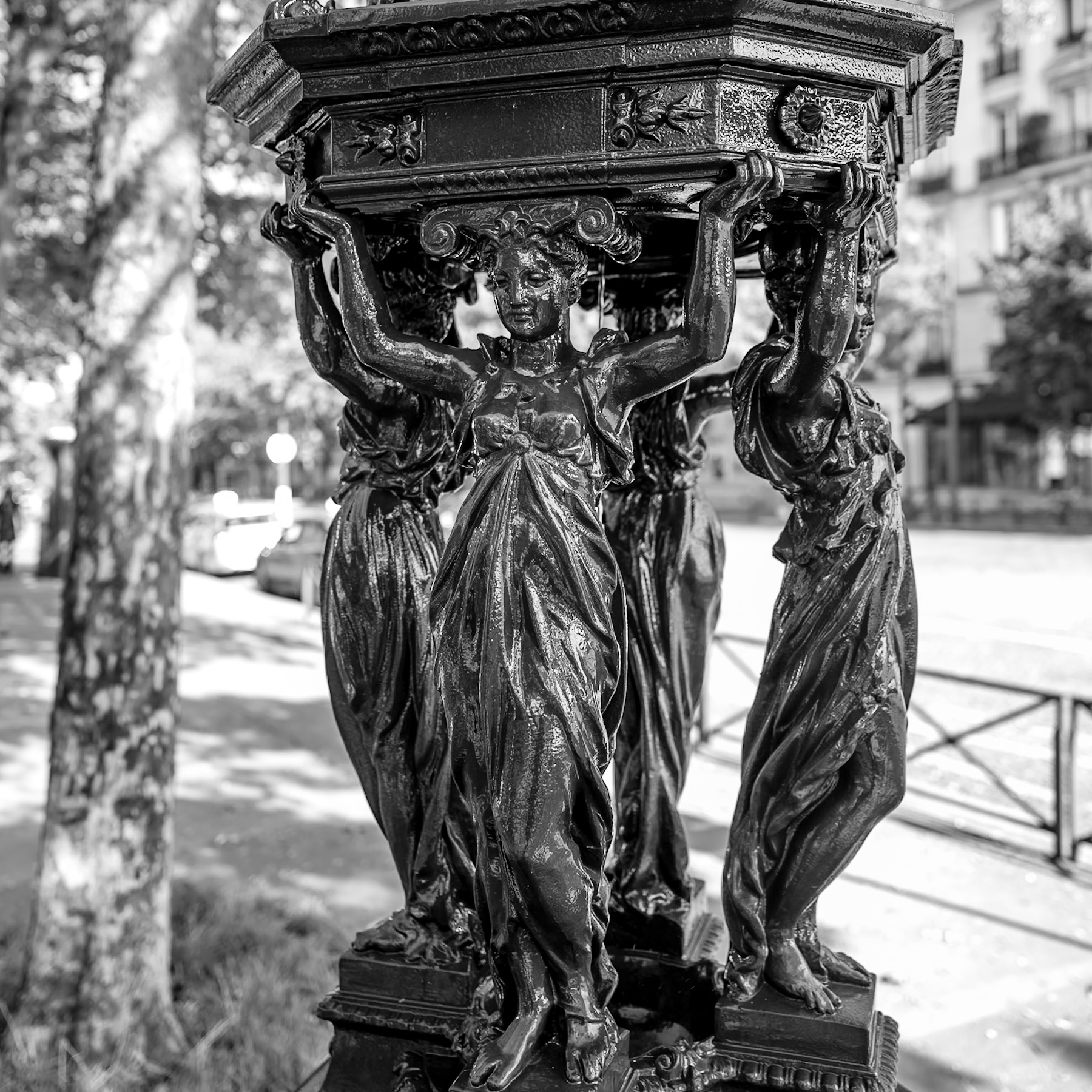
    The image presents a detailed, black and white view of the upper section of a Wallace Fountain, a distinctive piece of public art and infrastructure found across Paris and beyond. The focus is on the intricate sculptural work, specifically the four female figures, known as „Caryatids,“ that support a decorative, ornate basin above. These figures, rendered in dark, weathered metal, are depicted with flowing drapery that emphasizes their musculature and graceful posture. Their arms are raised, straining to hold the heavy structure, a powerful visual metaphor for endurance and support.
    The artistic style of these figures reflects the Second Empire aesthetic prevalent in Paris during the mid-19th century. This era, under Napoleon III, saw a significant urban renewal and beautification program, spearheaded by Baron Haussmann. The grand boulevards, uniform architecture, and proliferation of public art, including fountains, were hallmarks of this period. The Wallace Fountains, conceived by Sir Richard Wallace and designed by Charles-Auguste Lebourg, were not merely decorative elements; they served a vital social function.
    Commissioned in the 1870s, these fountains were intended to provide free access to drinking water for the public, a progressive initiative in a rapidly expanding city. They were placed strategically throughout Paris, becoming an integral part of the urban landscape and a symbol of philanthropic endeavor. The choice of classical figures, such as the Caryatids, to adorn the fountains was deliberate. In classical architecture, Caryatids are female figures used as supporting columns. Their inclusion here evokes a sense of timelessness and enduring strength, aligning with the fountain’s purpose of providing a stable and essential resource.
    The craftsmanship evident in the sculpture is remarkable. The detailed rendering of the faces, the folds of the fabric, and the muscular tension in the figures suggest a high level of skill from the foundry workers. The patina of the metal, captured in this monochrome image, adds a sense of age and gravitas, hinting at the many years these figures have stood in their public spaces, silently witnessing the ebb and flow of city life.
    The background of the photograph, slightly blurred, suggests an urban setting with trees lining a walkway and buildings in the distance. This context reinforces the fountain’s role as a piece of public art integrated into the daily life of the city. The contrast between the enduring, classical forms of the sculpture and the transient nature of the urban environment behind it is striking.
    The Wallace Fountains, and the sculptures that adorn them, represent a fascinating intersection of art, engineering, and social reform. They are enduring monuments to a period of significant change in Paris, offering not only a practical service but also a visual reminder of classical ideals and the artistic sensibilities of the 19th century. Each figure, diligently holding its load, becomes a silent testament to the historical context from which it emerged and the enduring value of public art.
    Keywords: Wallace Fountain, Paris, Public Art, Sculpture, Caryatids, 19th Century Art, Second Empire, Baron Haussmann, Charles-Auguste Lebourg, Sir Richard Wallace, Urban Infrastructure, Philanthropy, Classical Sculpture, Architectural Detail, Black and White Photography.
  • Paris Catacombs: A Chilling Testament to History

    Paris Catacombs: A Chilling Testament to History

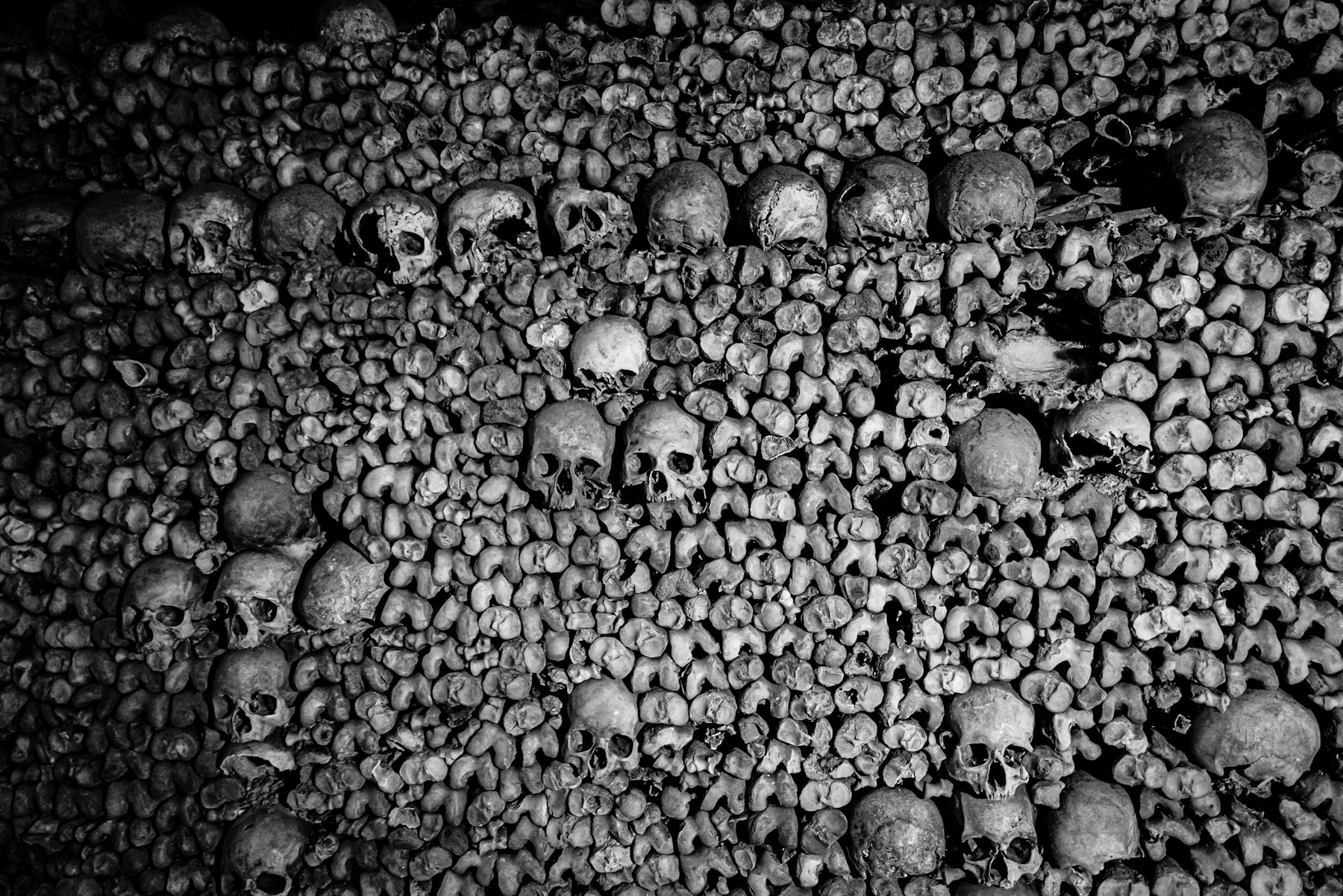
    The stark black and white photograph presents a disquieting yet historically significant scene: walls meticulously constructed from human skulls and bones. This image offers a glimpse into the Paris Catacombs, an ossuary holding the remains of millions of Parisians. The arrangement is not haphazard; skulls are often placed facing outwards, their empty eye sockets staring into the darkness, while femurs and tibias form intricate patterns, creating a macabre yet organized mosaic.
    Historical Context: Addressing a Sanitary Crisis
    The origins of the Paris Catacombs are rooted in a profound public health crisis that plagued the city in the late 18th century. The Parisian cemeteries, particularly the Holy Innocents‘ Cemetery, had become dangerously overcrowded. Centuries of burials had led to the ground becoming saturated with decomposing bodies, posing a significant risk of disease and foul odors that permeated the surrounding neighborhoods. The situation was deemed unsustainable and a threat to public well-being.
    In an effort to resolve this issue, a royal decree was issued in 1785, ordering the transfer of the remains from overflowing cemeteries to underground quarries. These subterranean limestone quarries, which had been excavated for centuries to provide building materials for Paris, offered a vast and stable network of tunnels. The process of exhumation and relocation was a monumental undertaking, involving the careful removal of bones and skulls from their resting places and their transport to the quarries under the cover of night.
    Transformation into an Ossuary
    Once in the quarries, the bones were not simply dumped. Over time, and under the supervision of various officials, they were arranged and organized. The intention was to create a more dignified and respectful resting place, transforming a sanitary necessity into a monumental ossuary. The distinctive wall formations seen in the photograph, with skulls and long bones deliberately stacked, are the result of this organized reburial process. This systematic arrangement served not only practical purposes of space management but also created a unique and somber aesthetic.
    The Catacombs Today: A Tourist Attraction and a Historical Reminder
    Today, a small portion of the Paris Catacombs is open to the public, attracting millions of visitors each year. It has become a significant tourist attraction, offering a unique and profound experience that delves into the history of Paris and the human condition. The site serves as a tangible reminder of past urban challenges, ingenious solutions, and the ephemeral nature of life. The visual impact of the stacked remains is undeniably powerful, evoking contemplation on mortality, memory, and the passage of time. The photograph captures this essence, presenting a silent, enduring testament to a critical period in Parisian history and the enduring human impulse to manage even the most challenging aspects of life and death.
  • Juxtaposition of Luxury and Survival: A Parisian Street Scene

    Juxtaposition of Luxury and Survival: A Parisian Street Scene

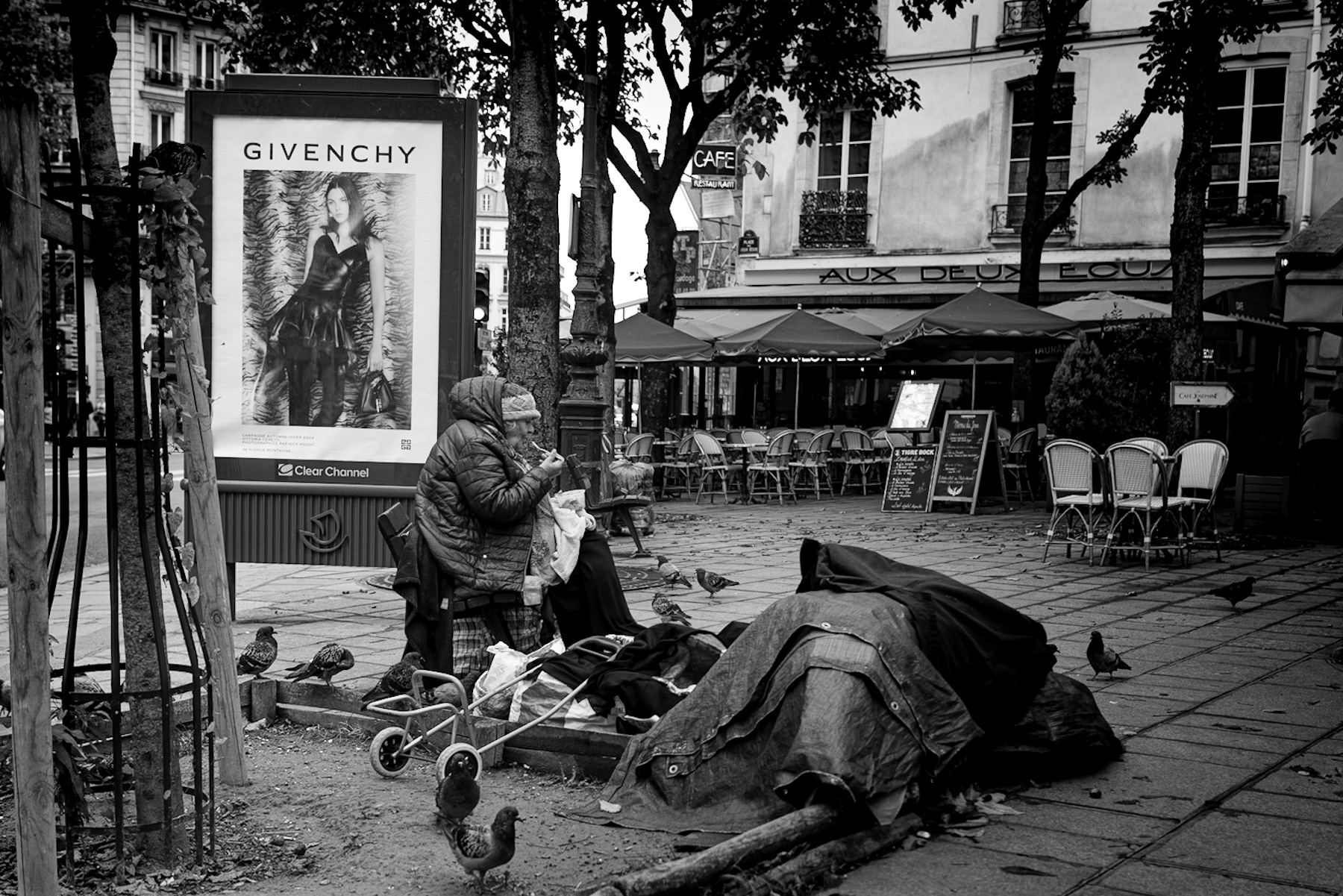
    This black and white photograph captures a poignant scene in what appears to be a Parisian street. The image is dominated by a stark contrast between the world of high fashion and the harsh realities of homelessness, set against the backdrop of a bustling café culture.
    In the foreground, a person, bundled in layers of clothing and a headscarf, is seated on a low surface, seemingly engaged in eating. Their belongings are spread around them, including a small trolley, bags, and what appears to be a makeshift shelter covered by a tarp. Pigeons peck at the ground nearby, a common sight in urban environments, adding to the sense of everyday life unfolding.
    Dominating the left side of the frame is a large advertisement for Givenchy, a renowned French luxury fashion house. The billboard features a striking image of a model in an avant-garde outfit, set against a tiger-print background. The prominent placement of this advertisement for luxury goods directly beside the individual experiencing homelessness creates a powerful visual juxtaposition. It highlights the vast economic disparities that can exist within a single urban space. The „Clear Channel“ branding on the billboard also points to the commercial nature of public space, where advertisements are a constant presence, often framing our perceptions of the world.
    Behind the individual and the advertisement, the scene opens up to a typical Parisian street with a café. Tables and chairs are neatly arranged under awnings, suggesting outdoor seating and a lively atmosphere. A sign for „CAFE RESTAURANT“ is visible, further emphasizing the presence of establishments catering to leisure and consumption. The architecture of the buildings in the background, with their characteristic windows and facades, firmly roots the scene in a European urban setting, likely Paris given the Givenchy advertisement and the café style.
    The historical context of Parisian street life is rich and varied. For centuries, Paris has been a center of art, culture, and commerce, attracting people from all walks of life. The image subtly touches upon the enduring presence of street vendors, artists, and those living on the margins, who have always been part of the city’s fabric. The café culture, in particular, has a long history in Paris, serving as social hubs and places for intellectual and artistic exchange.
    However, this photograph also brings to the fore the contemporary challenges faced by many cities, including Paris: the growing issue of homelessness and the visible presence of individuals struggling with poverty amidst opulence. The stark black and white treatment of the photograph enhances the dramatic contrast and the emotional impact of the scene, forcing the viewer to confront the complex realities of urban existence. It’s a moment frozen in time, capturing a silent narrative of human experience against a backdrop of aspirational advertising and everyday urbanity.
    SEO Keywords: Paris street photography, homelessness, luxury fashion, Givenchy, café culture, urban juxtaposition, social commentary, black and white photography, Parisian life, street scene, economic disparity.
  • Art Nouveau’s Enduring Elegance: A Parisian Métro Entrance

    Art Nouveau’s Enduring Elegance: A Parisian Métro Entrance

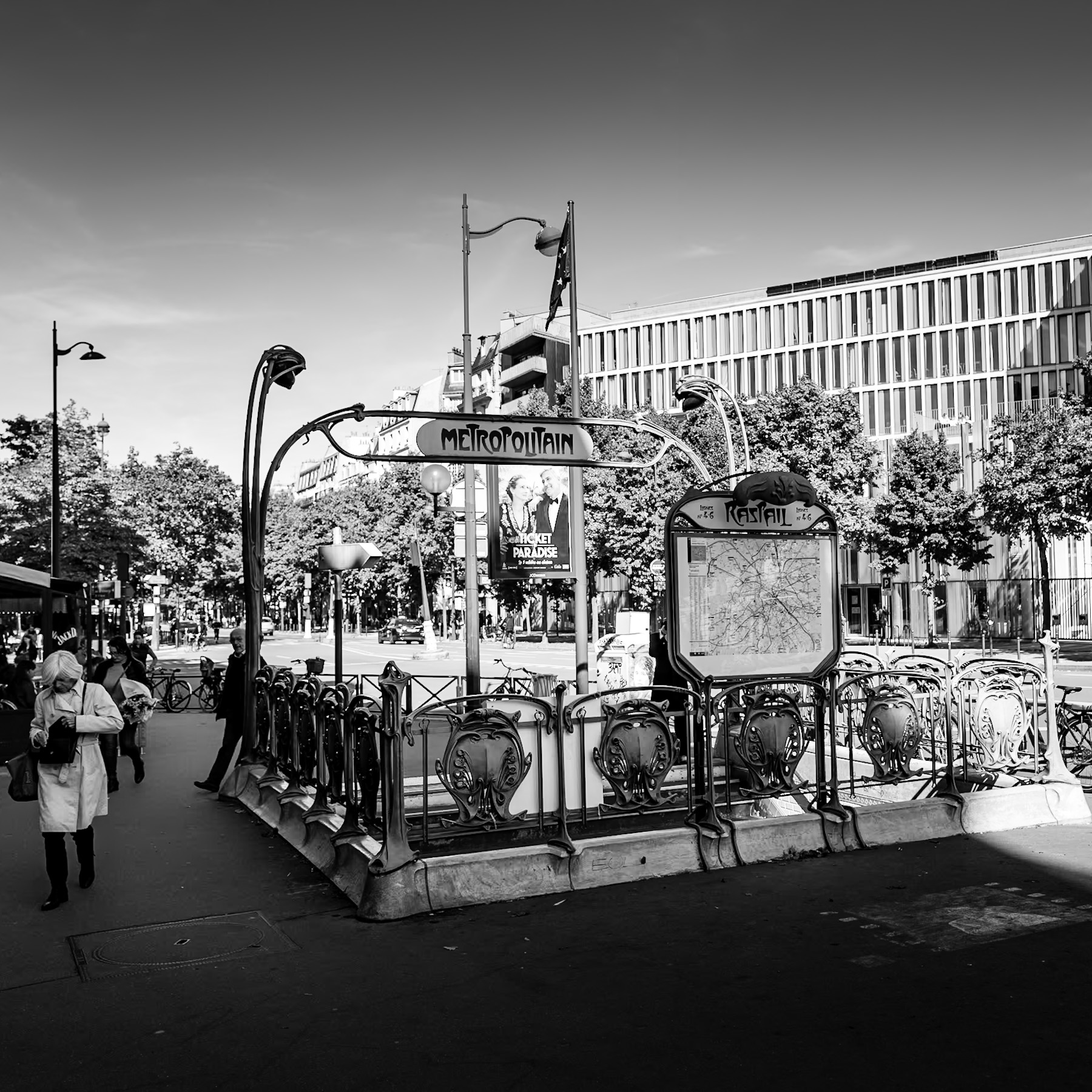
    The black and white photograph captures a quintessential Parisian scene, focusing on a historic Métropolitain entrance that stands as a testament to the enduring legacy of Art Nouveau. The intricate ironwork, characteristic of this artistic movement, forms a decorative barrier around the descent into the underground. These distinctive entrances, designed by Hector Guimard, were commissioned by the Paris Métro company for the 1900 Universal Exhibition, intended to bring a touch of modern artistic flair to the city’s burgeoning public transportation system.
    The „METROPOLITAIN“ signage, rendered in a distinctive font, is prominently displayed, a clear identifier of the station. Below it, an advertisement poster featuring a couple, possibly from a film or theatrical production, adds a layer of contemporary life to the historical structure. The poster, though faded in this monochrome depiction, hints at the vibrant cultural landscape of Paris.
    To the right, a detailed map of the Paris Métro system is encased in glass, showcasing the extensive network that has served the city for over a century. The station name „RASPAIL“ is visible, indicating the specific location, and the mention of „feuille n°46“ suggests an older edition of the map, further emphasizing the historical context.
    The surrounding environment is a blend of old and new. The elegant, organic forms of the Art Nouveau structure are contrasted with the modern, rectilinear architecture of the building in the background. This juxtaposition highlights how Paris, while deeply rooted in its history, continues to evolve. Trees line the street, their leaves providing a natural canopy, and pedestrians are seen moving along the sidewalk, their presence grounding the scene in the present day. The presence of streetlights, also designed in a style that echoes Guimard’s work, reinforces the cohesive aesthetic of the Métro’s early infrastructure.
    This image is more than just a snapshot of a Métro station; it is a visual narrative of Paris’s commitment to integrating art and functionality. The Art Nouveau entrances are not merely functional access points but are recognized as significant works of public art, cherished for their unique design and their contribution to the city’s identity. They represent a period when public infrastructure was conceived with an emphasis on beauty and artistic expression, a philosophy that continues to define the charm of Paris and its iconic Métro system. The timeless appeal of these structures ensures their place as enduring symbols of Parisian heritage and design innovation.