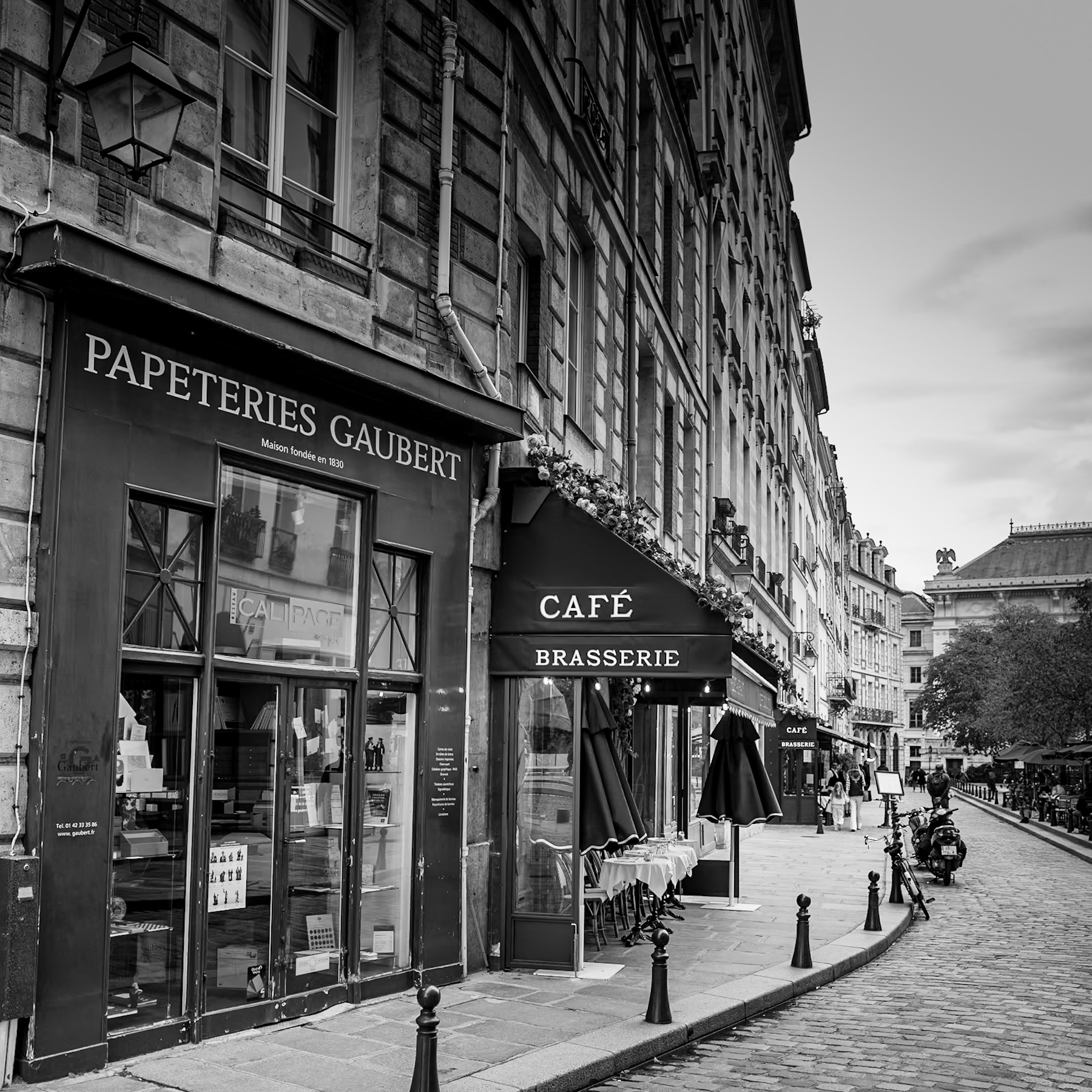
This monochromatic photograph captures a quintessential Parisian street scene, evoking a sense of timeless elegance and historical depth. The image focuses on the facades of buildings lining a cobblestone street, with a particular emphasis on two establishments: „PAPETERIES GAUBERT“ and a „CAFÉ BRASSERIE.“ The composition, rendered in stark black and white, enhances the architectural details and the textures of the urban environment, inviting the viewer to step back in time.
A Legacy in Stationery: Papeteries Gaubert
The prominent sign for „PAPETERIES GAUBERT“ immediately draws attention. Beneath the main lettering, the inscription „Maison fondée en 1830“ reveals the establishment’s long-standing history. Founded in 1830, this stationery shop has witnessed nearly two centuries of Parisian life. The year 1830 marks a significant period in French history, the July Revolution, which led to the overthrow of Charles X and the establishment of the July Monarchy. Businesses that endured through such turbulent times often possess a unique resilience and connection to their community.
The storefront itself, with its large display windows, offers a peek into the world of fine stationery. Although the details are softened by the grayscale, one can discern stacks of paper, elegant boxes, and what appear to be calligraphic tools or art supplies. The ornate window frames and the classic gas lamp mounted on the wall above further contribute to an atmosphere of old-world charm, suggesting a place where craftsmanship and tradition are valued. The presence of a website address and a telephone number indicates that while the establishment is steeped in history, it has also adapted to modern times.
The Allure of the Parisian Café
Adjacent to the papeterie, the awning of a „CAFÉ BRASSERIE“ signals a different facet of Parisian daily life. The word „CAFÉ“ is emblazoned above „BRASSERIE,“ a common designation for establishments that offer both coffee and light meals or drinks. The tables are set with white tablecloths, and closed umbrellas suggest either early morning, the end of the day, or perhaps a pause from the weather. This scene is a familiar tableau in Paris, where cafés serve as social hubs, places for conversation, reflection, and observation.
Historically, Parisian cafés have played a crucial role in the city’s cultural and intellectual life. From the Enlightenment salons to the literary cafés of the Belle Époque, these establishments have been meeting grounds for artists, writers, philosophers, and revolutionaries. The presence of such a café next to a historic stationery shop creates a narrative of continuity – a place where ideas might have been penned on fine paper and then discussed over coffee.
Architectural Harmony and the Cobblestone Street
The buildings themselves are a testament to Parisian architectural heritage. Their stone facades, adorned with intricate detailing and numerous windows, are characteristic of Haussmannian architecture, though some elements might predate that era. The rhythmic repetition of windows and the imposing scale of the buildings create a sense of grandeur and urban density. The cobblestone street, a defining feature of many historic European cities, adds to the visual texture and the sense of authenticity. The slight sheen on the cobblestones might indicate recent rain, adding a subtle atmospheric quality to the image.
The overall impression is one of a city that cherishes its past while continuing to function in the present. The photograph captures a moment that is both specific to this location and universally evocative of the Parisian experience – a blend of commerce, culture, and enduring architectural beauty. It’s a visual invitation to explore the stories held within these historic streets and the businesses that have become part of their fabric.
A Legacy in Stationery: Papeteries Gaubert
The prominent sign for „PAPETERIES GAUBERT“ immediately draws attention. Beneath the main lettering, the inscription „Maison fondée en 1830“ reveals the establishment’s long-standing history. Founded in 1830, this stationery shop has witnessed nearly two centuries of Parisian life. The year 1830 marks a significant period in French history, the July Revolution, which led to the overthrow of Charles X and the establishment of the July Monarchy. Businesses that endured through such turbulent times often possess a unique resilience and connection to their community.
The storefront itself, with its large display windows, offers a peek into the world of fine stationery. Although the details are softened by the grayscale, one can discern stacks of paper, elegant boxes, and what appear to be calligraphic tools or art supplies. The ornate window frames and the classic gas lamp mounted on the wall above further contribute to an atmosphere of old-world charm, suggesting a place where craftsmanship and tradition are valued. The presence of a website address and a telephone number indicates that while the establishment is steeped in history, it has also adapted to modern times.
The Allure of the Parisian Café
Adjacent to the papeterie, the awning of a „CAFÉ BRASSERIE“ signals a different facet of Parisian daily life. The word „CAFÉ“ is emblazoned above „BRASSERIE,“ a common designation for establishments that offer both coffee and light meals or drinks. The tables are set with white tablecloths, and closed umbrellas suggest either early morning, the end of the day, or perhaps a pause from the weather. This scene is a familiar tableau in Paris, where cafés serve as social hubs, places for conversation, reflection, and observation.
Historically, Parisian cafés have played a crucial role in the city’s cultural and intellectual life. From the Enlightenment salons to the literary cafés of the Belle Époque, these establishments have been meeting grounds for artists, writers, philosophers, and revolutionaries. The presence of such a café next to a historic stationery shop creates a narrative of continuity – a place where ideas might have been penned on fine paper and then discussed over coffee.
Architectural Harmony and the Cobblestone Street
The buildings themselves are a testament to Parisian architectural heritage. Their stone facades, adorned with intricate detailing and numerous windows, are characteristic of Haussmannian architecture, though some elements might predate that era. The rhythmic repetition of windows and the imposing scale of the buildings create a sense of grandeur and urban density. The cobblestone street, a defining feature of many historic European cities, adds to the visual texture and the sense of authenticity. The slight sheen on the cobblestones might indicate recent rain, adding a subtle atmospheric quality to the image.
The overall impression is one of a city that cherishes its past while continuing to function in the present. The photograph captures a moment that is both specific to this location and universally evocative of the Parisian experience – a blend of commerce, culture, and enduring architectural beauty. It’s a visual invitation to explore the stories held within these historic streets and the businesses that have become part of their fabric.
Schreibe einen Kommentar