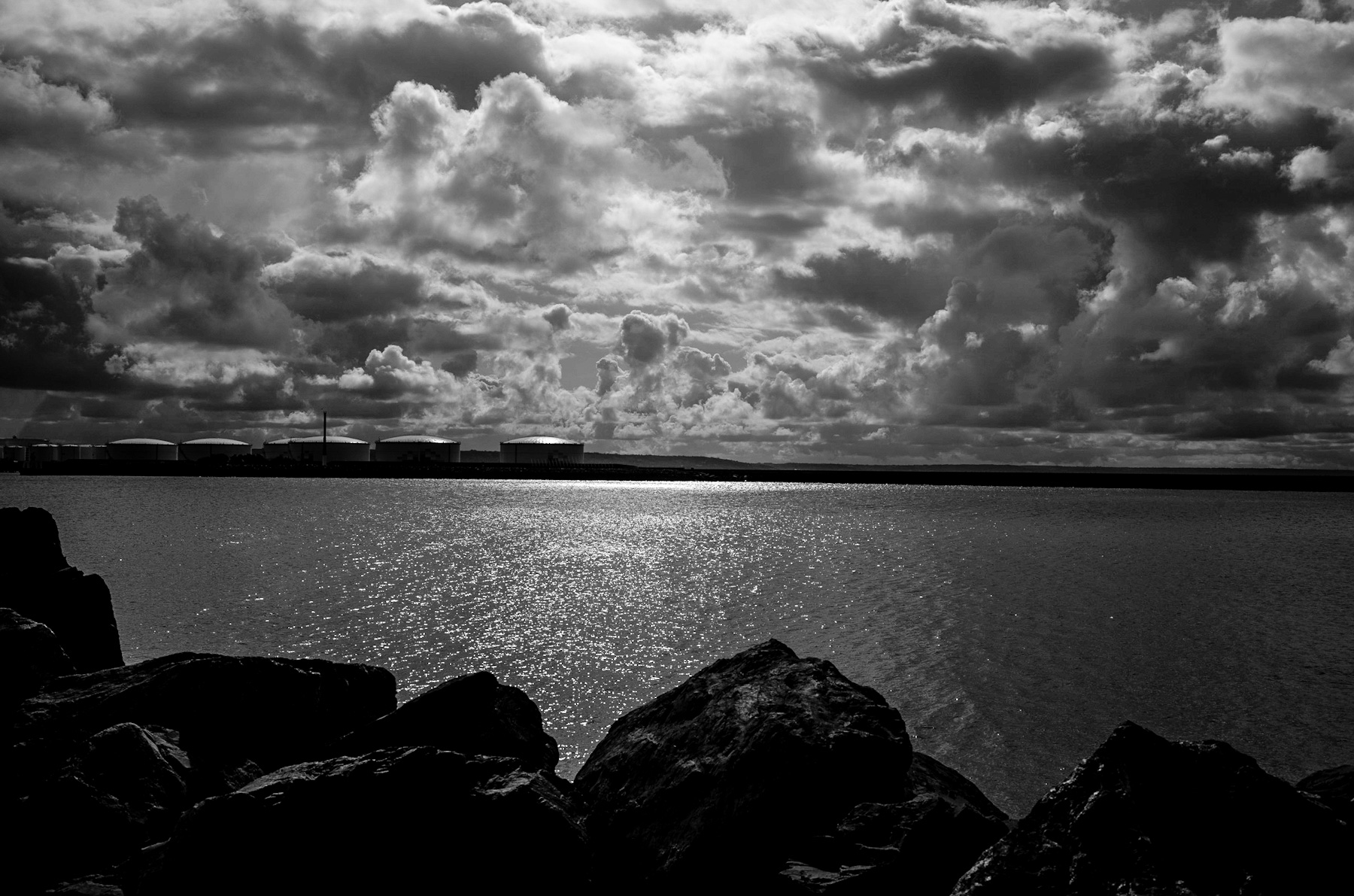
The stark monochrome composition presents a landscape where natural elements meet industrial might, captured under a dramatic sky. Foreground rocks, silhouetted against the shimmering water, anchor the scene, leading the eye towards a distant industrial complex.
This photograph is dominated by a powerful interplay of light and shadow, characteristic of black and white imagery. In the immediate foreground, rugged, dark rocks create a robust barrier, their forms defined by deep shadows and sharp edges. Beyond these, a vast expanse of water stretches, its surface alive with countless glints of light, reflecting a hidden sun.
This sparkling texture contrasts sharply with the smooth, dark band of the distant horizon. Behind it, a series of large, cylindrical storage tanks emerge. These industrial structures, uniform in their design, line the distant shore, punctuated by a single, slender chimney or stack, emitting what appears to be a faint wisp. Above, the sky is a tumultuous canvas of clouds – some brilliantly illuminated, others heavy and dark, creating a sense of dynamic movement and atmospheric depth.
These prominent storage tanks are emblematic of modern energy infrastructure. They are typically employed for holding vast quantities of liquids such as crude oil, refined petroleum products, or chemicals. Their presence signifies a critical node in the global supply chain, facilitating the storage and distribution of resources vital to contemporary economies.
Such facilities are often located in strategic coastal or riverside areas, leveraging access to deep-water ports for international shipping and efficient transport networks for inland distribution. The scale of these structures underscores the immense demand for energy and raw materials that characterizes industrialized societies.
The sight of such an industrial complex evokes a rich historical narrative, deeply intertwined with the age of industrialization and the rise of fossil fuels. From the mid-19th century onwards, as petroleum gained prominence as a primary energy source, the development of large-scale storage and refining capabilities became imperative.
These structures are direct descendants of the infrastructure that powered the Second Industrial Revolution, fueled global conflicts, and drove unprecedented economic growth. The strategic importance of such terminals grew exponentially with the advent of supertankers and the globalized energy market, making them silent witnesses to centuries of technological advancement, geopolitical shifts, and the relentless human quest for power and progress. They represent a tangible link to the historical reliance on these resources, shaping landscapes and economies worldwide.
This image, through its monochromatic lens, transcends a mere depiction of scenery. It captures a moment where the enduring power of nature – the vast water, the dramatic sky – coexists with the lasting imprint of human industry. It invites contemplation on the evolution of our energy needs, the scale of our infrastructure, and the historical forces that have shaped our modern world, all framed by the timeless beauty and stark contrasts of black and white photography. The scene serves as a powerful reminder of the deep connection between industrial development, global trade, and the landscapes we inhabit.
This photograph is dominated by a powerful interplay of light and shadow, characteristic of black and white imagery. In the immediate foreground, rugged, dark rocks create a robust barrier, their forms defined by deep shadows and sharp edges. Beyond these, a vast expanse of water stretches, its surface alive with countless glints of light, reflecting a hidden sun.
This sparkling texture contrasts sharply with the smooth, dark band of the distant horizon. Behind it, a series of large, cylindrical storage tanks emerge. These industrial structures, uniform in their design, line the distant shore, punctuated by a single, slender chimney or stack, emitting what appears to be a faint wisp. Above, the sky is a tumultuous canvas of clouds – some brilliantly illuminated, others heavy and dark, creating a sense of dynamic movement and atmospheric depth.
These prominent storage tanks are emblematic of modern energy infrastructure. They are typically employed for holding vast quantities of liquids such as crude oil, refined petroleum products, or chemicals. Their presence signifies a critical node in the global supply chain, facilitating the storage and distribution of resources vital to contemporary economies.
Such facilities are often located in strategic coastal or riverside areas, leveraging access to deep-water ports for international shipping and efficient transport networks for inland distribution. The scale of these structures underscores the immense demand for energy and raw materials that characterizes industrialized societies.
The sight of such an industrial complex evokes a rich historical narrative, deeply intertwined with the age of industrialization and the rise of fossil fuels. From the mid-19th century onwards, as petroleum gained prominence as a primary energy source, the development of large-scale storage and refining capabilities became imperative.
These structures are direct descendants of the infrastructure that powered the Second Industrial Revolution, fueled global conflicts, and drove unprecedented economic growth. The strategic importance of such terminals grew exponentially with the advent of supertankers and the globalized energy market, making them silent witnesses to centuries of technological advancement, geopolitical shifts, and the relentless human quest for power and progress. They represent a tangible link to the historical reliance on these resources, shaping landscapes and economies worldwide.
This image, through its monochromatic lens, transcends a mere depiction of scenery. It captures a moment where the enduring power of nature – the vast water, the dramatic sky – coexists with the lasting imprint of human industry. It invites contemplation on the evolution of our energy needs, the scale of our infrastructure, and the historical forces that have shaped our modern world, all framed by the timeless beauty and stark contrasts of black and white photography. The scene serves as a powerful reminder of the deep connection between industrial development, global trade, and the landscapes we inhabit.
Schreibe einen Kommentar