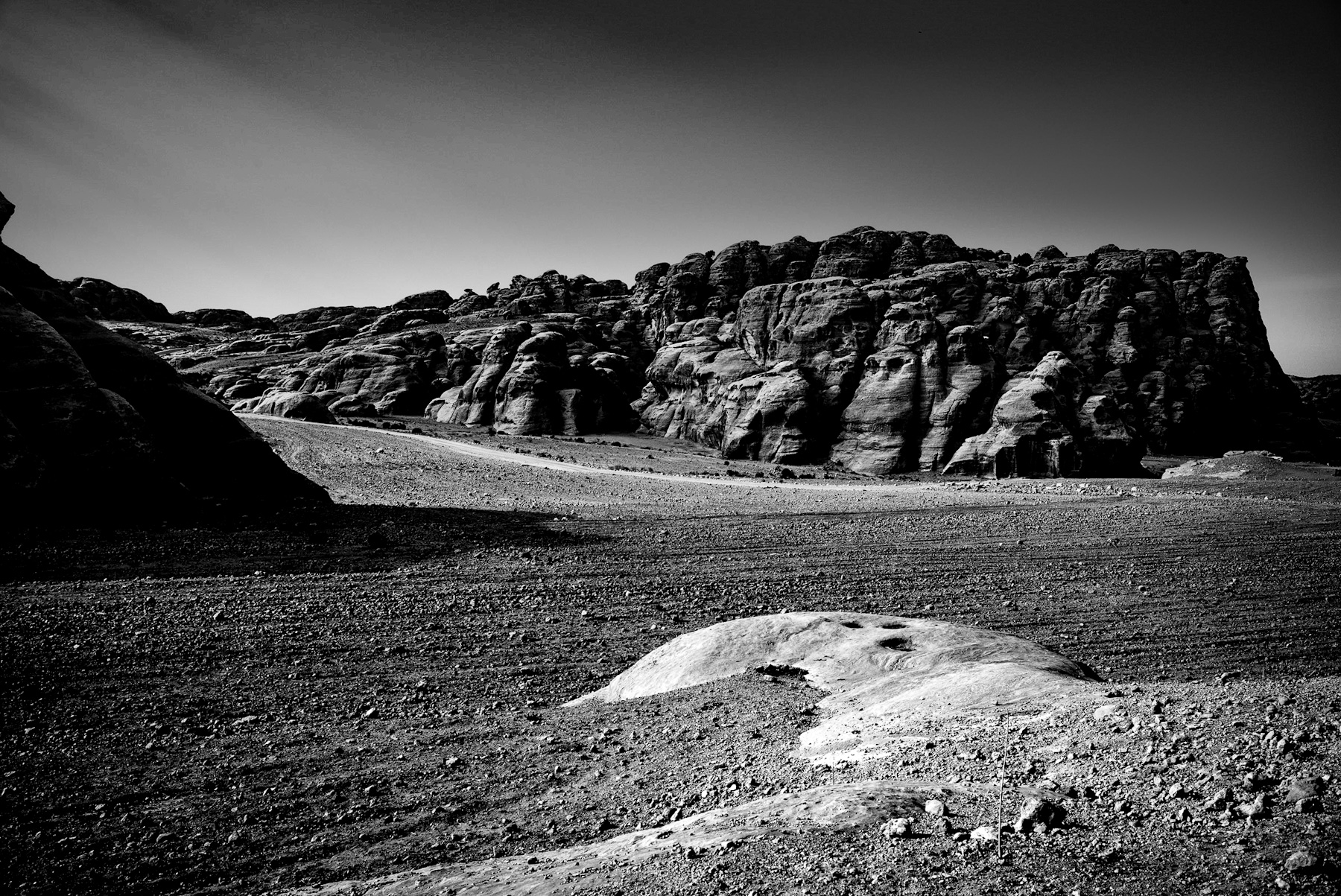
The stark contrast of black and white photography brings a timeless quality to the rugged landscapes of southern Jordan. The image captures a barren, gravel-strewn valley bordered by massive, weathered sandstone formations. A winding dirt track snakes through the center, leading the eye toward towering rock faces characterized by deep vertical fissures and rounded, beehive-like shapes. The harsh sunlight casts deep shadows, emphasizing the texture of the arid terrain and the ancient geological structures that define this historic region.
Ancient Formations, Enduring Legacy
The rock formations depicted are typical of the area surrounding Petra and Little Petra (Siq al-Barid). Composed primarily of Cambrian and Ordovician sandstone, these magnificent cliffs have been shaped over millions of years by relentless wind and water erosion. Historically, this challenging yet breathtaking terrain was the heartland of the Nabataean Kingdom, an ancient Arab civilization that flourished from the 4th century BCE until its annexation by the Roman Empire in 106 CE. The Nabataeans recognized the strategic value of these natural sandstone barriers, choosing not merely to build upon the land but to carve their monumental tombs, temples, and dwellings directly into the cliff faces, creating a unique synthesis of nature and architecture that still astounds visitors today.
Masters of Trade and Water
The winding path visible in the image is a powerful echo of the ancient caravan routes that once traversed this very region. The Nabataeans amassed immense wealth by ingeniously controlling the vital trade routes of the ancient world. They were at the heart of networks like the Incense Route, which connected the Arabian Peninsula with crucial Mediterranean ports. Caravans laden with valuable commodities such as frankincense, myrrh, exotic spices, and precious silk journeyed through these narrow valleys. To not only survive but thrive in this hyper-arid environment, the Nabataeans developed highly sophisticated water harvesting and storage systems. These innovations allowed them to support a large population and offer much-needed refuge to weary travelers, cementing their position as a crucial hub. The defensive advantages offered by this landscape were unparalleled. The deep canyons, famously known as siqs, provided natural protection against invading forces, rendering the Nabataean capital of Petra virtually impregnable for centuries.
A Timeless Connection to the Desert Landscape
Today, this extraordinary region is globally recognized for its profound cultural and historical value. Petra, the crown jewel, was deservedly designated a UNESCO World Heritage Site in 1985, drawing archaeologists, historians, and eager travelers from every corner of the globe. The photograph serves as a poignant visual reminder of the enduring and intricate relationship between human civilization and the natural environment. While the ancient traders and skilled builders have long departed, the majestic sandstone cliffs and the very desert pathways remain, meticulously preserving the history of a culture that mastered one of the most inhospitable landscapes on Earth. For modern visitors, exploring these ancient paths offers a profound and tangible connection to the past, where every weathered rock formation whispers a story of survival, ingenious engineering, and unparalleled architectural brilliance.
Ancient Formations, Enduring Legacy
The rock formations depicted are typical of the area surrounding Petra and Little Petra (Siq al-Barid). Composed primarily of Cambrian and Ordovician sandstone, these magnificent cliffs have been shaped over millions of years by relentless wind and water erosion. Historically, this challenging yet breathtaking terrain was the heartland of the Nabataean Kingdom, an ancient Arab civilization that flourished from the 4th century BCE until its annexation by the Roman Empire in 106 CE. The Nabataeans recognized the strategic value of these natural sandstone barriers, choosing not merely to build upon the land but to carve their monumental tombs, temples, and dwellings directly into the cliff faces, creating a unique synthesis of nature and architecture that still astounds visitors today.
Masters of Trade and Water
The winding path visible in the image is a powerful echo of the ancient caravan routes that once traversed this very region. The Nabataeans amassed immense wealth by ingeniously controlling the vital trade routes of the ancient world. They were at the heart of networks like the Incense Route, which connected the Arabian Peninsula with crucial Mediterranean ports. Caravans laden with valuable commodities such as frankincense, myrrh, exotic spices, and precious silk journeyed through these narrow valleys. To not only survive but thrive in this hyper-arid environment, the Nabataeans developed highly sophisticated water harvesting and storage systems. These innovations allowed them to support a large population and offer much-needed refuge to weary travelers, cementing their position as a crucial hub. The defensive advantages offered by this landscape were unparalleled. The deep canyons, famously known as siqs, provided natural protection against invading forces, rendering the Nabataean capital of Petra virtually impregnable for centuries.
A Timeless Connection to the Desert Landscape
Today, this extraordinary region is globally recognized for its profound cultural and historical value. Petra, the crown jewel, was deservedly designated a UNESCO World Heritage Site in 1985, drawing archaeologists, historians, and eager travelers from every corner of the globe. The photograph serves as a poignant visual reminder of the enduring and intricate relationship between human civilization and the natural environment. While the ancient traders and skilled builders have long departed, the majestic sandstone cliffs and the very desert pathways remain, meticulously preserving the history of a culture that mastered one of the most inhospitable landscapes on Earth. For modern visitors, exploring these ancient paths offers a profound and tangible connection to the past, where every weathered rock formation whispers a story of survival, ingenious engineering, and unparalleled architectural brilliance.
Schreibe einen Kommentar