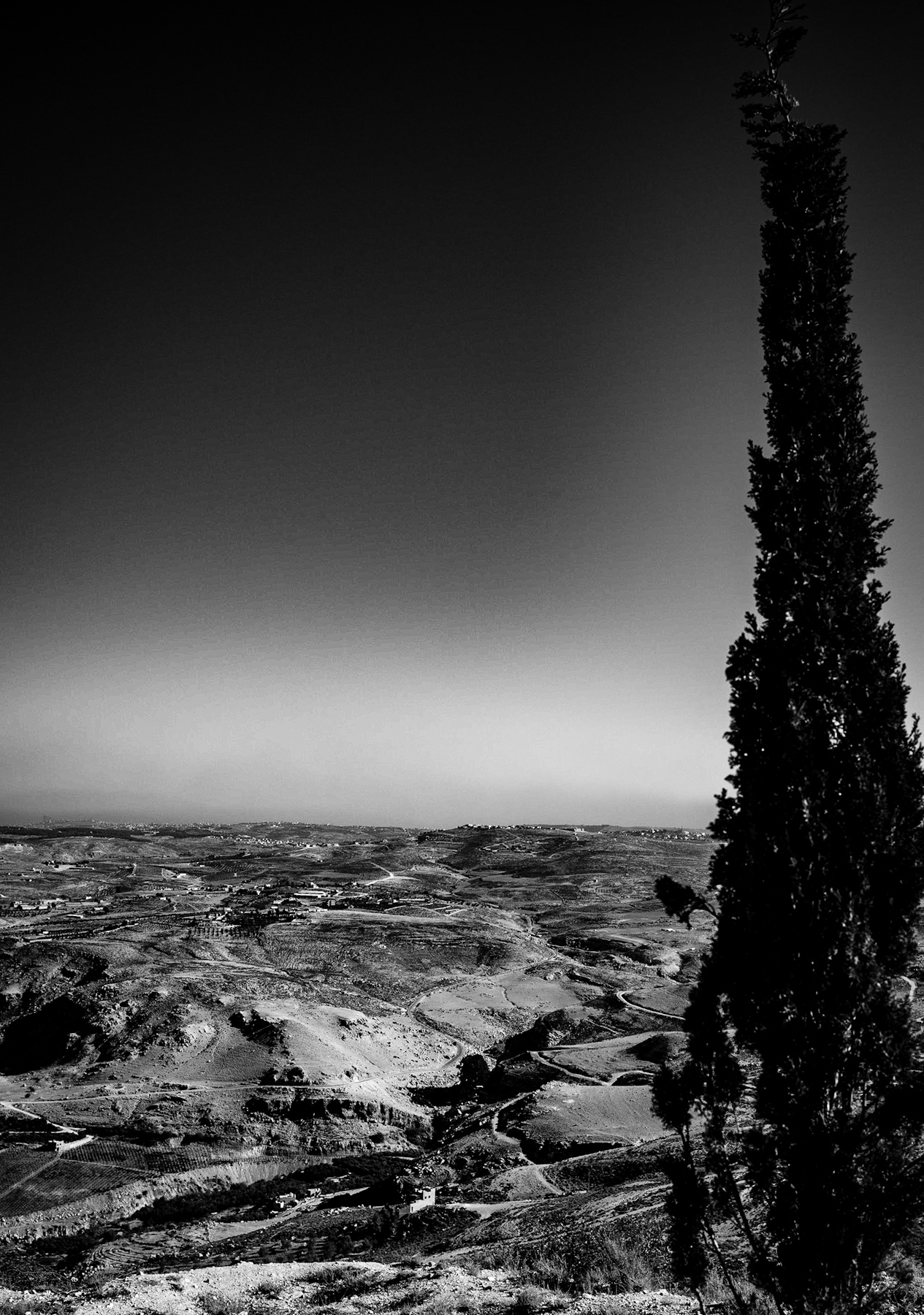
The stark contrast of black and white photography has a unique ability to strip away modern distractions, leaving behind the raw essence of a landscape. In this striking monochromatic image, the viewer is presented with a vast, undulating terrain that speaks of deep time, human endurance, and historical transitions. This blog post analyzes the visual elements of this photograph and explores the rich historical and geographical context of the region it represents.
**Visual Analysis: Contrast and Composition** The photograph is dominated by a dramatic vertical composition. On the right foreground stands a solitary, slender cypress tree (*Cupressus sempervirens*), reaching upward toward a dark, gradient sky. The high-contrast rendering turns the tree into a dark silhouette, serving as a powerful visual anchor.
Beyond the tree, the landscape opens up into a sweeping panorama of rugged, arid hills and valleys. The play of light and shadow highlights the complex topography of the land, revealing winding paths, sparse vegetation, and distant settlements scattered across the ridges. The gradient of the sky, shifting from a deep, almost black tone at the top to a bright horizon, adds a sense of immense scale and quiet drama to the scene.
**The Geographical Context: The Judean Wilderness and Highlands** The topography captured in the image is highly characteristic of the Judean Hills and the transition zone leading into the Judean Desert. Located in the Southern Levant, this region is defined by its limestone hills, deep ravines, and Mediterranean-to-semi-arid climate.
For thousands of years, this landscape has dictated the lifestyle of its inhabitants. The rugged terrain acted as both a natural barrier and a sanctuary. The valleys, though dry for much of the year, contain fertile pockets of soil that have supported pastoralism and agriculture since the Bronze Age.
**Historical Significance and Ancient Agriculture** One of the most defining features visible in the landscape is the presence of agricultural terracing. For millennia, inhabitants of the Levant modified these steep slopes to make them arable.
* **Soil Conservation:** Terraces prevent the precious topsoil from washing away during the heavy, sporadic winter rains. * **Water Management:** These stone-walled steps slow down water runoff, allowing the moisture to penetrate deep into the ground, which is crucial for cultivating olives, grapes, and grains. * **A Millennia-Old Legacy:** Many of the terrace systems visible in this region today date back to the Iron Age, the Roman-Byzantine periods, and the Ottoman era, representing a continuous tradition of dryland farming.
Historically, this region has been a crossroads of empires. From the ancient Canaanites and Israelites to the Romans, Byzantines, Crusaders, and Ottomans, countless civilizations have traversed these hills. The paths visible in the valley below likely follow ancient trade and pilgrimage routes that connected historic cities like Jerusalem, Bethlehem, and Hebron to the Jordan Valley and the Dead Sea.
**Symbolism of the Cypress Tree** The prominent cypress tree in the foreground carries its own historical and cultural weight. In Mediterranean and Near Eastern cultures, the cypress has long been a symbol of eternity, mourning, and persistence. Because of its longevity and evergreen nature, it is frequently planted near sacred sites, cemeteries, and historic boundaries throughout the region, serving as a silent sentinel over a landscape that has witnessed centuries of human history.
**Conclusion** This photograph is more than a study in light and shadow; it is a visual document of a landscape shaped by both nature and human hands over thousands of years. The combination of the timeless cypress tree and the ancient, terraced hills reminds us of the enduring relationship between humanity and the earth in one of the most historically significant regions of the world.
**Visual Analysis: Contrast and Composition** The photograph is dominated by a dramatic vertical composition. On the right foreground stands a solitary, slender cypress tree (*Cupressus sempervirens*), reaching upward toward a dark, gradient sky. The high-contrast rendering turns the tree into a dark silhouette, serving as a powerful visual anchor.
Beyond the tree, the landscape opens up into a sweeping panorama of rugged, arid hills and valleys. The play of light and shadow highlights the complex topography of the land, revealing winding paths, sparse vegetation, and distant settlements scattered across the ridges. The gradient of the sky, shifting from a deep, almost black tone at the top to a bright horizon, adds a sense of immense scale and quiet drama to the scene.
**The Geographical Context: The Judean Wilderness and Highlands** The topography captured in the image is highly characteristic of the Judean Hills and the transition zone leading into the Judean Desert. Located in the Southern Levant, this region is defined by its limestone hills, deep ravines, and Mediterranean-to-semi-arid climate.
For thousands of years, this landscape has dictated the lifestyle of its inhabitants. The rugged terrain acted as both a natural barrier and a sanctuary. The valleys, though dry for much of the year, contain fertile pockets of soil that have supported pastoralism and agriculture since the Bronze Age.
**Historical Significance and Ancient Agriculture** One of the most defining features visible in the landscape is the presence of agricultural terracing. For millennia, inhabitants of the Levant modified these steep slopes to make them arable.
* **Soil Conservation:** Terraces prevent the precious topsoil from washing away during the heavy, sporadic winter rains. * **Water Management:** These stone-walled steps slow down water runoff, allowing the moisture to penetrate deep into the ground, which is crucial for cultivating olives, grapes, and grains. * **A Millennia-Old Legacy:** Many of the terrace systems visible in this region today date back to the Iron Age, the Roman-Byzantine periods, and the Ottoman era, representing a continuous tradition of dryland farming.
Historically, this region has been a crossroads of empires. From the ancient Canaanites and Israelites to the Romans, Byzantines, Crusaders, and Ottomans, countless civilizations have traversed these hills. The paths visible in the valley below likely follow ancient trade and pilgrimage routes that connected historic cities like Jerusalem, Bethlehem, and Hebron to the Jordan Valley and the Dead Sea.
**Symbolism of the Cypress Tree** The prominent cypress tree in the foreground carries its own historical and cultural weight. In Mediterranean and Near Eastern cultures, the cypress has long been a symbol of eternity, mourning, and persistence. Because of its longevity and evergreen nature, it is frequently planted near sacred sites, cemeteries, and historic boundaries throughout the region, serving as a silent sentinel over a landscape that has witnessed centuries of human history.
**Conclusion** This photograph is more than a study in light and shadow; it is a visual document of a landscape shaped by both nature and human hands over thousands of years. The combination of the timeless cypress tree and the ancient, terraced hills reminds us of the enduring relationship between humanity and the earth in one of the most historically significant regions of the world.
Schreibe einen Kommentar