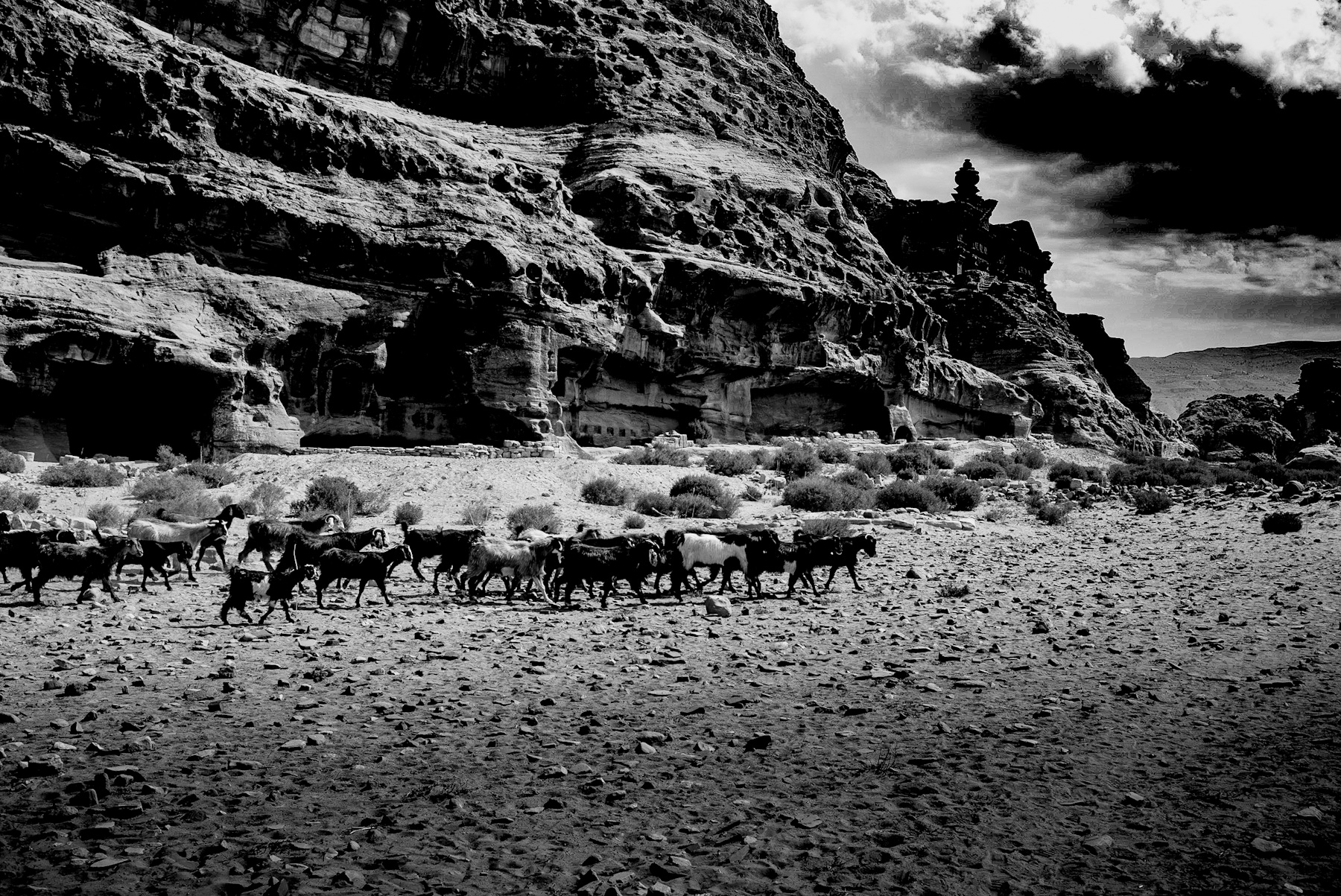
The stark contrast of black-and-white photography often reveals the raw essence of a landscape, stripping away the distraction of color to focus on form, texture, and history. In this striking image, the timeless ruggedness of Jordan’s desert landscape is captured in a single, powerful frame. The photograph depicts a herd of goats traversing a rocky plain, set against the monumental backdrop of ancient rock-cut architecture and dramatic, cloud-filled skies. This scene is not merely a depiction of rural life; it is a visual bridge connecting modern pastoral traditions with one of the ancient world’s most remarkable civilizations.
A Landscape Carved by Time and Human Hands
In the foreground of the image, a herd of goats moves systematically across a stony, arid terrain. This daily ritual of pastoralism has remained largely unchanged for millennia in the Middle East. However, it is the background that elevates this scene from a simple pastoral photograph to a historical document.
The towering sandstone cliffs visible in the background are characteristic of the region surrounding Petra, the ancient capital of the Nabataean Kingdom. Carved directly into the sheer rock faces are the dark openings of ancient caves and tombs. High on the ridge to the right, a monumental structure stands silhouetted against the dark, dramatic clouds. This architectural style, blending Hellenistic design elements with traditional Eastern motifs, is the hallmark of Nabataean craftsmanship.
The Historical Legacy of the Nabataean Kingdom
To understand the significance of the structures carved into these cliffs, one must look back to the Nabataeans, a nomadic Arab people who settled in the southern Levant around the 4th century BCE. Petra, strategically located at the crossroads of ancient trade routes, became the prosperous capital of their empire.
The Nabataeans accumulated immense wealth by controlling the trade of luxury goods, particularly frankincense, myrrh, and spices, which were transported from the Arabian Peninsula to the Mediterranean ports. This wealth allowed them to transform the rugged sandstone canyons into a thriving metropolis.
The carvings shown in the photograph are remnants of this golden age. While Petra is famous for grand monuments like the Treasury (Al-Khazneh) and the Monastery (Ad Deir), the surrounding valleys are filled with hundreds of smaller rock-cut tombs, dwellings, and cisterns. The Nabataeans were master hydrologists, constructing complex systems of dams, conduits, and reservoirs that allowed them to survive and flourish in an otherwise inhospitable desert environment.
The Continuity of Bedouin Culture
The presence of the goat herd in the photograph highlights the cultural continuity of the region. Following the decline of the Nabataean Empire and the subsequent Roman and Byzantine eras, Petra was largely forgotten by the Western world until its rediscovery in 1812. Throughout these centuries, local Bedouin tribes, such as the Bdoul, inhabited the ancient caves and maintained their traditional pastoral lifestyle.
Today, while Petra is recognized as a UNESCO World Heritage Site and a major global tourist destination, the traditional herding of livestock remains an integral part of the local economy and cultural identity. The image captures this harmonious coexistence: the monumental, permanent structures of a long-lost empire serving as the backdrop for the transient, daily patterns of nomadic life.
A Landscape Carved by Time and Human Hands
In the foreground of the image, a herd of goats moves systematically across a stony, arid terrain. This daily ritual of pastoralism has remained largely unchanged for millennia in the Middle East. However, it is the background that elevates this scene from a simple pastoral photograph to a historical document.
The towering sandstone cliffs visible in the background are characteristic of the region surrounding Petra, the ancient capital of the Nabataean Kingdom. Carved directly into the sheer rock faces are the dark openings of ancient caves and tombs. High on the ridge to the right, a monumental structure stands silhouetted against the dark, dramatic clouds. This architectural style, blending Hellenistic design elements with traditional Eastern motifs, is the hallmark of Nabataean craftsmanship.
The Historical Legacy of the Nabataean Kingdom
To understand the significance of the structures carved into these cliffs, one must look back to the Nabataeans, a nomadic Arab people who settled in the southern Levant around the 4th century BCE. Petra, strategically located at the crossroads of ancient trade routes, became the prosperous capital of their empire.
The Nabataeans accumulated immense wealth by controlling the trade of luxury goods, particularly frankincense, myrrh, and spices, which were transported from the Arabian Peninsula to the Mediterranean ports. This wealth allowed them to transform the rugged sandstone canyons into a thriving metropolis.
The carvings shown in the photograph are remnants of this golden age. While Petra is famous for grand monuments like the Treasury (Al-Khazneh) and the Monastery (Ad Deir), the surrounding valleys are filled with hundreds of smaller rock-cut tombs, dwellings, and cisterns. The Nabataeans were master hydrologists, constructing complex systems of dams, conduits, and reservoirs that allowed them to survive and flourish in an otherwise inhospitable desert environment.
The Continuity of Bedouin Culture
The presence of the goat herd in the photograph highlights the cultural continuity of the region. Following the decline of the Nabataean Empire and the subsequent Roman and Byzantine eras, Petra was largely forgotten by the Western world until its rediscovery in 1812. Throughout these centuries, local Bedouin tribes, such as the Bdoul, inhabited the ancient caves and maintained their traditional pastoral lifestyle.
Today, while Petra is recognized as a UNESCO World Heritage Site and a major global tourist destination, the traditional herding of livestock remains an integral part of the local economy and cultural identity. The image captures this harmonious coexistence: the monumental, permanent structures of a long-lost empire serving as the backdrop for the transient, daily patterns of nomadic life.
Schreibe einen Kommentar