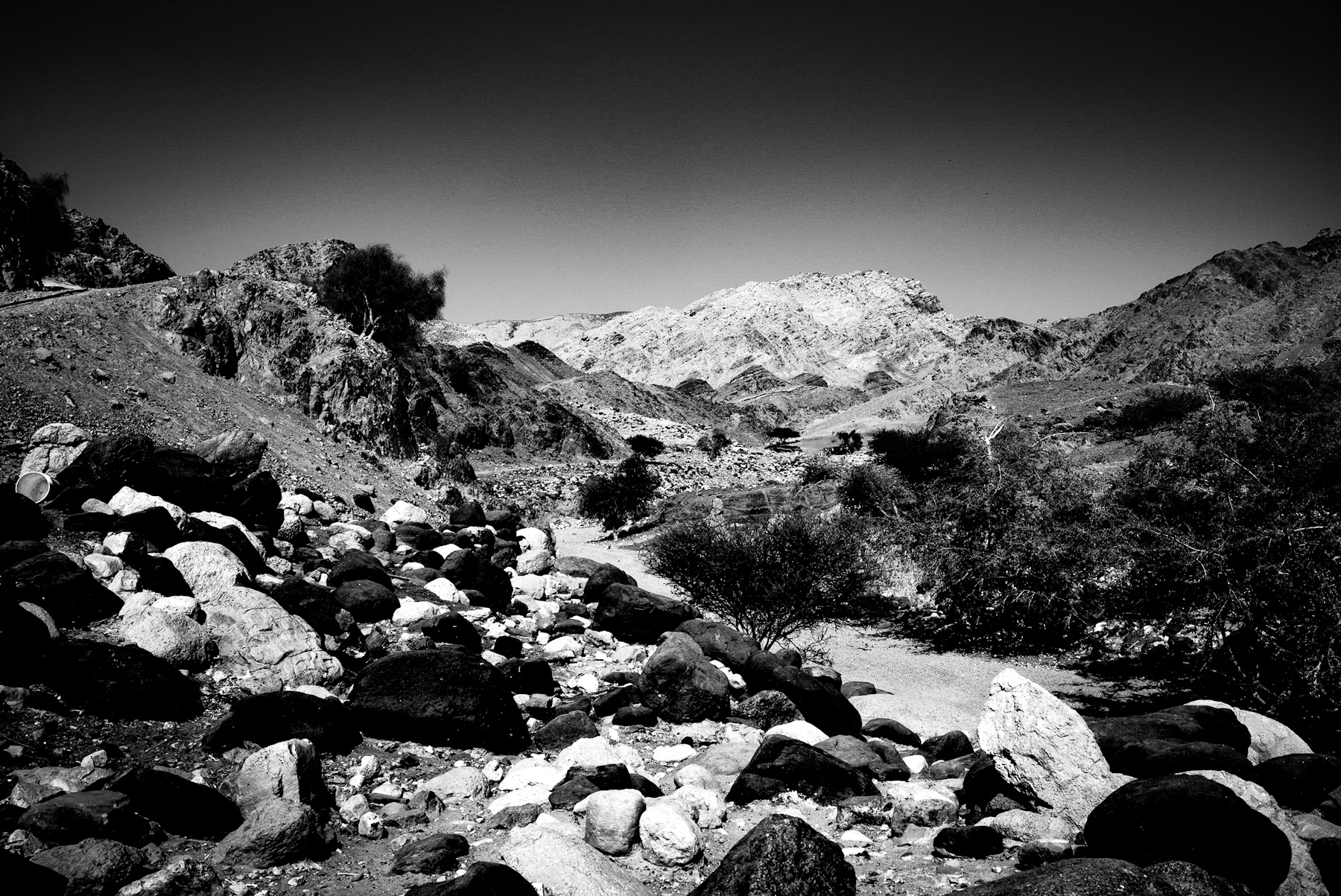
Arid landscapes have long captured the human imagination. Across the globe, rocky deserts and dry valleys serve as stark reminders of nature’s raw power and the passage of time. The monochrome photograph presented here captures a rugged, boulder-strewn valley, likely a wadi, winding through eroded mountain ranges. This specific topography is characteristic of Middle Eastern desert regions, such as the Sinai Peninsula, the Negev, or the mountainous areas of Jordan.
By stripping away color, the high-contrast black-and-white image emphasizes the harsh textures, unique geological formations, and sparse vegetation that define these ancient terrains.
***
**Visual Analysis of the Desert Terrain**
The photograph illustrates a classic desert valley floor, cluttered with a mixture of dark, basaltic boulders and lighter, weathered limestone rocks. In the foreground, the accumulation of stones indicates the path of a dry riverbed, or wadi. These channels remain dry for most of the year but can transform into raging torrents during brief, seasonal flash floods.
Sparse, hardy vegetation, including deep-rooted shrubs and small acacia-like trees, clings to the rocky slopes. In the background, layered, sun-bleached mountains rise against a dark, cloudless sky. The lack of modern infrastructure highlights the isolation and timelessness of the environment, making it difficult to distinguish whether the image was captured today or a century ago.
***
**The Historical Significance of the Wadi and Desert Routes**
Regions matching this geological profile have played pivotal roles in human history. Far from being empty voids, these arid valleys served as crucial corridors for migration, trade, and cultural exchange for millennia.
**1. Ancient Trade and the Incense Route**
For thousands of years, deserts like the Negev and the Arabian Peninsula were crisscrossed by complex trade networks. The most famous of these, the Incense Route, facilitated the transport of frankincense and myrrh from southern Arabia to the Mediterranean port of Gaza. Nabataean merchants mastered the art of survival in these harsh landscapes, establishing hidden water cisterns and fortified outposts along rocky valleys similar to the one pictured.
**2. Nomadic Survival and Bedouin Culture**
The survival of nomadic tribes, such as the Bedouins, is deeply tied to this landscape. For centuries, these communities navigated the rugged terrain, utilizing wadis for seasonal grazing and water collection. Their deep understanding of geology and botany allowed them to thrive in an environment that appeared uninhabitable to outsiders.
**3. Spiritual and Biblical History**
In historical and religious texts, the wilderness is often depicted as a place of testing, refuge, and revelation. The Sinai Peninsula, characterized by its jagged granite mountains and deep valleys, is historically associated with the biblical Exodus. For early Christian monastics in the 3rd and 4th centuries, the extreme isolation of these desert valleys provided the perfect environment for spiritual contemplation, leading to the establishment of some of the world’s oldest continuously inhabited monasteries.
***
**Conclusion**
The rugged beauty captured in this black-and-white photograph is more than just a geological study; it is a visual record of a landscape that has profoundly shaped human civilization. From ancient traders navigating rocky paths to seekers of spiritual solitude, these timeless desert valleys remain a powerful symbol of endurance, history, and natural majesty.
By stripping away color, the high-contrast black-and-white image emphasizes the harsh textures, unique geological formations, and sparse vegetation that define these ancient terrains.
***
**Visual Analysis of the Desert Terrain**
The photograph illustrates a classic desert valley floor, cluttered with a mixture of dark, basaltic boulders and lighter, weathered limestone rocks. In the foreground, the accumulation of stones indicates the path of a dry riverbed, or wadi. These channels remain dry for most of the year but can transform into raging torrents during brief, seasonal flash floods.
Sparse, hardy vegetation, including deep-rooted shrubs and small acacia-like trees, clings to the rocky slopes. In the background, layered, sun-bleached mountains rise against a dark, cloudless sky. The lack of modern infrastructure highlights the isolation and timelessness of the environment, making it difficult to distinguish whether the image was captured today or a century ago.
***
**The Historical Significance of the Wadi and Desert Routes**
Regions matching this geological profile have played pivotal roles in human history. Far from being empty voids, these arid valleys served as crucial corridors for migration, trade, and cultural exchange for millennia.
**1. Ancient Trade and the Incense Route**
For thousands of years, deserts like the Negev and the Arabian Peninsula were crisscrossed by complex trade networks. The most famous of these, the Incense Route, facilitated the transport of frankincense and myrrh from southern Arabia to the Mediterranean port of Gaza. Nabataean merchants mastered the art of survival in these harsh landscapes, establishing hidden water cisterns and fortified outposts along rocky valleys similar to the one pictured.
**2. Nomadic Survival and Bedouin Culture**
The survival of nomadic tribes, such as the Bedouins, is deeply tied to this landscape. For centuries, these communities navigated the rugged terrain, utilizing wadis for seasonal grazing and water collection. Their deep understanding of geology and botany allowed them to thrive in an environment that appeared uninhabitable to outsiders.
**3. Spiritual and Biblical History**
In historical and religious texts, the wilderness is often depicted as a place of testing, refuge, and revelation. The Sinai Peninsula, characterized by its jagged granite mountains and deep valleys, is historically associated with the biblical Exodus. For early Christian monastics in the 3rd and 4th centuries, the extreme isolation of these desert valleys provided the perfect environment for spiritual contemplation, leading to the establishment of some of the world’s oldest continuously inhabited monasteries.
***
**Conclusion**
The rugged beauty captured in this black-and-white photograph is more than just a geological study; it is a visual record of a landscape that has profoundly shaped human civilization. From ancient traders navigating rocky paths to seekers of spiritual solitude, these timeless desert valleys remain a powerful symbol of endurance, history, and natural majesty.
Schreibe einen Kommentar