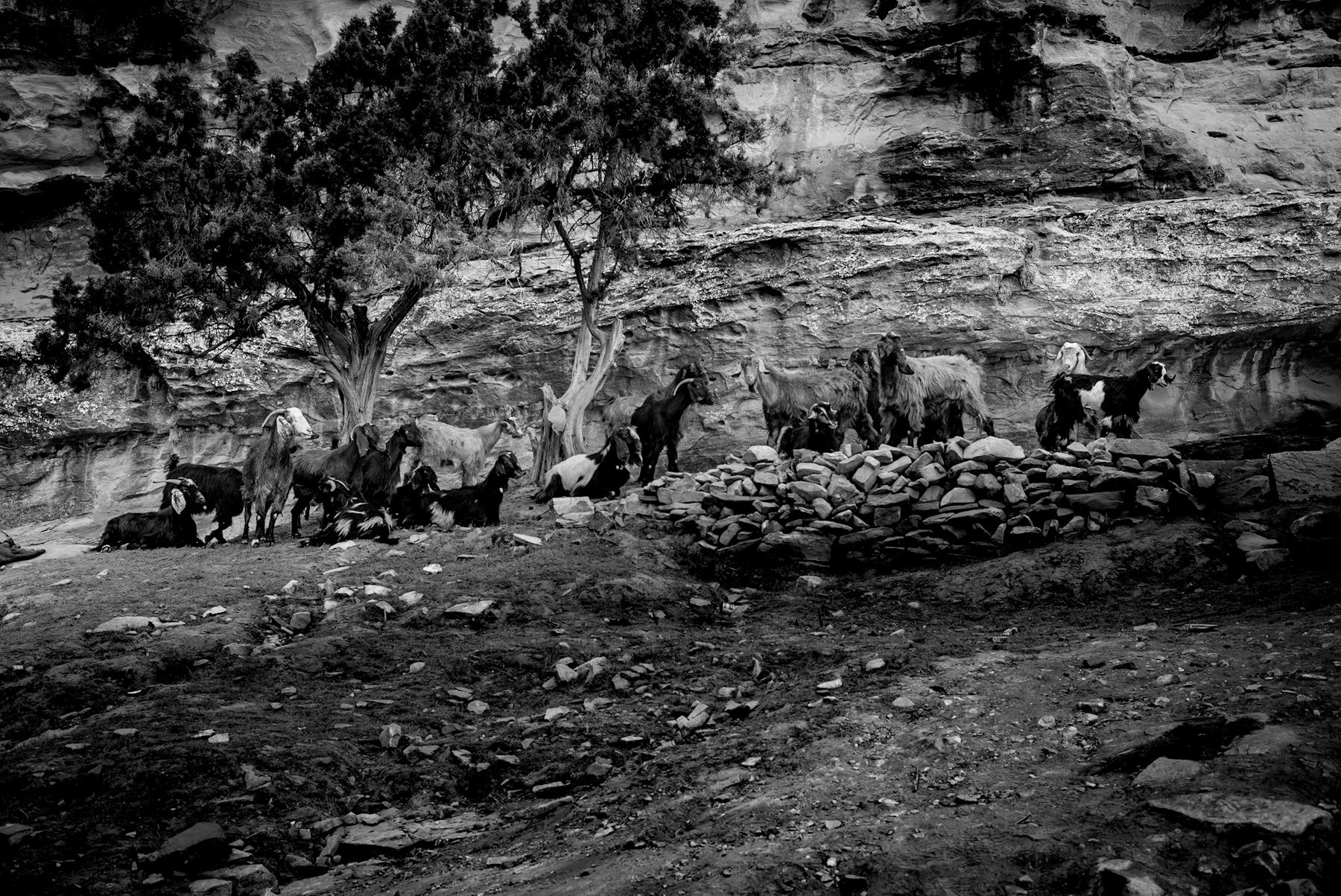
Monochrome photography has a unique ability to strip away modern distractions, revealing the timeless essence of a scene. The featured black and white photograph captures a herd of goats seeking shelter and sustenance at the base of a steep, stratified rock formation. This striking image serves as a visual bridge to the deep history of human agriculture and the enduring practice of traditional pastoralism.
A VISUAL ANALYSIS OF THE ARID LANDSCAPE The photograph depicts a scene of rugged beauty. A diverse herd of goats, displaying various coat patterns and horn shapes, is scattered across a stony slope. Some animals stand alert, while others rest in the shade of two hardy, twisted trees that cling to the rocky soil.
In the background, a massive cliff face of layered sedimentary rock dominates the upper half of the frame, highlighting the geological history of the region. In the foreground, a low, crudely constructed dry stone wall stands as a testament to human presence. The stark contrast of the black and white medium emphasizes the rough textures of the stone, the coarse hair of the goats, and the arid nature of the environment.
THE HISTORICAL ROOTS OF GOAT DOMESTICATION The scene captured in this image is not merely a modern pastoral snapshot; it is a living link to the Neolithic Revolution. Goats (Capra hircus) were among the very first domesticated livestock, with archaeological evidence pointing to their domestication approximately 10,000 to 11,000 years ago in the Fertile Crescent—a region spanning modern-day Iran, Iraq, Turkey, and Syria.
During the transition from hunter-gatherer societies to settled agricultural communities, ancient humans recognized the immense value of the wild goat (Capra aegagrus). Goats are exceptionally resilient animals, capable of digesting tough, fibrous vegetation that other livestock cannot consume. They provided early societies with a reliable source of: – Nutrition: Milk, cheese, and meat. – Materials: Durable hides for clothing and water vessels, and hair for weaving textiles and tents. – Mobility: The ability to move wealth and sustenance across difficult terrains.
This adaptability made goats the ideal companion for nomadic and semi-nomadic pastoralists inhabiting the dry, mountainous regions of the Middle East and the Mediterranean.
DRY STONE MASONRY: ANCIENT AGRICULTURAL INFRASTRUCTURE Another key historical element in the photograph is the dry stone wall. Dry stone construction—the art of building structures without mortar—is one of the oldest architectural techniques known to humanity, dating back to the Bronze Age and earlier.
For millennia, pastoralists have used local stones cleared from fields to construct boundaries, terraces, and animal pens (corrals). These structures served to protect herds from predators and harsh winds at night. The presence of the stone structure in the image highlights how traditional herders have historically utilized local, natural materials to adapt to their environment without leaving a heavy ecological footprint.
THE ENDURANCE OF TRADITIONAL PASTORALISM In an era dominated by industrial agriculture, the scene in the photograph represents an enduring way of life. In many arid and mountainous regions worldwide, traditional pastoralism remains the most viable and sustainable method of land use.
This photograph captures a practice that has remained virtually unchanged for thousands of years. It reminds us of the ancient, symbiotic relationship between humans, animals, and the challenging landscapes they inhabit.
A VISUAL ANALYSIS OF THE ARID LANDSCAPE The photograph depicts a scene of rugged beauty. A diverse herd of goats, displaying various coat patterns and horn shapes, is scattered across a stony slope. Some animals stand alert, while others rest in the shade of two hardy, twisted trees that cling to the rocky soil.
In the background, a massive cliff face of layered sedimentary rock dominates the upper half of the frame, highlighting the geological history of the region. In the foreground, a low, crudely constructed dry stone wall stands as a testament to human presence. The stark contrast of the black and white medium emphasizes the rough textures of the stone, the coarse hair of the goats, and the arid nature of the environment.
THE HISTORICAL ROOTS OF GOAT DOMESTICATION The scene captured in this image is not merely a modern pastoral snapshot; it is a living link to the Neolithic Revolution. Goats (Capra hircus) were among the very first domesticated livestock, with archaeological evidence pointing to their domestication approximately 10,000 to 11,000 years ago in the Fertile Crescent—a region spanning modern-day Iran, Iraq, Turkey, and Syria.
During the transition from hunter-gatherer societies to settled agricultural communities, ancient humans recognized the immense value of the wild goat (Capra aegagrus). Goats are exceptionally resilient animals, capable of digesting tough, fibrous vegetation that other livestock cannot consume. They provided early societies with a reliable source of: – Nutrition: Milk, cheese, and meat. – Materials: Durable hides for clothing and water vessels, and hair for weaving textiles and tents. – Mobility: The ability to move wealth and sustenance across difficult terrains.
This adaptability made goats the ideal companion for nomadic and semi-nomadic pastoralists inhabiting the dry, mountainous regions of the Middle East and the Mediterranean.
DRY STONE MASONRY: ANCIENT AGRICULTURAL INFRASTRUCTURE Another key historical element in the photograph is the dry stone wall. Dry stone construction—the art of building structures without mortar—is one of the oldest architectural techniques known to humanity, dating back to the Bronze Age and earlier.
For millennia, pastoralists have used local stones cleared from fields to construct boundaries, terraces, and animal pens (corrals). These structures served to protect herds from predators and harsh winds at night. The presence of the stone structure in the image highlights how traditional herders have historically utilized local, natural materials to adapt to their environment without leaving a heavy ecological footprint.
THE ENDURANCE OF TRADITIONAL PASTORALISM In an era dominated by industrial agriculture, the scene in the photograph represents an enduring way of life. In many arid and mountainous regions worldwide, traditional pastoralism remains the most viable and sustainable method of land use.
This photograph captures a practice that has remained virtually unchanged for thousands of years. It reminds us of the ancient, symbiotic relationship between humans, animals, and the challenging landscapes they inhabit.
Schreibe einen Kommentar