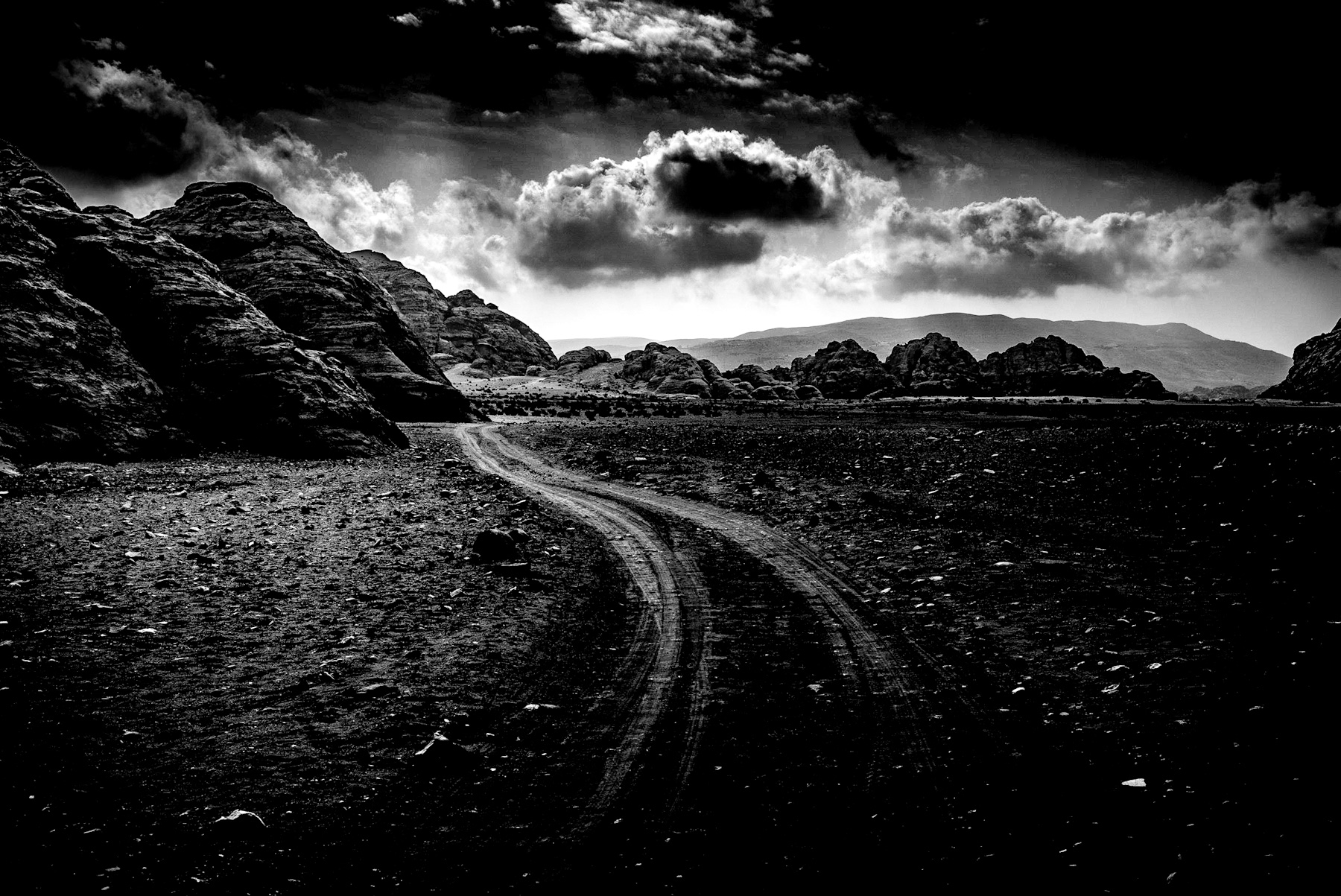
The power of monochrome photography lies in its ability to strip away the distractions of color, revealing the raw texture, contrast, and timelessness of a landscape. In this dramatic black-and-white image, a winding dirt track cuts through a rugged, arid terrain, guided by towering, weathered sandstone formations under a turbulent, cloud-filled sky. This visual narrative is not merely a depiction of a barren wilderness; it is a gateway to understanding the historic trade routes of the Middle East, specifically the region surrounding southern Jordan and the ancient Nabataean kingdom.
Visual Analysis of a Timeless Landscape
The photograph utilizes a strong leading line—the dirt road—which invites the viewer’s eye to travel from the dark, textured foreground into the distant, hazy horizon. The composition is dominated by geological formations characterized by rounded, dome-like sandstone hills. These structures are highly typical of the desert topography found near Petra and Wadi Rum in Jordan.
The high-contrast lighting accentuates the harshness of the environment. Deep shadows cling to the crevices of the rocks, while pockets of bright sunlight break through the heavy cloud cover, illuminating parts of the plain. This interplay of light and shadow emphasizes the isolation and vastness of the terrain, evoking a sense of journey and endurance.
The Historical Context: The Nabataean Incense Route
The path depicted in the image mirrors the ancient caravan routes that once buzzed with economic activity over two thousand years ago. Between the 3rd century BC and the 1st century AD, this region was the heart of the Nabataean Empire. The Nabataeans were nomadic Arabs who became wealthy merchants by controlling the lucrative Incense Route.
These desert tracks were the lifelines of the ancient world. Caravans consisting of hundreds of camels traversed these precise landscapes, carrying precious goods such as: – Frankincense and myrrh from southern Arabia – Spices and silks from India and Asia – Asphalt and precious metals destined for the Roman and Greek empires
The rugged terrain served both as a barrier to invaders and a sanctuary for those who knew how to navigate it. The Nabataeans survived in this hyper-arid environment by mastering water harvesting, carving hidden cisterns into the very sandstone rocks visible in the background of the image.
Geology as a Historical Fortress
The rock formations shown in the photograph are more than geological wonders; they were natural fortresses. The soft sandstone was easily carved, allowing ancient civilizations to create monumental tombs, dwellings, and temples, most famously preserved in the UNESCO World Heritage site of Petra, located just beyond these desert passes.
Over millennia, wind and water erosion have shaped these rocks, creating a labyrinth of canyons (siqs) and open valleys. For ancient travelers, these formations provided essential shade from the scorching sun and protection from sandstorms, making them vital landmarks along the trade routes.
The Modern Legacy of the Desert Path
Today, these historic paths are no longer trodden by spice caravans, but they remain active as off-road tracks for local Bedouins and adventurous travelers. The image captures the enduring spirit of exploration. It serves as a reminder that beneath the quiet, desolate beauty of the desert lies a rich history of human resilience, commerce, and cultural exchange that shaped the modern world.
Visual Analysis of a Timeless Landscape
The photograph utilizes a strong leading line—the dirt road—which invites the viewer’s eye to travel from the dark, textured foreground into the distant, hazy horizon. The composition is dominated by geological formations characterized by rounded, dome-like sandstone hills. These structures are highly typical of the desert topography found near Petra and Wadi Rum in Jordan.
The high-contrast lighting accentuates the harshness of the environment. Deep shadows cling to the crevices of the rocks, while pockets of bright sunlight break through the heavy cloud cover, illuminating parts of the plain. This interplay of light and shadow emphasizes the isolation and vastness of the terrain, evoking a sense of journey and endurance.
The Historical Context: The Nabataean Incense Route
The path depicted in the image mirrors the ancient caravan routes that once buzzed with economic activity over two thousand years ago. Between the 3rd century BC and the 1st century AD, this region was the heart of the Nabataean Empire. The Nabataeans were nomadic Arabs who became wealthy merchants by controlling the lucrative Incense Route.
These desert tracks were the lifelines of the ancient world. Caravans consisting of hundreds of camels traversed these precise landscapes, carrying precious goods such as: – Frankincense and myrrh from southern Arabia – Spices and silks from India and Asia – Asphalt and precious metals destined for the Roman and Greek empires
The rugged terrain served both as a barrier to invaders and a sanctuary for those who knew how to navigate it. The Nabataeans survived in this hyper-arid environment by mastering water harvesting, carving hidden cisterns into the very sandstone rocks visible in the background of the image.
Geology as a Historical Fortress
The rock formations shown in the photograph are more than geological wonders; they were natural fortresses. The soft sandstone was easily carved, allowing ancient civilizations to create monumental tombs, dwellings, and temples, most famously preserved in the UNESCO World Heritage site of Petra, located just beyond these desert passes.
Over millennia, wind and water erosion have shaped these rocks, creating a labyrinth of canyons (siqs) and open valleys. For ancient travelers, these formations provided essential shade from the scorching sun and protection from sandstorms, making them vital landmarks along the trade routes.
The Modern Legacy of the Desert Path
Today, these historic paths are no longer trodden by spice caravans, but they remain active as off-road tracks for local Bedouins and adventurous travelers. The image captures the enduring spirit of exploration. It serves as a reminder that beneath the quiet, desolate beauty of the desert lies a rich history of human resilience, commerce, and cultural exchange that shaped the modern world.
Schreibe einen Kommentar