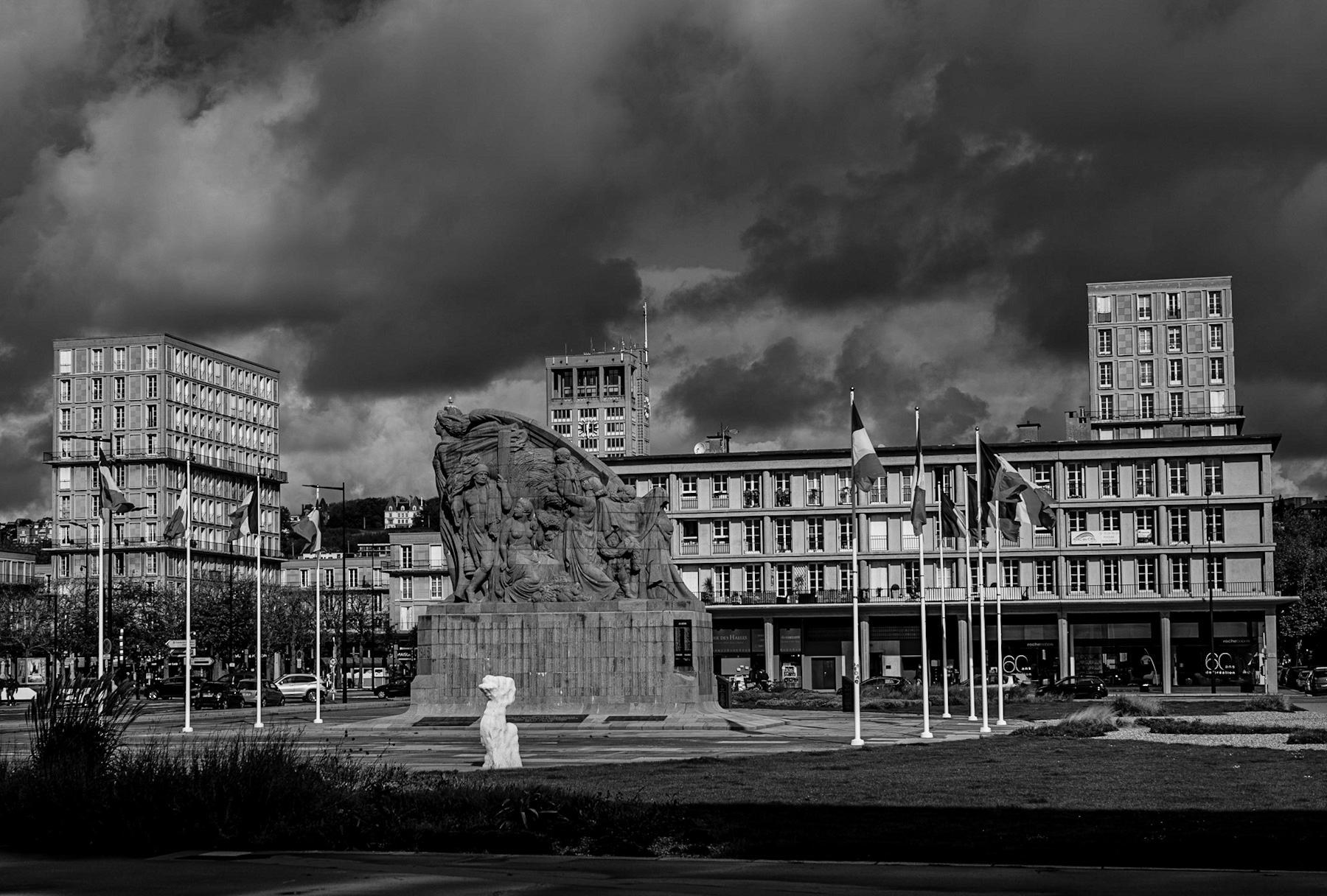
The stark black and white tonality of this image immediately draws attention to its dramatic composition, capturing an urban landscape dominated by monumental architecture and a significant historical sculpture. Under a brooding, heavily clouded sky, the scene unfolds with a powerful sense of gravitas, emphasizing textures, forms, and the interplay of light and shadow over vibrant color.
At the heart of the photograph stands a colossal stone monument, its intricate carvings depicting numerous figures in a dynamic, almost heroic tableau. This central sculpture is the focal point, commanding attention with its sheer scale and detailed narrative. Its base is robust, suggesting permanence and a profound purpose. To its left, a smaller, abstract white sculpture provides a contrasting form, a more contemporary artistic expression against the classical weight of the main memorial.
Flanking the monument and stretching into the midground are several flagpoles proudly displaying French flags, their white sections subtly distinct from the darker blue and red in the monochrome palette. These national symbols reinforce the geographical context and hint at the patriotic sentiment often associated with such public spaces. Beyond, a collection of modernist buildings rises, characterized by their rectilinear forms, repetitive window patterns, and the visible texture of concrete. One prominent structure on the right features a distinctive clock tower, suggesting a civic or administrative function. The overall architectural style speaks to a specific era of urban planning and construction.
**A City Forged from Ashes: The Legacy of Le Havre**
The architecture and monument captured in this image are deeply intertwined with a pivotal moment in French history: the post-World War II reconstruction. This scene is identifiable as the Place de l’Hôtel de Ville in Le Havre, a city in Normandy that suffered catastrophic destruction during the Second World War. Between 1940 and 1944, Allied bombings, intended to dislodge German forces, decimated the city center, leaving an estimated 80% of its buildings in ruins and claiming thousands of lives.
In the aftermath, Le Havre embarked on an ambitious and groundbreaking reconstruction project led by the visionary architect Auguste Perret. Perret, a pioneer of reinforced concrete architecture, conceived a new urban plan that blended classical principles of proportion and symmetry with modern construction techniques. The buildings visible in the photograph, with their modular facades and exposed concrete, are quintessential examples of Perret’s work. The Hôtel de Ville, with its iconic clock tower, is a prime example of this modernist vision, embodying resilience and a forward-looking spirit. In recognition of its unique architectural and urban planning significance, the reconstructed city center of Le Havre was designated a UNESCO World Heritage site in 2005.
**The Weight of Remembrance: Le Havre’s War Memorial**
The central monument is the *Monument aux Morts de la Seconde Guerre Mondiale* (War Memorial of the Second World War), also known as the *Monument à la Résistance et à la Libération*. Designed by Arthur Le Duc and erected after the war, it stands as a poignant tribute to the victims of the conflict, the city’s resistance fighters, and the liberation of France. The sculptural group depicts allegorical figures representing the suffering, courage, and ultimate triumph over adversity, directly referencing the profound human cost and the spirit of defiance during the war. The smaller white sculpture in the foreground, *La Victoire* by Henri-Georges Adam, further complements the memorial, symbolizing hope and peace after the devastation.
This photograph, through its monochrome lens, distills the essence of Le Havre’s enduring spirit. It presents not merely a city square, but a powerful tableau of remembrance, architectural innovation, and the enduring human capacity for rebuilding and resilience in the face of unimaginable destruction. It serves as a visual testament to a city that rose from its ashes, its modern landscape forever bearing the scars and triumphs of its past.
At the heart of the photograph stands a colossal stone monument, its intricate carvings depicting numerous figures in a dynamic, almost heroic tableau. This central sculpture is the focal point, commanding attention with its sheer scale and detailed narrative. Its base is robust, suggesting permanence and a profound purpose. To its left, a smaller, abstract white sculpture provides a contrasting form, a more contemporary artistic expression against the classical weight of the main memorial.
Flanking the monument and stretching into the midground are several flagpoles proudly displaying French flags, their white sections subtly distinct from the darker blue and red in the monochrome palette. These national symbols reinforce the geographical context and hint at the patriotic sentiment often associated with such public spaces. Beyond, a collection of modernist buildings rises, characterized by their rectilinear forms, repetitive window patterns, and the visible texture of concrete. One prominent structure on the right features a distinctive clock tower, suggesting a civic or administrative function. The overall architectural style speaks to a specific era of urban planning and construction.
**A City Forged from Ashes: The Legacy of Le Havre**
The architecture and monument captured in this image are deeply intertwined with a pivotal moment in French history: the post-World War II reconstruction. This scene is identifiable as the Place de l’Hôtel de Ville in Le Havre, a city in Normandy that suffered catastrophic destruction during the Second World War. Between 1940 and 1944, Allied bombings, intended to dislodge German forces, decimated the city center, leaving an estimated 80% of its buildings in ruins and claiming thousands of lives.
In the aftermath, Le Havre embarked on an ambitious and groundbreaking reconstruction project led by the visionary architect Auguste Perret. Perret, a pioneer of reinforced concrete architecture, conceived a new urban plan that blended classical principles of proportion and symmetry with modern construction techniques. The buildings visible in the photograph, with their modular facades and exposed concrete, are quintessential examples of Perret’s work. The Hôtel de Ville, with its iconic clock tower, is a prime example of this modernist vision, embodying resilience and a forward-looking spirit. In recognition of its unique architectural and urban planning significance, the reconstructed city center of Le Havre was designated a UNESCO World Heritage site in 2005.
**The Weight of Remembrance: Le Havre’s War Memorial**
The central monument is the *Monument aux Morts de la Seconde Guerre Mondiale* (War Memorial of the Second World War), also known as the *Monument à la Résistance et à la Libération*. Designed by Arthur Le Duc and erected after the war, it stands as a poignant tribute to the victims of the conflict, the city’s resistance fighters, and the liberation of France. The sculptural group depicts allegorical figures representing the suffering, courage, and ultimate triumph over adversity, directly referencing the profound human cost and the spirit of defiance during the war. The smaller white sculpture in the foreground, *La Victoire* by Henri-Georges Adam, further complements the memorial, symbolizing hope and peace after the devastation.
This photograph, through its monochrome lens, distills the essence of Le Havre’s enduring spirit. It presents not merely a city square, but a powerful tableau of remembrance, architectural innovation, and the enduring human capacity for rebuilding and resilience in the face of unimaginable destruction. It serves as a visual testament to a city that rose from its ashes, its modern landscape forever bearing the scars and triumphs of its past.
Schreibe einen Kommentar