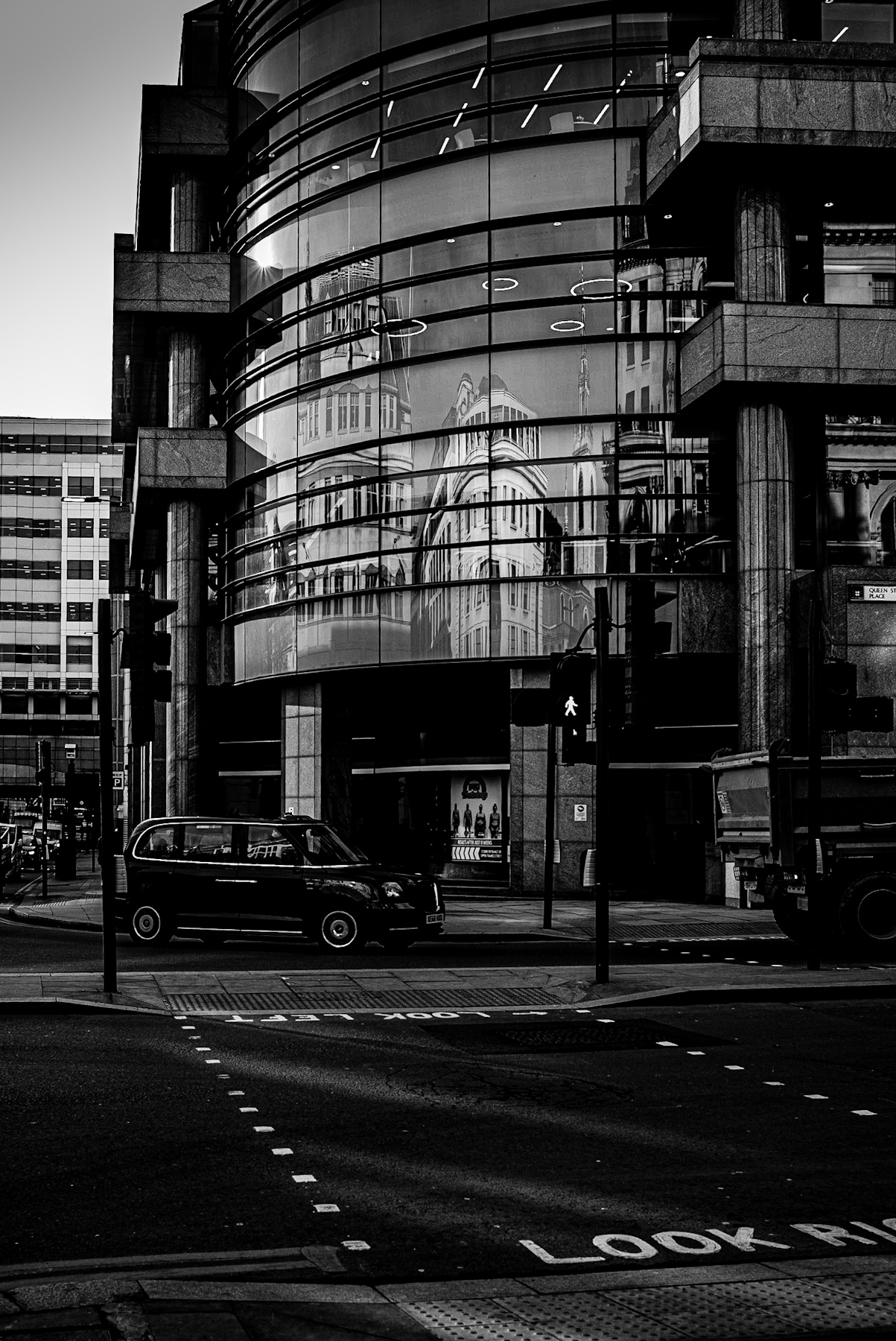
The urban landscape of London frequently presents a compelling dialogue between eras. This striking monochrome photograph encapsulates this very essence, offering a visual narrative of a city perpetually evolving yet deeply rooted in its past.
**Architectural Juxtaposition and Reflective Narratives**
At the heart of the image stands a prominent modern building, characterised by its sleek, curved glass facade. This contemporary structure, a testament to London’s continuous development as a global financial hub, dominates the central frame. Its polished surface, however, performs a remarkable feat: it mirrors the intricate details of older, classical architecture from the surrounding area. These reflections, softened by the black and white palette, reveal ornate cornices, traditional window patterns, and the distinctive silhouettes of buildings that speak to a different century. This interplay between the present and the past, captured within a single frame, is a hallmark of **London architecture**.
The buildings reflected are likely remnants or reconstructions of the city’s rich **historical buildings**, possibly from the Victorian or Edwardian eras, or even earlier periods that predate widespread **modern design**. This visual paradox is not accidental; it is a fundamental characteristic of the **City of London**, where centuries of urban planning and organic growth have resulted in a unique tapestry of styles.
**Iconic Symbols and Enduring Heritage**
Beneath this architectural dialogue, a classic **London black cab** rests at a crossroads. This iconic vehicle, instantly recognisable worldwide, serves as a powerful symbol of continuity amidst the city’s constant transformation. Its design, while updated over decades, retains a timeless quality, connecting the viewer to generations of Londoners and their daily commutes. The black cab represents the enduring spirit and practical heritage of London’s transportation, a constant presence on its historic streets.
The street itself bears further subtle historical markers. The „LOOK LEFT“ and „LOOK RIGHT“ painted instructions on the asphalt are quintessential elements of British road safety, guiding pedestrians accustomed to right-hand traffic in other parts of the world. These details, though seemingly minor, reinforce the specific geographical and cultural context, grounding the image firmly in the **London urban landscape**.
**A City Forged by History and Progress**
The visual contrast between the gleaming, reflective facade and the traditional structures it mirrors speaks to London’s long and often tumultuous history. From the devastating Great Fire of 1666, which necessitated a massive rebuilding effort, to the widespread destruction of the Blitz during World War II, London has repeatedly risen from its ashes. Each period of reconstruction has layered new architectural styles onto the existing fabric, creating a city that is a living museum of its own evolution.
This photograph, therefore, is more than a mere snapshot; it is a profound commentary on **urban reflections** and the city’s **architectural heritage**. It illustrates how **contemporary cityscape** elements coexist with, and indeed celebrate, the past. The monochrome treatment further enhances this timeless quality, stripping away the distractions of colour to focus on form, texture, and the powerful interplay of light and shadow, revealing the enduring character of a city that constantly reinvented itself while honouring its deep roots. It’s a compelling piece of **street photography** that captures London’s dynamic identity.
**Architectural Juxtaposition and Reflective Narratives**
At the heart of the image stands a prominent modern building, characterised by its sleek, curved glass facade. This contemporary structure, a testament to London’s continuous development as a global financial hub, dominates the central frame. Its polished surface, however, performs a remarkable feat: it mirrors the intricate details of older, classical architecture from the surrounding area. These reflections, softened by the black and white palette, reveal ornate cornices, traditional window patterns, and the distinctive silhouettes of buildings that speak to a different century. This interplay between the present and the past, captured within a single frame, is a hallmark of **London architecture**.
The buildings reflected are likely remnants or reconstructions of the city’s rich **historical buildings**, possibly from the Victorian or Edwardian eras, or even earlier periods that predate widespread **modern design**. This visual paradox is not accidental; it is a fundamental characteristic of the **City of London**, where centuries of urban planning and organic growth have resulted in a unique tapestry of styles.
**Iconic Symbols and Enduring Heritage**
Beneath this architectural dialogue, a classic **London black cab** rests at a crossroads. This iconic vehicle, instantly recognisable worldwide, serves as a powerful symbol of continuity amidst the city’s constant transformation. Its design, while updated over decades, retains a timeless quality, connecting the viewer to generations of Londoners and their daily commutes. The black cab represents the enduring spirit and practical heritage of London’s transportation, a constant presence on its historic streets.
The street itself bears further subtle historical markers. The „LOOK LEFT“ and „LOOK RIGHT“ painted instructions on the asphalt are quintessential elements of British road safety, guiding pedestrians accustomed to right-hand traffic in other parts of the world. These details, though seemingly minor, reinforce the specific geographical and cultural context, grounding the image firmly in the **London urban landscape**.
**A City Forged by History and Progress**
The visual contrast between the gleaming, reflective facade and the traditional structures it mirrors speaks to London’s long and often tumultuous history. From the devastating Great Fire of 1666, which necessitated a massive rebuilding effort, to the widespread destruction of the Blitz during World War II, London has repeatedly risen from its ashes. Each period of reconstruction has layered new architectural styles onto the existing fabric, creating a city that is a living museum of its own evolution.
This photograph, therefore, is more than a mere snapshot; it is a profound commentary on **urban reflections** and the city’s **architectural heritage**. It illustrates how **contemporary cityscape** elements coexist with, and indeed celebrate, the past. The monochrome treatment further enhances this timeless quality, stripping away the distractions of colour to focus on form, texture, and the powerful interplay of light and shadow, revealing the enduring character of a city that constantly reinvented itself while honouring its deep roots. It’s a compelling piece of **street photography** that captures London’s dynamic identity.
Schreibe einen Kommentar