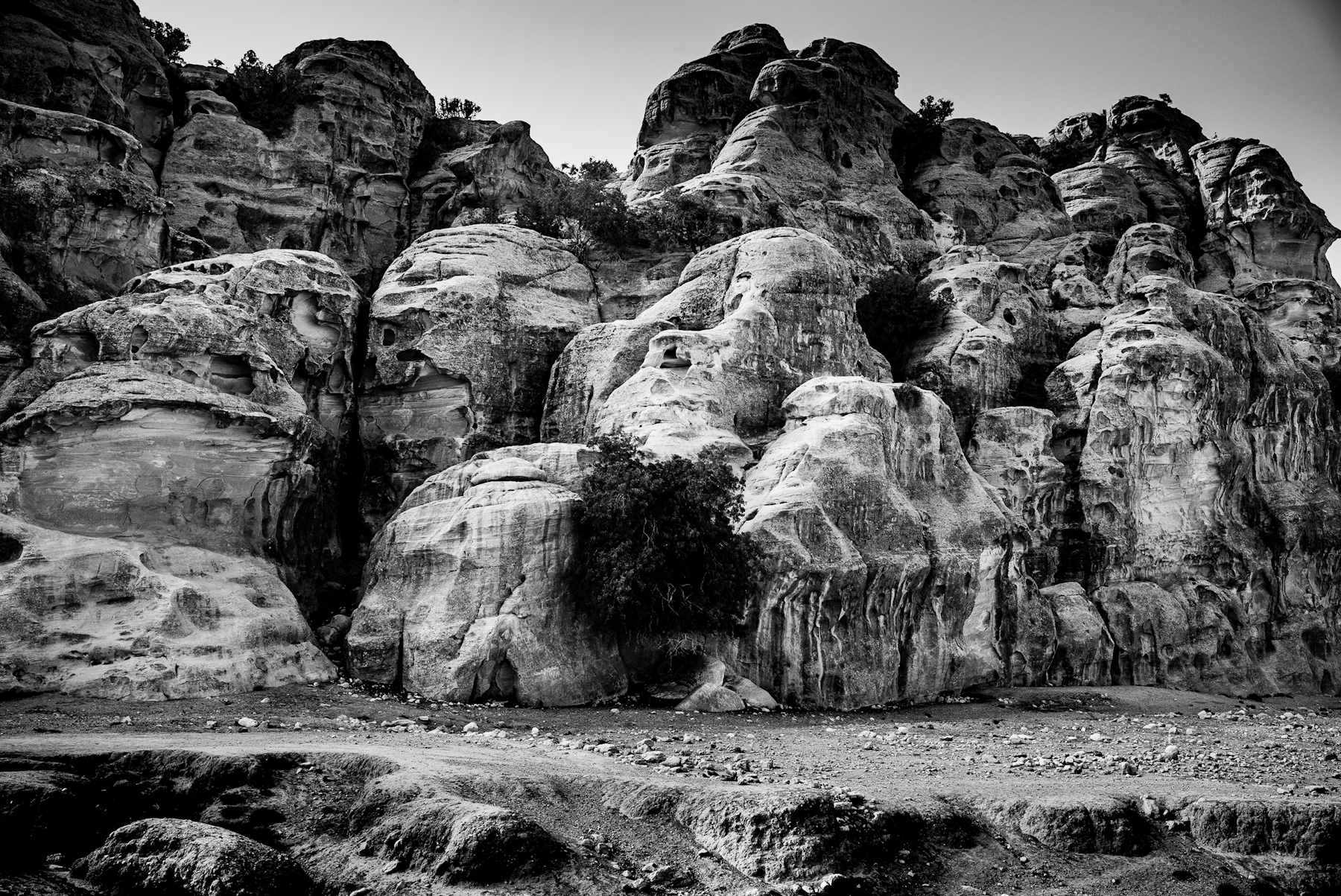
The striking monochromatic image presents a formidable tableau of ancient rock-cut architecture, deeply embedded within a rugged, arid landscape. Dominated by massive sandstone formations, the scene immediately conveys a sense of timelessness and human ingenuity. The intricate interplay of light and shadow, intensified by the black and white medium, accentuates the weathered textures and the subtle details of the carved structures, inviting closer examination.
A Landscape Forged by Time and Hand
At first glance, the photograph reveals towering rock faces, sculpted by millennia of natural erosion. Yet, upon closer inspection, the unmistakable signs of human intervention emerge. Numerous openings, niches, and meticulously carved facades are visible across the rock formations, suggesting a complex settlement or necropolis. These structures appear to be multi-tiered, with some openings situated high up in the rock face, while others are closer to the ground, integrated into the natural contours of the landscape. The dark crevices and deep shadows hint at hidden depths and perhaps pathways that wind through the natural and man-made elements. Sparse, resilient vegetation clings to parts of the rock, a testament to life enduring in an austere environment, providing a stark contrast to the imposing stone. The ground in the foreground is rough and stony, indicative of a desert terrain, further emphasizing the challenging conditions under which these marvels were created.
The Legacy of the Nabataeans: Masters of Stone
The architectural style and desert setting strongly suggest a connection to the ancient Nabataean civilization, renowned for its extraordinary rock-cut cities. While specific identification without further context is challenging, the structures bear a striking resemblance to those found in sites like Petra or Little Petra (Siq al-Barid) in modern-day Jordan. The Nabataeans, an ancient Arab people, flourished as a mercantile kingdom from the 4th century BCE, establishing a vast trade network that stretched across the Arabian Peninsula, North Africa, and the Levant. Their capital, Petra, became a vibrant hub, celebrated for its elaborate temples, tombs, and dwellings carved directly into the rose-red sandstone cliffs.
These rock-cut structures served various purposes. Many were elaborate tombs for the Nabataean elite, designed to house the deceased and commemorate their status, reflecting a sophisticated belief system concerning the afterlife. Others functioned as dwellings, religious shrines, or communal spaces, demonstrating the Nabataeans‘ exceptional skill in hydraulic engineering and urban planning within a challenging desert environment. Their distinct architectural style, a fusion of Hellenistic, Roman, and indigenous elements, is characterized by intricate facades, often featuring columns, friezes, and decorative motifs, even if less elaborate examples are depicted here.
Enduring Mystery and Modern Relevance
The black and white imagery enhances the sense of historical depth and mystery surrounding these ancient sites. It strips away the distractions of color, allowing the viewer to focus solely on form, texture, and the profound impact of human endeavor on the natural world. These rock-cut cities stand as powerful testaments to a sophisticated civilization that mastered its environment and left an indelible mark on history. Today, they remain vital archaeological sites, offering invaluable insights into ancient cultures, trade routes, and architectural innovation. Their preservation is crucial for understanding our shared human heritage and appreciating the remarkable achievements of societies that thrived millennia ago amidst formidable landscapes.
A Landscape Forged by Time and Hand
At first glance, the photograph reveals towering rock faces, sculpted by millennia of natural erosion. Yet, upon closer inspection, the unmistakable signs of human intervention emerge. Numerous openings, niches, and meticulously carved facades are visible across the rock formations, suggesting a complex settlement or necropolis. These structures appear to be multi-tiered, with some openings situated high up in the rock face, while others are closer to the ground, integrated into the natural contours of the landscape. The dark crevices and deep shadows hint at hidden depths and perhaps pathways that wind through the natural and man-made elements. Sparse, resilient vegetation clings to parts of the rock, a testament to life enduring in an austere environment, providing a stark contrast to the imposing stone. The ground in the foreground is rough and stony, indicative of a desert terrain, further emphasizing the challenging conditions under which these marvels were created.
The Legacy of the Nabataeans: Masters of Stone
The architectural style and desert setting strongly suggest a connection to the ancient Nabataean civilization, renowned for its extraordinary rock-cut cities. While specific identification without further context is challenging, the structures bear a striking resemblance to those found in sites like Petra or Little Petra (Siq al-Barid) in modern-day Jordan. The Nabataeans, an ancient Arab people, flourished as a mercantile kingdom from the 4th century BCE, establishing a vast trade network that stretched across the Arabian Peninsula, North Africa, and the Levant. Their capital, Petra, became a vibrant hub, celebrated for its elaborate temples, tombs, and dwellings carved directly into the rose-red sandstone cliffs.
These rock-cut structures served various purposes. Many were elaborate tombs for the Nabataean elite, designed to house the deceased and commemorate their status, reflecting a sophisticated belief system concerning the afterlife. Others functioned as dwellings, religious shrines, or communal spaces, demonstrating the Nabataeans‘ exceptional skill in hydraulic engineering and urban planning within a challenging desert environment. Their distinct architectural style, a fusion of Hellenistic, Roman, and indigenous elements, is characterized by intricate facades, often featuring columns, friezes, and decorative motifs, even if less elaborate examples are depicted here.
Enduring Mystery and Modern Relevance
The black and white imagery enhances the sense of historical depth and mystery surrounding these ancient sites. It strips away the distractions of color, allowing the viewer to focus solely on form, texture, and the profound impact of human endeavor on the natural world. These rock-cut cities stand as powerful testaments to a sophisticated civilization that mastered its environment and left an indelible mark on history. Today, they remain vital archaeological sites, offering invaluable insights into ancient cultures, trade routes, and architectural innovation. Their preservation is crucial for understanding our shared human heritage and appreciating the remarkable achievements of societies that thrived millennia ago amidst formidable landscapes.
Schreibe einen Kommentar