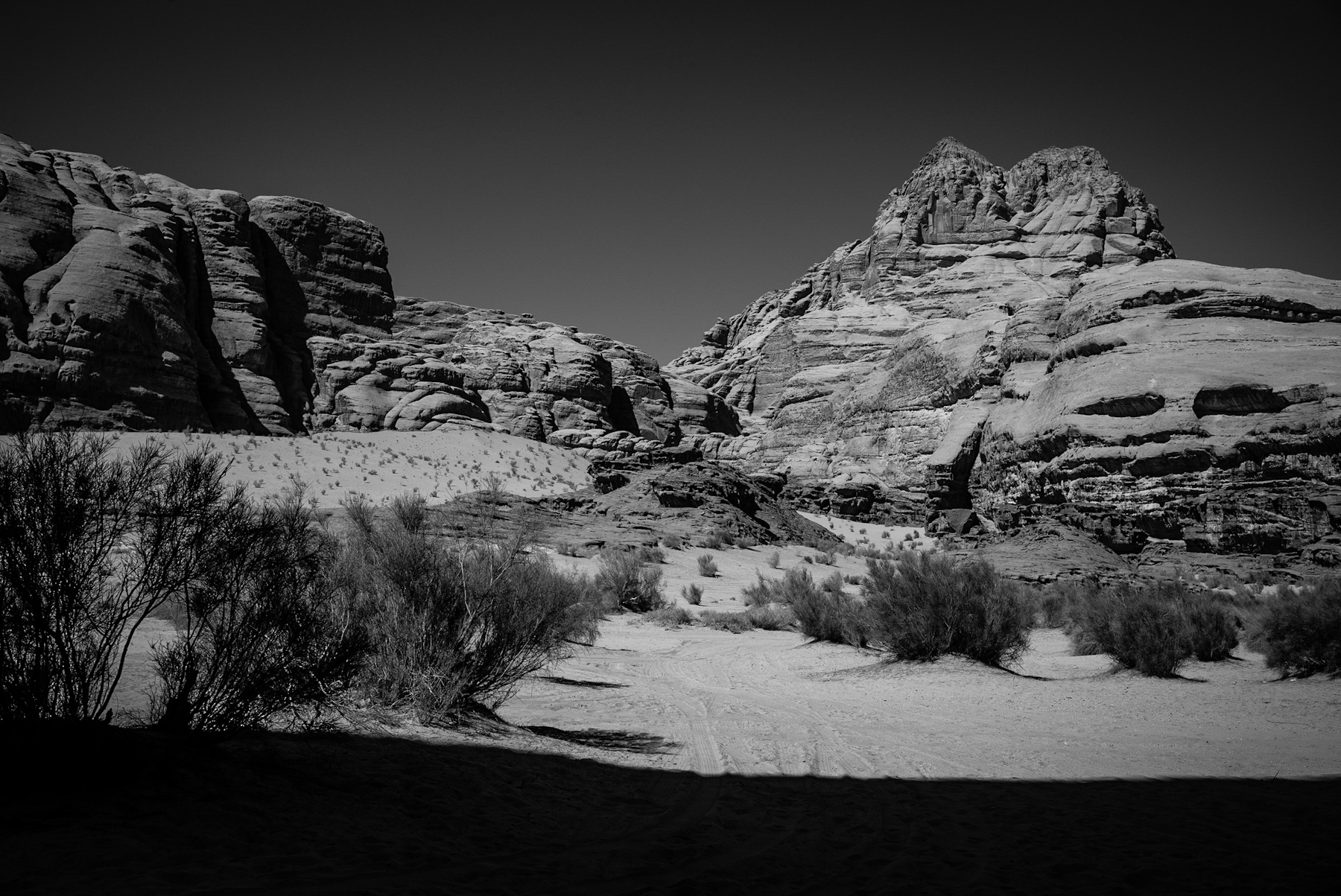
The stark beauty captured in this monochromatic image presents a profound study of an arid landscape, where geological grandeur meets historical resonance. Dominated by immense rock formations, the scene unfolds under a vast, clear sky, rendered in a striking palette of grays, blacks, and whites that accentuate texture, form, and the dramatic interplay of light and shadow.
This is a landscape forged by time itself. In the foreground, scattered desert shrubs, their branches intricate and bare, cast elongated shadows that anchor the viewer to the sandy terrain. These resilient plants, adapted to extreme conditions, symbolize life’s perseverance in a challenging environment. The middle ground reveals an expanse of fine sand, subtly marked by faint tracks, hinting at recent passage – perhaps by vehicles or desert dwellers. These imprints are transient, destined to be erased by the next gust of wind, yet they speak to an enduring human presence. Rising majestically in the background are colossal sandstone mountains, their surfaces deeply grooved and sculpted by millennia of wind and water erosion. These formations exhibit layered strata, a testament to their ancient geological history, revealing the slow, deliberate work of natural forces. The contrasting tones in the black and white rendition emphasize the rugged contours, the deep crevices, and the sheer scale of these natural monuments, evoking a sense of timelessness and immense power. The composition draws the eye inward, creating a pathway between these imposing natural walls, suggesting a hidden valley or a route through an otherwise impenetrable terrain.
Beyond their geological magnificence, these landscapes whisper of ancient passage and enduring cultures. Regions characterized by these dramatic sandstone formations, often found in the Arabian Peninsula like Wadi Rum in Jordan, have served as critical arteries for civilizations and cultures for millennia. These valleys and canyons were integral parts of ancient trade networks, most notably the Incense Route. Caravans laden with precious spices, frankincense, myrrh, and other goods traversed these challenging paths, connecting the Arabian South with the Mediterranean world. The tracks in the sand, however faint, echo the countless journeys undertaken by merchants, pilgrims, and armies over centuries.
For indigenous nomadic peoples, such as the Bedouins, these deserts are not barren wastelands but homelands rich in resources and knowledge. They possess an intimate understanding of the wadis, water sources, and shelters provided by the rock formations, skills honed over generations of living in harmony with the harsh environment. Their history is interwoven with the very fabric of these mountains, from ancient rock carvings to the oral traditions passed down through time. Historically, these landscapes also held strategic significance. During periods like the Arab Revolt (1916-1918), led in part by T.E. Lawrence, these formidable natural fortresses provided cover and tactical advantages. The labyrinthine canyons and hidden passages offered ideal conditions for guerrilla warfare, allowing smaller forces to outmaneuver larger, conventional armies.
This photograph transcends a simple depiction of nature; it is a portal to a world where geological processes and human narratives converge. The enduring rock formations stand as silent witnesses to countless stories of survival, trade, conflict, and adaptation. The black and white aesthetic further enhances this sense of historical depth, stripping away modern distractions to reveal the raw, powerful essence of a landscape that has profoundly shaped, and been shaped by, human civilization. It invites contemplation on the resilience of both nature and humanity in the face of time.
This is a landscape forged by time itself. In the foreground, scattered desert shrubs, their branches intricate and bare, cast elongated shadows that anchor the viewer to the sandy terrain. These resilient plants, adapted to extreme conditions, symbolize life’s perseverance in a challenging environment. The middle ground reveals an expanse of fine sand, subtly marked by faint tracks, hinting at recent passage – perhaps by vehicles or desert dwellers. These imprints are transient, destined to be erased by the next gust of wind, yet they speak to an enduring human presence. Rising majestically in the background are colossal sandstone mountains, their surfaces deeply grooved and sculpted by millennia of wind and water erosion. These formations exhibit layered strata, a testament to their ancient geological history, revealing the slow, deliberate work of natural forces. The contrasting tones in the black and white rendition emphasize the rugged contours, the deep crevices, and the sheer scale of these natural monuments, evoking a sense of timelessness and immense power. The composition draws the eye inward, creating a pathway between these imposing natural walls, suggesting a hidden valley or a route through an otherwise impenetrable terrain.
Beyond their geological magnificence, these landscapes whisper of ancient passage and enduring cultures. Regions characterized by these dramatic sandstone formations, often found in the Arabian Peninsula like Wadi Rum in Jordan, have served as critical arteries for civilizations and cultures for millennia. These valleys and canyons were integral parts of ancient trade networks, most notably the Incense Route. Caravans laden with precious spices, frankincense, myrrh, and other goods traversed these challenging paths, connecting the Arabian South with the Mediterranean world. The tracks in the sand, however faint, echo the countless journeys undertaken by merchants, pilgrims, and armies over centuries.
For indigenous nomadic peoples, such as the Bedouins, these deserts are not barren wastelands but homelands rich in resources and knowledge. They possess an intimate understanding of the wadis, water sources, and shelters provided by the rock formations, skills honed over generations of living in harmony with the harsh environment. Their history is interwoven with the very fabric of these mountains, from ancient rock carvings to the oral traditions passed down through time. Historically, these landscapes also held strategic significance. During periods like the Arab Revolt (1916-1918), led in part by T.E. Lawrence, these formidable natural fortresses provided cover and tactical advantages. The labyrinthine canyons and hidden passages offered ideal conditions for guerrilla warfare, allowing smaller forces to outmaneuver larger, conventional armies.
This photograph transcends a simple depiction of nature; it is a portal to a world where geological processes and human narratives converge. The enduring rock formations stand as silent witnesses to countless stories of survival, trade, conflict, and adaptation. The black and white aesthetic further enhances this sense of historical depth, stripping away modern distractions to reveal the raw, powerful essence of a landscape that has profoundly shaped, and been shaped by, human civilization. It invites contemplation on the resilience of both nature and humanity in the face of time.
Schreibe einen Kommentar