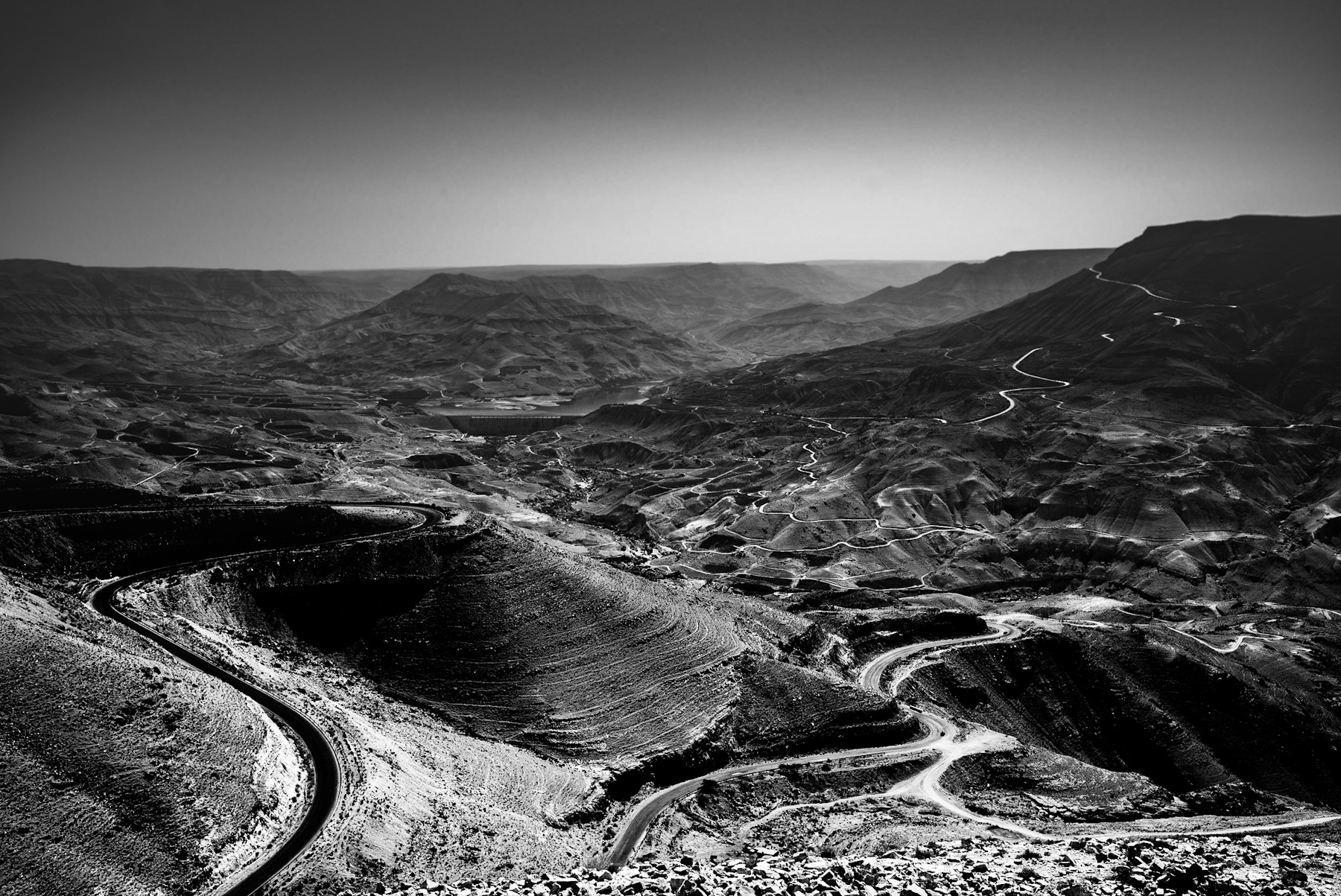
The monochrome lens transforms a sprawling mountainous vista into a study of stark contrasts and enduring forms. This captivating black and white photograph unveils an expansive, rugged landscape, dominated by undulating mountains and deep valleys, their surfaces etched with the passage of time and the elements. The scene is a testament to both nature’s grandeur and humanity’s persistent interaction with challenging environments.
The Unfolding Terrain
From a high vantage point, the viewer’s gaze sweeps across a vast expanse of barren, arid terrain. The geological formations are pronounced, with layered rock faces and eroded slopes creating intricate patterns of light and shadow. The absence of color accentuates the textures and contours of the land, highlighting the raw, untamed beauty of the environment. Far below, and extending into the mid-ground, numerous winding roads snake through the landscape. These serpentine pathways, often appearing as switchbacks, are carved into the mountainsides, illustrating the considerable engineering effort required to navigate such formidable topography. Their white lines, stark against the dark rock, draw the eye deeper into the frame, suggesting journeys both ancient and modern.
In the mid-distance, a significant man-made structure is visible: a large dam impounding a body of water. This element stands as a focal point, a symbol of human ingenuity and necessity in adapting to and harnessing natural resources within an arid climate. The reservoir’s calm surface contrasts with the turbulent appearance of the surrounding mountains, reflecting an essential balance between human civilization and the natural world.
Paths Through Time: A Historical Tapestry
This dramatic landscape is deeply resonant with historical significance, particularly in regions like the Middle East, where similar terrains have hosted human civilization for millennia. The intricate network of roads depicted in the photograph evokes the ancient trade routes and vital arteries that once connected empires and facilitated cultural exchange.
Consider the King’s Highway in Jordan, an ancient route dating back over 5,000 years. This historic road traversed landscapes remarkably similar to the one captured, winding through deep wadis and over rugged plateaus. It served as a crucial link between Mesopotamia, Egypt, and the Arabian Peninsula, connecting significant ancient cities such as Petra, Madaba, and Amman. Along its path, civilizations like the Nabataeans, Romans, Byzantines, and various Islamic dynasties left their indelible marks, constructing fortresses, caravanserai, and towns that relied on these challenging routes for commerce, defense, and communication. The very act of building and maintaining roads through such terrain was an immense undertaking, reflecting the strategic importance of these arteries for trade in spices, incense, gold, and other precious commodities.
Furthermore, the presence of the dam is not merely a modern feature but a continuation of an age-old human endeavor. In arid regions, water management has always been paramount. Ancient civilizations employed sophisticated systems of cisterns, aqueducts, and dams to collect and store precious water, sustaining populations and agriculture in challenging conditions. This modern dam, therefore, stands as a contemporary echo of humanity’s enduring struggle to manage water resources, ensuring survival and prosperity in landscapes where water is a most valuable commodity.
Enduring Journeys
The photograph, with its profound depth and sweeping perspective, encapsulates the enduring narrative of human interaction with the natural world. It speaks to the resilience required to traverse, inhabit, and transform formidable landscapes. The winding roads, whether ancient or modern, symbolize the continuous journey of humanity, seeking connection, commerce, and survival across the earth’s diverse terrains. This image is more than a landscape; it is a visual archive of history, etched into the very stone of the earth.
The Unfolding Terrain
From a high vantage point, the viewer’s gaze sweeps across a vast expanse of barren, arid terrain. The geological formations are pronounced, with layered rock faces and eroded slopes creating intricate patterns of light and shadow. The absence of color accentuates the textures and contours of the land, highlighting the raw, untamed beauty of the environment. Far below, and extending into the mid-ground, numerous winding roads snake through the landscape. These serpentine pathways, often appearing as switchbacks, are carved into the mountainsides, illustrating the considerable engineering effort required to navigate such formidable topography. Their white lines, stark against the dark rock, draw the eye deeper into the frame, suggesting journeys both ancient and modern.
In the mid-distance, a significant man-made structure is visible: a large dam impounding a body of water. This element stands as a focal point, a symbol of human ingenuity and necessity in adapting to and harnessing natural resources within an arid climate. The reservoir’s calm surface contrasts with the turbulent appearance of the surrounding mountains, reflecting an essential balance between human civilization and the natural world.
Paths Through Time: A Historical Tapestry
This dramatic landscape is deeply resonant with historical significance, particularly in regions like the Middle East, where similar terrains have hosted human civilization for millennia. The intricate network of roads depicted in the photograph evokes the ancient trade routes and vital arteries that once connected empires and facilitated cultural exchange.
Consider the King’s Highway in Jordan, an ancient route dating back over 5,000 years. This historic road traversed landscapes remarkably similar to the one captured, winding through deep wadis and over rugged plateaus. It served as a crucial link between Mesopotamia, Egypt, and the Arabian Peninsula, connecting significant ancient cities such as Petra, Madaba, and Amman. Along its path, civilizations like the Nabataeans, Romans, Byzantines, and various Islamic dynasties left their indelible marks, constructing fortresses, caravanserai, and towns that relied on these challenging routes for commerce, defense, and communication. The very act of building and maintaining roads through such terrain was an immense undertaking, reflecting the strategic importance of these arteries for trade in spices, incense, gold, and other precious commodities.
Furthermore, the presence of the dam is not merely a modern feature but a continuation of an age-old human endeavor. In arid regions, water management has always been paramount. Ancient civilizations employed sophisticated systems of cisterns, aqueducts, and dams to collect and store precious water, sustaining populations and agriculture in challenging conditions. This modern dam, therefore, stands as a contemporary echo of humanity’s enduring struggle to manage water resources, ensuring survival and prosperity in landscapes where water is a most valuable commodity.
Enduring Journeys
The photograph, with its profound depth and sweeping perspective, encapsulates the enduring narrative of human interaction with the natural world. It speaks to the resilience required to traverse, inhabit, and transform formidable landscapes. The winding roads, whether ancient or modern, symbolize the continuous journey of humanity, seeking connection, commerce, and survival across the earth’s diverse terrains. This image is more than a landscape; it is a visual archive of history, etched into the very stone of the earth.
Schreibe einen Kommentar